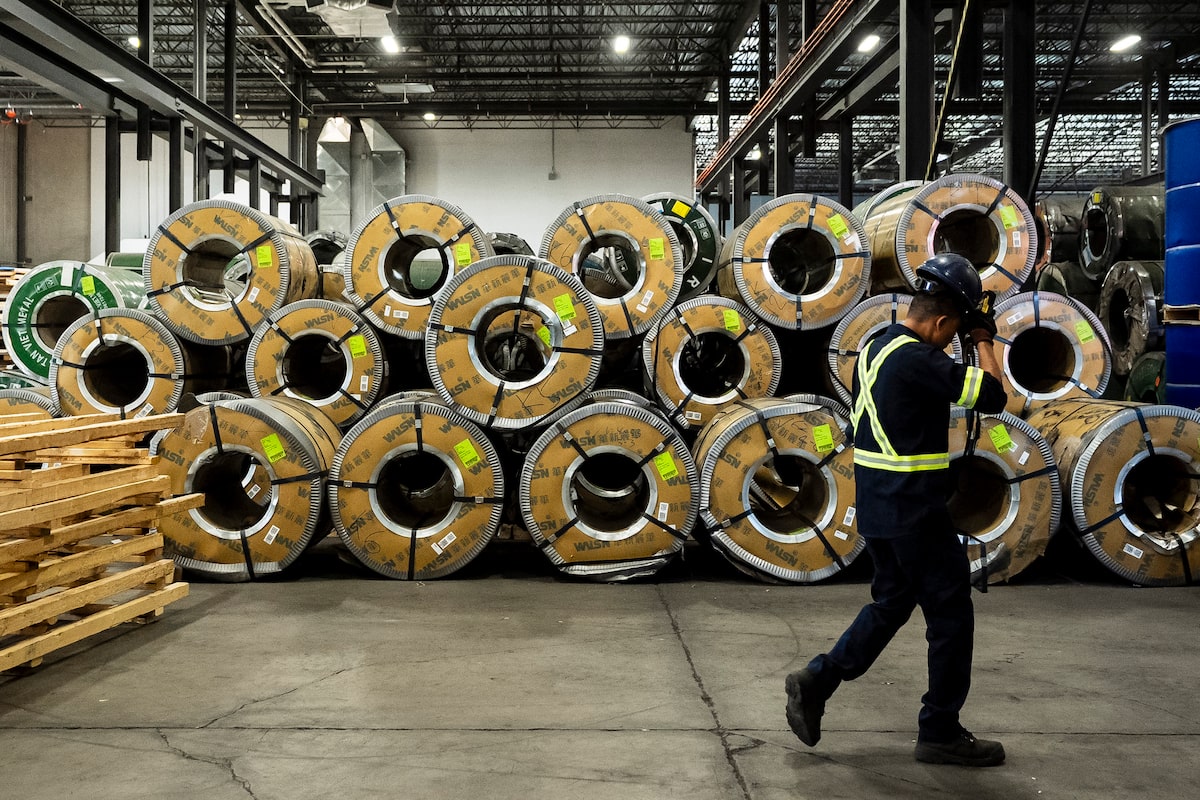
Open this photo in gallery:Stainless steel coils at a factory in Montreal. U.S. President Donald Trump's latest tariffs are meant to punish Canada for retaliating against his previous tariffs on autos, steel and aluminum.Christopher Katsarov/The Canadian PressTo many Americans, the Smoot-Hawley Tariff Act is nothing more than the half-remembered topic of Ben Stein’s monotone economics lecture in Ferris Bueller’s Day Off. To economists, the law is shorthand for tariffs’ history of failure. But to Donald Trump, it’s the latest weapon in his trade war against Canada.In rolling out another suite of tariffs against one of his country’s top trading partners this week, the U.S. President reached all the way back to 1930 to resurrect a piece of legislation once consigned to the ash heap of history.The intent of Smoot-Hawley – named after the two legislators who pushed it through Congress – was to counteract the effects of the Great Depression by building a tariff wall around the U.S. economy. Instead, it had the opposite effect, triggering an international trade war and driving the downturn lower still.A secondary provision, Section 338, gave the president the power to impose additional tariffs on any country deemed to have discriminated against U.S. products by subjecting them to higher trade barriers than those faced by other trading partners. It has never previously been used.The White House has beef with Canada’s dairy import rules. Does the EU have a better deal?It is this section that Mr. Trump invoked this week, ordering 50-per-cent tariffs on roughly US$20-billion worth of Canadian goods, to take effect Aug. 19. The tariffs are ostensibly meant to punish Canada for retaliating against Mr. Trump’s previous tariffs on autos, steel and aluminum. The administration cites Canada’s treatment of U.S. autos, liquor and dairy exports.John Veroneau, a former high-ranking trade official in president George W. Bush’s administration, has extensively researched Section 338’s history. He found several occasions in the 1930s and forties in which U.S. officials either threatened to use the provision or discussed using it against, among others, France, Germany, Australia, Spain, Japan and China.But Section 338 was never invoked and, after 1949, there were no further references to it in government documents. The reason, Mr. Veroneau says, is that its purpose was negated by the rules-based international trade regime that arose after the Second World War, starting with the 1947 General Agreement on Tariffs and Trade.“The GATT eliminated the problem 338 was designed to address,” Mr. Veroneau said in an interview.That all changed with Mr. Trump’s election in 2016. Coming to power on an agenda of economic protectionism, he searched for authorities to levy tariffs. Section 338 was floated by his advisers.Trump’s own trade war contributing to drop in U.S. auto exports to Canada, experts sayUntil now, however, he has relied on other legislative provisions: Section 232 of the Trade Expansion Act of 1962, Section 301 of the Trade Act of 1974, and the International Emergency Economic Powers Act (IEEPA.) The former two have withstood court challenges and have a more extensive record of use, making them the safer options for ensuring tariffs stick.Unlike sections 232 and 301, however, Smoot-Hawley doesn’t explicitly require time-consuming investigations or consultations before announcing tariffs, which may be why Mr. Trump and his trade chief, Jamieson Greer, chose to use it in this case. They are taking a risk though: The use of Section 338 has not faced a legal test. And earlier this year, the conservative-majority U.S. Supreme Court struck down Mr. Trump’s use of IEEPA to impose tariffs as exceeding his presidential authority.Mr. Veroneau outlined two possible legal arguments against what Mr. Trump is doing. One is that Congress can only delegate its right to set tariff rates in narrow circumstances, not in the broad way Mr. Trump is interpreting it.The other is that Section 338 was intended to fight back against countries that were taking unilateral actions against the United States, not to punish countries for responding to the U.S.’s own unilateral actions.From wine to whey to wigs, here are the Canadian goods targeted by new 50% tariffsUntil Mr. Trump launched his trade war last year, in fact, Ottawa and Washington were granting each other extensive preferential treatment under the U.S.-Mexico-Canada Agreement.“The irony here is that Canada was treating the U.S. better than most of Canada’s other trading partners and the U.S. was treating Canada better than most of the U.S.’s other trading partners,” Mr. Veroneau said.Peter Harrell, a White House economic adviser under former president Joe Biden, said a legal argument against 338 could turn on the fact that Smoot-Hawley has been superseded by subsequent trade legislation. A court challenge might also point out that, in the 1930s and forties, the International Trade Commission launched investigations before the president determined whether a country was unfairly discriminating against U.S. trade, a procedure the Trump administration did not follow.A defence, meanwhile, could rely on the fact that Congress never explicitly repealed Section 338 and the wording of the statute doesn’t spell out required steps before the president announces tariffs.“If you just read the plain text of 338, it certainly appears to be a quite broad and discretionary authority,” Mr. Harrell said.Throughout his time in office, Mr. Trump has floated a wide range of reasons and a wide range of laws to pursue tariffs. In the case of Canada alone, he has cited everything from national security to fentanyl to forest fires.Mr. Harrell theorizes that Mr. Trump previously didn’t use Section 338 because it provided neither the legal certainty of Section 301 nor the wide-ranging authority he claimed under IEEPA. Now, with IEEPA struck down and trade negotiations with Canada stalled, Mr. Trump landed on 338 as the swiftest way to gain some leverage.“Trump has just been chafing at not having a more flexible tariff authority. He’s been casting about for one, and his advisers have kept coming back to this,” he said. “The administration has been frustrated in negotiations with Canada and they are looking for a way to increase the pressure.”
Section 338 of the Tariff Act gives Trump a quick and easy way to impose tariffs
Full Article
Original Source
Read the full article at Theglobeandmail →KhanList aggregates and links to publicly available news content. We do not host full articles from third-party sources. Always verify important information with original sources.