
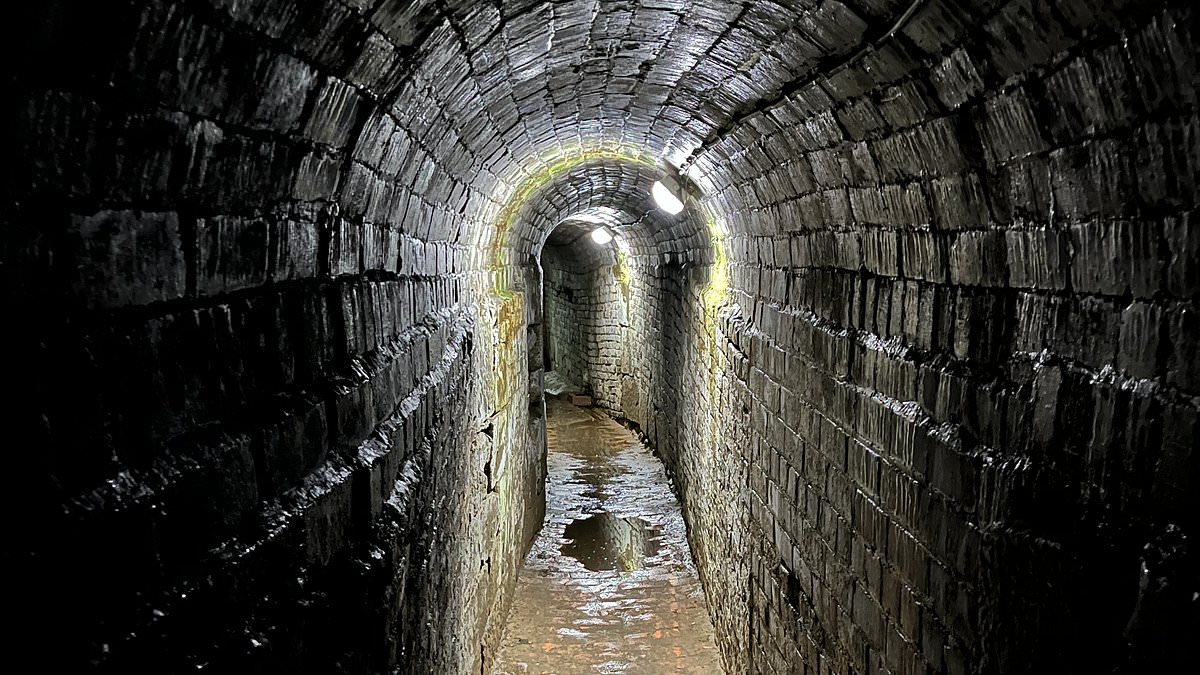
From smugglers' tunnels to sliding doors and priest holes all once used for dubious purposes, much of the remnants of Britain's secret underworld past are often still remarkably intact today.Hidden in plain sight, there's dungeons – and even bones – in some of the country's historic properties as well as underground realms that lie behind supposedly cursed sealed doors. Whether it is rumoured folklore, local whispers or written into history – there's plenty to discover. A new book, Lost Chambers & Subterranea, uncovers more than 500 hidden locations across the UK. Here, we've picked some of the fascinating places featured... Edinburgh Castle, Edinburgh Edinburgh Castle is one of the oldest fortified places in EuropeSat on a volcanic rock, Edinburgh Castle hides many secrets and tales within its walls.Dating back centuries, the Scottish landmark is one of the oldest fortified places in Europe and the most besieged place in Britain.The castle has seen plenty of drama and horrors; there's a pit prison beneath James VI's birth chamber and an underground labyrinth is said to be where a piper mysteriously vanished.The Honours of Scotland – the Crown, Sceptre and Sword of State – were even locked away in the castle's Crown Room for more than a century. They were only discovered when Sir Walter Scott opened the sealed chamber in 1818.Chillingham Castle, Northumberland Chillingham Castle's walls are said to be haunted by spirits and ghoulsDescribed as 'Britain's most haunted historic castle', Chillingham Castle dates back to the 13th century and has plenty of spooky tales and gruesome history.Located in Northumberland, the impressive property boasts an armoury, medieval courtyard and a grisly dungeon. The castle sees 'some of the highest levels of paranormal activity in the country', according to its website.The dungeon's walls are covered in tally marks and etched letters carved out by prisoners and the bones of a child can be seen beneath a trap-door that looks down to a vault. Chillingham Castle is said to be haunted by a ghost called the Radiant Boy, who has reportedly been seen glowing beside a four-poster bed.Massacre Cave, Isle of Eigg On the Isle of Eigg, Massacre Cave has a tragic historyOver 400 island inhabitants were said to have died in Massacre Cave on the Isle of Eigg in the 16th century. According to local legend, a bitter feud started between the native MacDonalds and the MacLeods of Skye when a group of visiting MacLeods made unwanted advances on the women of Eigg in 1577 and were 'castrated' by angry MacDonalds.It prompted the MacLeods to return in force, with almost the entire MacDonald clan fleeing to the cave in an attempt to escape. However, the hideout was discovered and the MacLeods piled thatch and roof timbers at the entrance to the cave before setting it alight, suffocating those inside.The cave still stands on the Hebridean island today but is prone to rockfalls. The Isle of Eigg Heritage Trust advises against visitors entering its walls. Sudeley Castle, Gloucestershire Sudeley Castle is said to be haunted by Henry VIII's wife Katherine ParrSurrounded by the rolling countryside of the Cotswolds, Sudeley Castle has a tantalising history spanning across 1,000 years of history.From royal connections to romantic ruins – the castle walls have seen plenty.It was visited by Henry VIII and Anne Boleyn and the notorious king's final wife, Katherine Parr, was buried on the castle grounds in St Mary's Church. Her lead coffin was only discovered in 1782 and now her ghost is said to haunt Sudeley Castle.The Mermaid Inn, Rye The Mermaid Inn has an intriguing 600-year history and has a secret hiding in its chimneyThe 600-year-old Mermaid Inn can be found on a charming cobbled street in Rye.Its cellars date from 1156 and the main building was rebuilt in 1420 – the watering hole is rich with interesting tales from the past. The notorious Hawkhurst gang smugglers are said to have met at the pub in the 1730s and 40s and a secret passageway entrance still stands.Several of the rooms are thought to be haunted too and there is a hidden stair behind a fake bookcase in Dr Syn's Bedchamber.The secret tunnel leads to the Giant's Fireplace Bar where there is an inglenook fireplace. Up the chimney there is a space local legend claims to be a priest hole but it was more likely used to smoke meat. Gwrych Castle, Conwy Gwrych Castle has everything from ghosts to supposed tunnelsWith beautiful views of the North Wales coastline, Gwrych Castle is set in an idyllic location but its Gothic walls hide eerie ghouls. The Grade I listed country house was built between 1812 and 1822 and sits on 250 acres of grounds. It has a reputation for being haunted and its chapel is rumoured to have a secret room hidden behind a sealed door. Local legend warns against opening it... apparently anyone who does will be cursed. There are also tales of tunnels from the castle leading deep into the limestone hillside, but no entrance to the secret routes has ever been found.Harvington Hall, Worcestershire With seven priest hides, Harvington Hall has a very interesting history to delve intoHarvington Hall is a characterful red-bricked building in Worcestershire with an intriguing past.It is home to seven priest hides – which is more than any other property in England – and is surrounded by a 13th Century moat.The dark and damp hides were used to keep priests safe from local priest hunters who would search the house.Harvington Hall has a varied selection – some more basic and others 'ingenious'. They can be found around the Great Staircase and one is located behind a swinging beam.Another clever hiding spot was crafted above the bread oven, thought to date to the early 1590s it measures 5ft deep, 2ft 7" by 3ft 9" and can be entered by a trapdoor.Athelhampton House (Athelhampton Hall), Dorset Athelhampton House is said to be haunted by a pet ape who tragically passed awayAthelhampton House is a Tudor manor with over 500 years of history and secrets to explore. It was originally built for Sir William Martyn and one of his daughters is said to have hidden in a secret room behind panelling in the Great Chamber. The family apparently had a pet ape and the creature followed the woman into the secret space.However, the daughter didn't realise and when she later left the hiding spot, the ape got stuck and died of starvation... the mammal's spirit is said to haunt the room and scratching noises have reportedly been heard from the walls. Samlesbury Hall, Lancashire Lancashire's Samlesbury Hall used to hide missionary priestsSamlesbury Hall is another historic building used to shelter missionary priests from harm.The manor house was built in the 15th century and is riddled with 13 ghosts as well as a priest hole and supposed secret passage. The first recorded sighting of a ghoul on Samlesbury Hall's grounds was in 1873, and there have been plenty more since. Lady Dorothea Southworth is said to have haunted the house and grounds since the Elizabethan times and is often described as 'The Lady in White' because of her eerie appearance.The Lamb Inn, Eastbourne The Lamb Inn, in Eastbourne, is linked to erstwhile smugglers The Lamb Inn is a 14th century public house bursting with hidden history under its beamed ceilings. Located in Eastbourne, the pub is said to have a secret tunnel once used by smugglers running from it to either St Mary's Church or the Old Parsonage.Meanwhile, there's a crypt cellar with a 6 metre-deep shaft that narrows as it goes further down seemingly towards the church. Romney Marsh, KentKent's Romney Marsh boasts a long history of smuggling across its low-lying ground nearby the coast.Described as 'the birthplace of smuggling in southern England', by Romney Marsh History, it became a hotspot for illegal wool exports and other goods. Several local medieval churches got caught up with the illicit trades including St Augustine's, Brookland, St George's, Ivychurch, St Dunstan's, Snargate, and St Thomas Becket, Fairfield and there are legends of long tunnels linking them and other pubs and farms.Redcliffe Caves, Bristol Bristol's Redcliffe Caves once held prisoners of warBeneath Bristol lies a series of sandstone tunnels from the Redcliffe Caves dating back to the Middle Ages. They were originally cut to source sand to make glass and pottery but were later used to store trade goods. French prisoners of war are said to have been kept in the tunnels during the Napoleonic Wars.Ashby-de-la-Zouch Castle, Leicestershire Ashby-de-la-Zouch Castle boasts an underground passage dating back to 1646Ashby-de-la-Zouch Castle was built by Lord Hastings in the 15th century and the Great Tower still stands today. There is an underground passage that leads from the kitchen to the tower, which English Heritage speculates could have been created during the siege during the Civil War in 1646.Lost Chambers & Subterranea: The Explorer’s Guide to Secret Britain is out now (£18.99, Otherlands Publishing).
Secrets of Britain's underground past laid bare: New book details nation's concealed tunnels, macabre dungeons and smugglers' caves
Full Article
Original Source
Read the full article at Dailymail →KhanList aggregates and links to publicly available news content. We do not host full articles from third-party sources. Always verify important information with original sources.