
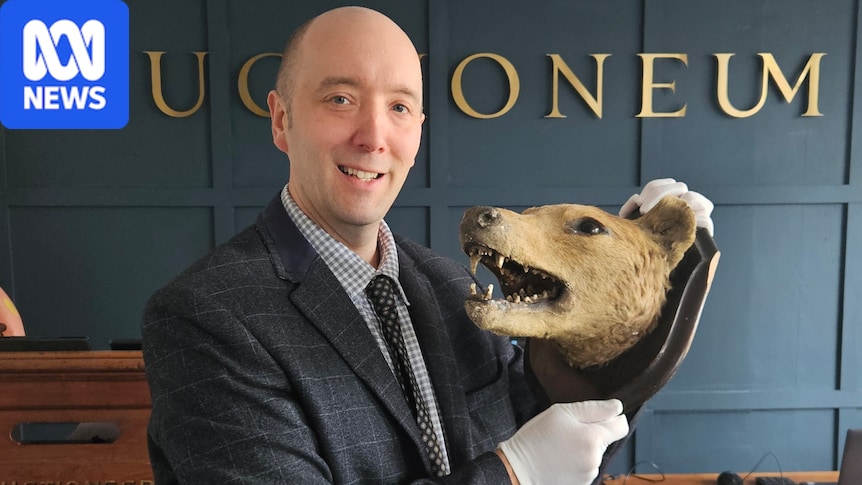
They say lightning never strikes the same place twice, but that's not the case for one British auction house.Just weeks after a rare privately owned thylacine head sold well above reserve, a second mounted head has been found and presented to the auction house.Bristol-based auctioneer Andrew Stowe, from Auctioneum, said the latest find of the extinct Tasmanian tiger, nicknamed Trevor, came from a family in London who had been storing it under a bed.The head was stored under a bed. (Supplied: Auctioneum)He said the family had stashed the head out of sight as they were "genuinely quite frightened of it"."The story, as I understand it, is that they were reading the news and spotted the report of our previous example."I don't think they have ever gotten out of the bed as quick as they did that day to go and get it out."A radiograph taken by a local vet confirmed the head as belonging to a thylacine. (Supplied: Auctioneum)Mr Stowe said the latest find came with some provenance.It is understood the specimen was shot in Sheffield, in Tasmania's north-west, sometime in the early 1900s and brought to the UK in 1905, where it changed hands a number of times. Trevor is understood to have arrived in the UK in 1905. (Supplied: Auctioneum)He said unlike the first specimen, which had a bulbous head and googly eyes that led auctioneers to believe it was a fox, this latest taxidermied Tasmanian tiger had been sculpted well, likely by someone who had seen a thylacine in real life."It could do with some sympathetic restoration, but it is in good condition," Mr Stowe said."One of its ears has come loose at some point, probably about 50 or 60 years ago, but it's present, so it is complete."There is not a googly eye in sight on this one."The find is the third-known mounted thylacine head in existence.Once-in-a-lifetime discovery, twiceIn August, UK collector James Cranfield purchased a mounted thylacine head after a heated bidding war with another bidder who also recognised what it really was.The head, which was sold in poor condition, had been listed as a fox's head and was expected to fetch between £30 ($57) to £50 ($95).It ended up selling for £62,600 ($120,000), including auction fees.Curiosity shop owner James Cranfield with the mounted thylacine head he bought at auction. (Instagram/@thetaxidermist)Mr Cranfield, who owns a curiosity shop in Essex, recognised the online 'fox' listing ahead of the auction as incorrect.At the time, Mr Cranfield called the find "a discovery of a lifetime", saying "it is the holy grail of natural history collecting".Mr Stowe said while this second mounted thylacine head was still an exciting scientific discovery, he admitted the story was "not as fun".Mr Cranfield recognised the head as a thylacine after inspecting its teeth. (Supplied: James Cranfield)"[That] was the story that everyone wants, something that lay undiscovered for so long and sells for lots of money. It was such a fantastic story," he said."This one, it's already been authenticated, it's already been added to the database. It's the only one to have come up to have been done properly."The last-known thylacine died in captivity in Hobart on September 7, 1936, a date that has since been commemorated as World Threatened Species Day.Curiosity shop owner hopes more specimens are foundTaking to Instagram, Mr Cranfield said the discovery of two thylacines in the 90th year since the marsupial was declared extinct was "incredible"."I'm so pleased that when I trusted my gut on a 'fox head', and it subsequently made international news," he said."This has made this third discovery possible … and will hopefully mean that more specimens are discovered."He said he was pleased his work to authenticate his find had helped to verify the latest specimen.The last thylacine in captivity, at Beaumaris Zoo Hobart in 1933. (Credit: David Fleay)About 815 thylacine specimens from around the world have been recorded by the International Thylacine Specimen Database (ITSD), which range from a "microscopic slide" of tissue to a full mount.The UK holds the largest collection of thylacine specimens, mainly held in museums and universities.The latest thylacine head will go to auction on November 26.
Second thylacine head hits UK auction house after years stashed under bed
Full Article
Original Source
Read the full article at Abc →KhanList aggregates and links to publicly available news content. We do not host full articles from third-party sources. Always verify important information with original sources.