
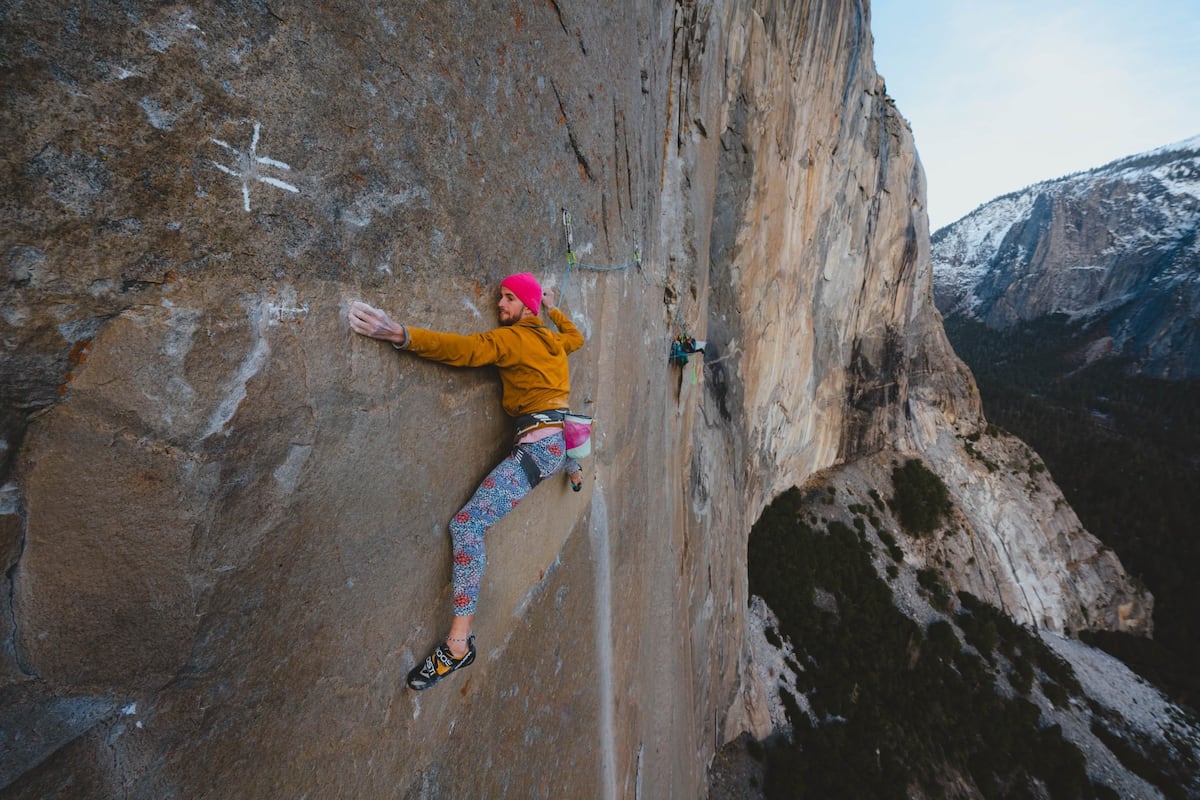
Seb Berthe, 33, is one of a kind — a breath of fresh air on the climbing scene, someone who strives to live out his passion for big walls in a free and honest way. For now, moments of happiness alternate with darker emotions where intense suffering surfaces. The young man from Belgium who burst onto the world stage a decade ago, backed by his compatriots Nico and Olivier Favresse and Sean Villanueva (three of the most important climbers of the 21st century), wore eye-catching Lycra leggings — garish and provocative — that made some people laugh. No one is laughing anymore: those leggings represent the brand image of someone who can boast of having free-climbed the most demanding big-wall route on the planet: The Dawn Wall, at El Capitan, Yosemite. Only Tommy Caldwell, in 2015, and the phenomenon Adam Ondra (in 2016) can say the same. Berthe, who on November 19 gave a masterclass at the Factory Boulder climbing gym in the northern Spanish city of San Sebastián (where the documentary The Dawn Wall by Your Side, directed by Soline Kentzel and winner of the Golden Edelweiss at the Torelló Mountain Film Festival, was screened), is now considering a change in style: “At first, the idea was to bring some color and freshness, to break the codes of masculinity… but maybe it’s time for a change, and perhaps I’ll start climbing in a skirt,” he laughs.To conquer the Dawn Wall, Berthe chose the most arduous route possible. Instead of flying to California, renting a car, and getting right to work, he decided to sail to Panama and cross Central America before entering the United States in a rickety RV that broke down every so often. It was 2022; he spent 23 days on the wall accompanied by Siebe Vanhee and Connor Herson — and failed. He linked the entire route except for the final move of the crux pitch, pitch 14, rated 9a. He spent days trying to figure out that move — to no avail. He returned home retracing his steps by sailboat. In 2025, he returned the same way — by sailboat again — and used public transportation to reach Yosemite Valley. “It was a gesture, more symbolic than practical: it’s my way of saying that you can tackle goals calmly, without such a rush, and with less consumption. But it’s also true that I’m aware traveling by boat isn’t a solution in and of itself, and that deep down, I can do it because I’m privileged. It’s not about telling everyone: ‘Don’t take planes — travel by boat.’ What I’ve loved about traveling by sailboat is that you spend two months on the way there and two on the way back disconnected — without a cellphone or the internet — which allows you to reconnect with yourself and your surroundings,” he explains.Berthe quickly sums up the statistics of his adventure on El Capitan: “Two trips of 10 months each, four Atlantic crossings, 40,000 kilometers of sailing at an average speed of 10 km/h, 32 weeks living on the sailboat, three full weeks on the bus, 300 days and two full winters spent in Yosemite, 30 kilometers of fixed ropes climbed, three months of work on the wall, and two all-out attempts — one lasting 23 days and the other 14.”All the passion, motivation, and energy devoted to a dream did not yield the expected return. Where the Belgian had expected an overdose of happiness, he found only a void that took him a while to identify. “I expected that the moment I reached the summit of Capitan, I would feel something extraordinary — euphoria, incredible joy — and I was surprised to find that I felt none of that. Maybe it was because I was extremely tired, and it’s true that in the days that followed, I felt a bit more joy. Little by little, I’ve come to realize that I enjoyed the process more than the final success. When I linked the key pitch on pitch 14, that was indeed very powerful, intense. I think it’s important to have realized that the specific moment of success is less important than the sum of the different stages, experiences, longings, and thoughts that occur along the way. It’s the first time I’ve felt that kind of emptiness,” he admits.Tom Hornbein, shortly before completing his incredible first ascent of Everest’s West Ridge in 1963, wondered if, should he succeed, he would be a better man. Berthe now wonders if he is a happier man after his climb of the Dawn Wall: “I firmly believed that would be the case, that it would bring me happiness, but that definitely hasn’t been the case,” he smiles. Instead, he says he has reached a certain maturity that allows him to understand that what mattered wasn’t success in and of itself, but rather the path he took and the discovery of his true motivations.There are days when Berthe sees, with crystal clarity, that the Dawn Wall was his swan song — that he won’t be the protagonist of another epic feat that surpasses it. “Before traveling, I read a lot about what’s called post-Olympic syndrome — which involves depression among athletes and a loss of meaning in their lives… and I’ve felt something similar; it’s been hard for me to find meaning in my life, especially because what defined my identity was that I’m a climber. Now I’m trying to evolve to add new facets to my identity so it isn’t reduced to that of a mere climber. I’ve found environmental activism and the fight against the far right and fascism. I’ve also asked myself about my true motivations for climbing. Now I’m trying to find deep, intrinsic motivations for taking on challenges — rather than doing them simply because I’m Seb Berthe and climbing hard is supposedly what I’m supposed to do. It’s a new challenge, but I like it. And the Dawn Wall has given me all of this,” he admits.And that’s where other conflicts begin. With sponsors, for example. “I’ve had problems with sponsors in the past because I support Palestine or advocate for the fight against climate change. Many sponsors embraced the rhetoric of sustainable materials and used me for greenwashing. That’s the dark side of sponsorship. Then there are issues like Palestine, and this is where you hit a brick wall. If you wear a Palestinian flag on your helmet, brands won’t want to share images where the helmet is visible, claiming they want to remain neutral. Relying on brand sponsorship creates major moral dilemmas for me in my day-to-day life. On many occasions, brands have refused to support me once they discovered the causes I advocate for. Sharing my passion with people through images, videos, or the texts I write is something I love — I see it as necessary and even beautiful. But the whole marketing aspect tied to it creates internal conflicts for me, and I know that in the long run it’s going to hurt me — that I won’t be able to keep going like this for another decade. I don’t see myself being able to continue this way.”He adds: “I’m going to try to make a living as best I can by giving talks, without relying on sponsorships, but I know the most sensible thing would be to find a regular job and climb when I have time. It’s the only way I can feel free. Right now I’m only working with the most committed sponsors, but even so, it’s complicated. There’s a lot of hypocrisy in the mountaineering industry, and even when you find dedicated people working for a clothing or mountaineering gear brand — people who believe it’s possible to change things — they clash with the reality of the capitalist system and get swallowed up.”There’s a lot of loneliness in Berthe’s world. Very, very few professional climbers or mountaineers follow his example; instead, they’re increasingly adopting the mindset of soccer players who’ve learned to speak without actually saying anything. “It’s clear that hypocrisy and silence reign in the world of sports. It’s also true that when you compete at a very high level — as I have — you fall into a routine where you’re so focused on yourself that you see nothing but your dreams and goals. It’s easy to become completely blind to the rest of life. Professional mountaineers and climbers hardly ever talk about climate change anymore, as if it were a topic that was trendy not long ago but isn’t anymore. But the threat is still there, more powerful than ever. We’re taking steps backward, and the urgency is growing. There’s just been a huge controversy at the Kendal Mountain Film Festival because the event’s sponsor is a car manufacturer, and this is a festival that hosts many debates and conferences on the need to be eco-responsible… it’s completely nonsensical,” he argues.The Royal Academy of the Spanish Language has just added the word “eco-anxiety” to its dictionary with the following definition: anxiety caused by environmental degradation resulting from human activity and climate change. “It’s good that the term is becoming known, because the climate emergency has affected me enormously for years, and I’ve suffered from it severely. Right now I experience fewer moments of fear, but it depresses me more than it scares me.” The latest major source of conflict in Berthe’s life surrounds his relationship with social media. “Honestly, I’m fed up with social media, because it really hurts me. I use it for my work and for my activism, and I think it’s an important tool for talking about anti-fascism, ecology, or feminism (the mountaineering world has always been sexist and misogynistic, he recalls), but at the same time, it’s a tool that makes me unhappy — it’s really diabolical.”There are days when Berthe wonders if climbing is the only thing he has in his life. Over time, he has learned to answer that question from a position of hope: “I recognize that I need a passion to live, but I’ve learned that it could be anything else.”Sign up for our weekly newsletter to get more English-language news coverage from EL PAÍS USA Edition
Seb Berthe: ‘I thought climbing the Dawn Wall would make me happy, but that definitely hasn’t been the case’
Full Article
Original Source
Read the full article at English →KhanList aggregates and links to publicly available news content. We do not host full articles from third-party sources. Always verify important information with original sources.