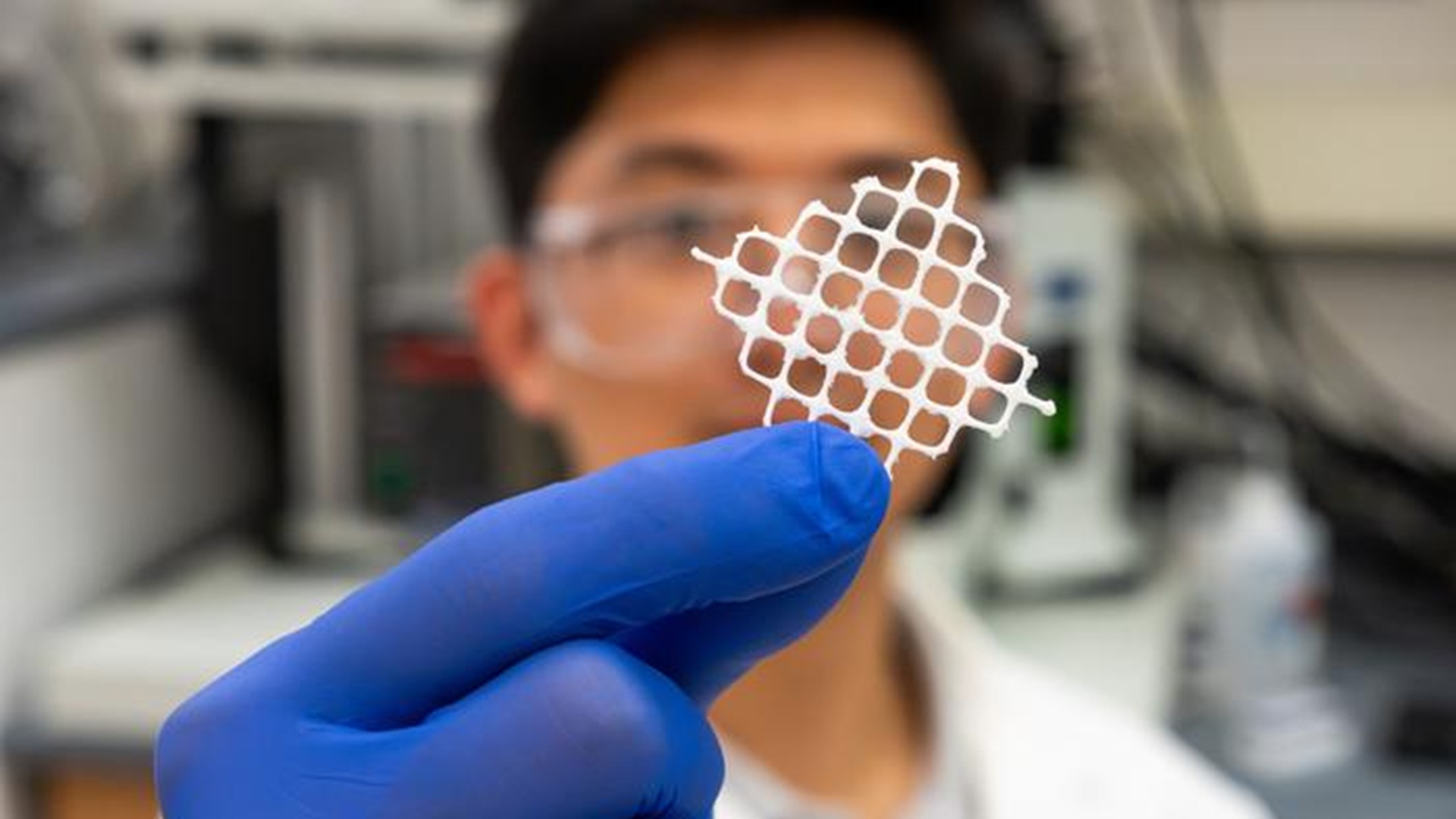
A team of US scientists has developed a biodegradable mesh inspired by tangled seaweed that can capture microplastics ranging from millimeter-sized fragments to particles just tens of nanometers wide. The new material was designed by researchers at North Carolina State University. It can work in both freshwater and saltwater, and addresses one of the biggest challenges in removing plastic pollution from aquatic environments. Microplastics are defined as plastic particles that are smaller than five millimeters. They have become a growing environmental concern because they accumulate in rivers, lakes, and oceans and can enter food chains. Meanwhile, existing cleanup technologies often perform well only within a limited size range, leaving either larger fragments or ultrafine particles behind. To address the issue, the scientists created a single material that can trap microplastics across multiple scales. Mimicking tangled seaweed For the design, the scientists drew inspiration from floating mats of seaweed and naturally occurring Neptune balls. These are tightly tangled balls of seagrass that have been found to collect microplastics in marine environments. “Our goal here was to develop a multiscale structure that allows us to capture the full range of plastic microparticles,” Orlin Velev, PhD, a chemical and biomolecular engineering professor at North Carolina State University, revealed. “We wanted to create structures that mimicked what the tangled seaweed is already doing.” Rather than simply copying the appearance of seaweed, the researchers recreated its tangled structure using sustainable biopolymers. According to Velev, the mesh is made from alginate, a carbohydrate polymer derived from seaweed, as well as chitosan, which comes from crustacean shells. A collection of plastic microparticles.Credit: Byeunggon Kim, Haeleen Hong, Orlin Velev / NC State University It features a highly porous network coated with extremely fine chitosan fibers that consist of soft dendritic colloids. These are structures that branch repeatedly into finer and finer filaments, ending in a tuft-like crown of nanofibers. The combination creates what looks like a fluffy net. The structure allows the soft dendritic colloids to stick to almost any surface and to directly capture polymer microparticles and nanoparticles from water. The larger openings in the mesh can physically capture bigger plastic fragments. Meanwhile, the fuzzy nanofiber coating adheres to much smaller particles, which would normally pass through conventional filters. Trapping plastics of all sizes In proof-of-concept testing, the new mesh successfully captured both laboratory-produced nanoparticles and real-world microplastics collected from water. It was effective in both freshwater and saltwater, and therefore proved its potential for a variety of aquatic environments. “What you end up with looks like a fluffy net,” Velev explained. “The ‘net’ part of the structure is a mesh capable of capturing the larger plastic microparticles – a millimeter or larger in size.” One of the mesh’s main advantages is its ability to capture particles spanning an exceptionally broad size range, from approximately five millimeters down to tens of nanometers. This could potentially replace multiple filtration systems used to capture different-sized particles. Additionally, if the mesh becomes filled with plastic debris, it could potentially be recycled through microbial digestion. As both the mesh and its captured contents can be processed biologically, the approach could break down the biodegradable material and the collected microplastics. It could furthermore produce raw materials to manufacture new cleanup meshes. “We’ve demonstrated that this design works,” Velev concluded in a press release. “And the materials we used are of natural origin and relatively inexpensive.” The study has been published in the journal Science Advances. Recommended ArticlesGet the latest in engineering, tech, space & science - delivered daily to your inbox.Based in Skopje, North Macedonia. Her work has appeared in Daily Mail, Mirror, Daily Star, Yahoo, NationalWorld, Newsweek, Press Gazette and others. She covers stories on batteries, wind energy, sustainable shipping and new discoveries. When she's not chasing the next big science story, she's traveling, exploring new cultures, or enjoying good food with even better wine.
Seaweed-inspired mesh captures microplastics from 5 mm down to tens of nanometers
Full Article
Original Source
Read the full article at Interestingengineering →KhanList aggregates and links to publicly available news content. We do not host full articles from third-party sources. Always verify important information with original sources.