
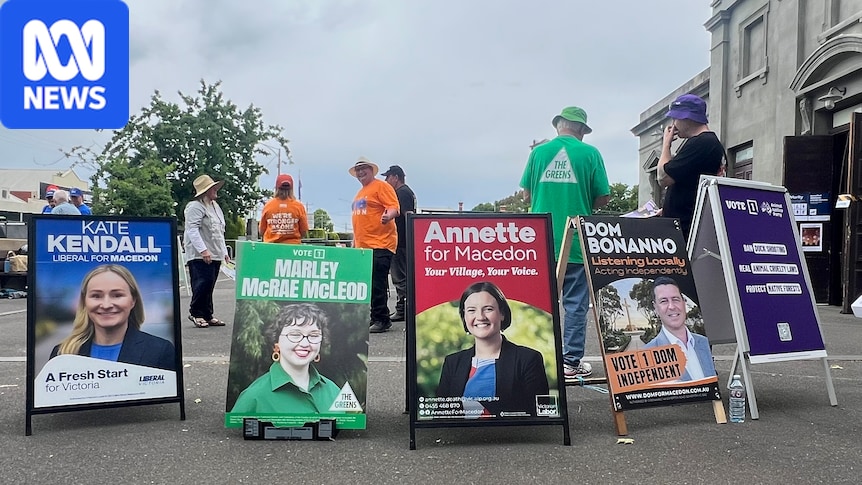
Walk down the main street of any country town across Victoria and ask about politics and you will get very similar answers.People feel that renewables projects have been approved without proper consultation, their hospitals are in chaos, and their roads are falling apart.Many will mention that their community has missed out on funding while mega-projects race ahead in Melbourne.And there is scepticism about the ability of the major parties to address the issues.Regional Victorians have aired their grievances about a range of issues during this term of parliament.On budget day in 2025, angry farmers and Country Fire Authority volunteers rallied on the steps of parliament about the Emergency Services and Volunteers Fund, which they said would increase their tax bills.CFA volunteers and farmers protest on budget day in 2025 over the emergency services levy. (ABC News: Joseph Dunstan)Tractors circled parliament house in August 2023 in protest about plans to build transmission lines across farmland in Victoria's west, which the Coalition has pledged to scrap and Labor has promised to review.And potholes have become emblematic of regional frustrations, symbolised by the death of a motorcyclist who reportedly hit a pothole on the Western Highway, and a large pothole on the Princes Freeway in Gippsland that left 30 drivers with flat tyres.On Saturday, November 28 voters will have their say on Labor's handling of these issues and whether they think the Coalition opposition can do better.Complicating electoral calculations in regional Victoria is the rise of One Nation, which is riding a wave of voter disillusionment with the major parties.See what the major issues are in your seat.Potholes have become emblematic of regional Victoria's frustrations with the state government. (Landline: Tim Lee)The state of playRegional Victoria contributes 25 of the 88 seats which make up Victoria's lower house.Those seats are split fairly evenly between Labor and the Coalition, with the government holding 11 to the Coalition's 14.Labor draws much of its regional strength from the larger centres of Ballarat, Bendigo and Geelong, while the Coalition dominates in seats further away from Melbourne.RedBridge Group pollster and director of strategy Kos Samaras told the ABC that Labor had held seats in those regional centres since Steve Bracks won the 1999 election, but this election he expected many of those seats would be lost to the Coalition."We expect a good chunk of them will [be lost], which will be a very different result to what the Labor Party was able to secure in 2010 when it did lose that election, where it was able to hold its provincial foothold and rebuild from that," Mr Samaras said."On this occasion, they will be losing seats in regional Victoria, that's for sure."Kos Samaras expects the Coalition to pick up seats in Victoria's regional cities. (Supplied: Peter Healy)The ghosts of 1999The last time there was widespread anger in regional Victoria was in 1999 when Jeff Kennett was seeking a third term.Labor's Steve Bracks was little fancied going into the election with Mr Kennett expected to win in a canter.But anger was simmering below the surface after seven years of privatisations and cuts to schools, hospital and transport.The Coalition finished just short of a 45-seat majority, finishing with 43 seats to Labor's 42.Regional Victoria was central to the outcome, with Labor picking up the seats of Ballarat East, Ballarat West, Bendigo East, Seymour and Narracan.Mr Bracks formed minority government after securing the support of three rural independents, Craig Ingram in Gippsland East, Russell Savage in Mildura and Susan Davies in Gippsland West.Steve Bracks led Labor back to power, winning elections in 1999, 2002 and 2006. (ABC TV)See what the major issues are in your seat.Major party declineFast forward 27 years and Labor is on the nose in regional Victoria and appears likely to lose government, if polling is accurate.But anyone expecting a repeat of the 1999 result should not hold their breath.Support for the major parties has declined since 1999, when Labor won 45.57 per cent of the primary vote to the Coalition's 47.02 per cent.A RedBridge poll published in the Australian Financial Review on November 11 put support for the Coalition at 31 per cent with Labor at 23 per cent.Surge in One Nation voteA big part of what makes this election so different is the rise of One Nation.It received 22 per cent of support in the RedBridge survey after securing a 2.04 per cent primary vote at the 2022 election.But with the Coalition's vote improving as election day draws closer, Mr Samaras is not expecting an orange wave across regional Victoria.One Nation's vote had dropped from the high 20s earlier this year to its current level, he said. "That's a problem because One Nation needs a fairly high primary vote to remove a National Party MP or a Liberal Party MP who are occupying a regional electorate," Mr Samara said.One Nation Victoria leader Warren Pickering with Pauline Hanson announcing the party's energy policy in the Latrobe Valley. (ABC News: Madeleine Stuchbery)See what the major issues are in your seat.He said because of Australia's preferential voting system, One Nation would need a primary vote above 35 per cent in order to translate its support into seats."If they end up in most of these seats with a primary vote similar to that of the Coalition's, it'll be Labor preferences that actually elect the Coalition MP or candidate," Mr Samaras said.He thinks that if One Nation wins anywhere, it will be in Morwell, which encompasses Victoria's coal heartland in the Latrobe Valley. A Roy Morgan survey in October rated Morwell as the seat most likely to fall to One Nation."Basically, people [in Morwell] are of the view that whether it's the Coalition or whether it's the Labor Party, both have not really done the right thing by that part of Victoria," Mr Samaras said. "It's an area that's obviously experienced significant industrial and economic decline and obviously the economic face of that part of Victoria has changed drastically and I think the politics will express that."What's happening in your seat?BellarineRead more BenambraRead more Bendigo EastRead more Bendigo WestRead more EildonRead more EurekaRead more EuroaRead more GeelongRead more Gippsland EastRead more Gippsland SouthRead more LowanRead more MacedonRead more MilduraRead more MorwellRead more Murray PlainsRead more NarracanRead more Ovens ValleyRead more PolwarthRead more RiponRead more SheppartonRead more South BarwonRead more South-West CoastRead more WendoureeRead more
Seat by seat, these are the major election issues in regional Victoria
Full Article
Original Source
Read the full article at Abc →KhanList aggregates and links to publicly available news content. We do not host full articles from third-party sources. Always verify important information with original sources.