
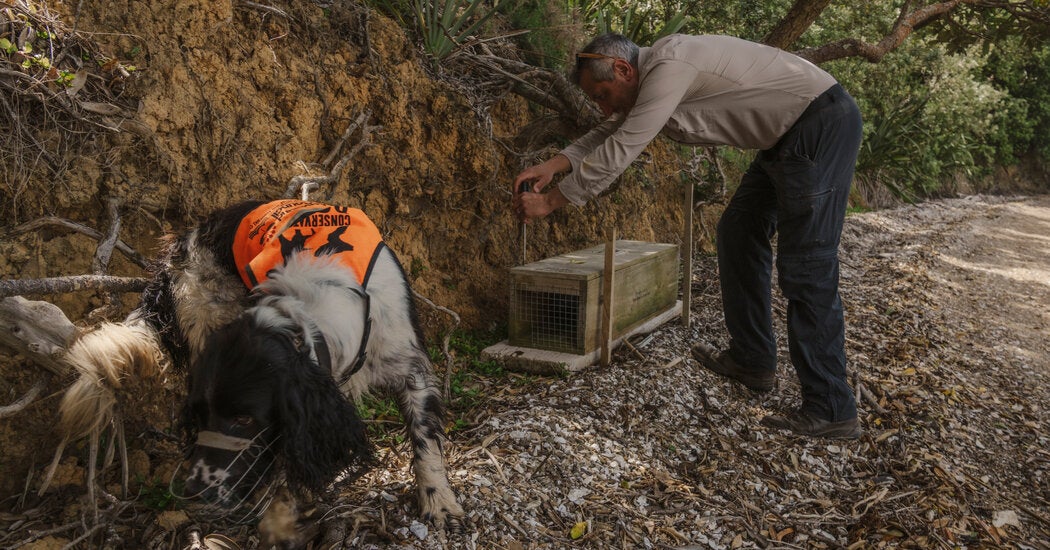
Can the tourist destination become the first urban island to rid itself of the stoat — an introduced predator that has ravaged New Zealand’s endemic wildlife?Frank Lepera, stoat operations manager at Te Korowai o Waiheke, installing a trap where a stoat was recently reported, on Waiheke Island, New Zealand.Searching for the Last Stoats of Waiheke IslandCan the tourist destination become the first urban island to rid itself of the stoat — an introduced predator that has ravaged New Zealand’s endemic wildlife?Frank Lepera, stoat operations manager at Te Korowai o Waiheke, installing a trap where a stoat was recently reported, on Waiheke Island, New Zealand.Credit...To catch a stoat, you need to think like one. For Tilde Sorensen, that means imagining having tiny legs and picturing which route the weasel-like creature might take as it haunts the wilderness of New Zealand, preying on unique birdlife.Then she sets up a trap along that path.“We’ve caught all of the ones that will happily go into a trap. So now we’ve got to figure out how to get the really shy ones,” Ms. Sorensen said of the stoat population on Waiheke Island, a 40-minute boat ride from New Zealand’s largest city, Auckland.“We’re trying to work ourselves out of a job.”ImageTilde Sorensen is a stoat-detection-and-response coordinator for Te Korowai o Waiheke project.Ms. Sorensen is a stoat-detect-and-respond coordinator for a project called Te Korowai o Waiheke, a Māori name that means The Cloak of Waiheke. It has captured more than 280 stoats since 2020 and, while it is not known how many remain, testing suggests the population has dwindled.The campaign to eradicate stoats, and many other introduced species, has widespread support in New Zealand, where introduced predators, including rats and possums, kill about 25 million native birds each year.Waiheke Island, which covers about 36 square miles, is home to 4,300 people, a number that swells to about 45,000 in the summer.Tourists are drawn to its golden beaches, crystalline water and wineries. But for stoats, it’s all about the birds.ImageA taxidermied stoat attacking a native bird on display at the organization’s office.ImageA stoat spotted by a monitoring camera installed on the island.Stoats, known also as short-tailed weasels in North America, have reddish-brown fur and a white underbelly, and can measure about 39 centimeters, or 15 inches, from nose to tip of tail. They were initially introduced to New Zealand from Britain in the late 1870s to control the population of rabbits, which themselves were introduced for food and sport in the country as early as the 1830s.The carnivores quickly turned their appetites to New Zealand’s native birds, many of which evolved to be flightless because the islands were isolated for millions of years and had no ground-dwelling predators.Stoats, like other animals introduced by Europeans to New Zealand such as goats, rats and red deer, have pushed several species to the brink of extinction, either as predators or through habitat destruction.VideoA view of the sunrise on the 40-minute boat ride from Auckland to the island.ImageWaiheke Island is home to 4,300 people, a number that swells to about 45,000 in the summer.If Te Korowai o Waiheke successfully eradicates them, it will create the world’s first predator-free urban island, possibly forming a blueprint for others to follow. New Zealand has bold plans to be free of predator-free by 2050, and other programs are underway to eradicate other invasive species.Mary Morgan-Richards, evolutionary biology professor at Massey University Manawatū, said keeping people and governments committed to the goal — and ensuring ample funding — will be crucial. When conservation means ‘killing stuff’Te Korowai o Waiheke — a name bestowed by the local iwi (tribe), the Ngāti Paoa — is funded by the country’s environment department as well as the local council and philanthropic organizations.Growing up on the island, Ms. Sorensen, 30, said she rarely saw native birds like the kākā, a type of parrot, or the pāteke, a dabbling duck, which the team refers to as “stoat chocolates.”But in the past six years, these birds have returned in large numbers, Ms. Sorensen said.ImageA kākā, a type of parrot.ImageTwo pāteke, rare native ducks.Each year, experienced bird spotters record everything they hear and see across 70 sites on the island over five minutes. Figures from November 2020 versus 2025 show a 99.6 percent increase in native birds counted, including a 930 percent increase in kākā birds, of which there are estimated to be fewer than 10,000 left.And 24 flightless kiwi birds, the country’s unofficial national emblem, have been reintroduced to the island in the past couple of years and successfully bred, an effort led by another conservation group and local tribes. Those on the island say it has been a long time since kiwi birds freely wandered the shores.While walking in the forest, Ms. Sorensen regularly pauses conversations to point out the calls of the kākā as it flies nearby.“Sometimes you’ve just got to stop and listen and go, ‘oh my god’,” she said.VideoA trail through a park on Waiheke Island.ImageA kererū, also known as a New Zealand wood pigeon.“Conservation in general in New Zealand is a little bit strange in that most of it is killing stuff,” she said.The team uses a range of measures to catch the stoats, including motion cameras and 1,600 traps laced with lures that might entice them. These could include stoat anal scent glands, soiled stoat bedding, fried chicken or duck fat.The team also installs small fences along stoat pathways that direct the pest into traps by blocking escape routes. A further 200 traps are installed by the team across the island following sightings by members of the public or using dogs that are trained to sniff out stoat feces.VideoCarina Oliver, a field team technician, checked the coastline with a trained dog named Parker.ImageThe program is funded by the country’s environment department as well as the local council and philanthropic organizations.The response team and volunteers are constantly brainstorming for new ideas that might help capture the remaining animals. They work across the island, sometimes hiking for miles into the bush to set or check traps, sometimes finding nothing.To keep the team motivated, Frank Lepera, stoat operations manager, tells them: “You never know when a stoat is having a bad day.”“You have to have every single trap in like perfect condition, so when it is having a bad day and it walks by that trap, it goes in.”On the day The New York Times visited, the team responded to a stoat sighting reported by a person who had seen it dashing across the front lawn, into the scrub and beach below.The team placed traps along different routes, each one laced with a combination of lures including canned sardines, rabbit blood or a recording of stoat babies (known as kits). They work like a giant mousetrap to kill the stoat, and were to be checked every few days.ImageSardines were used as bait in one of the traps.ImageA camouflaged stoat trap.Once caught, the dead stoat’s tail and ears are sent off for genetic testing — the island’s population is inbred, so testing can show if there have been any new incursions from other islands. The stoat’s teeth are used to determine its age — a decline in younger ones would mean the stoats may be breeding less as the adult population shrinks.While there is no way of knowing exactly how many furry predators remain, the increasingly empty traps and return of native birds indicate that the stoat population is declining.Stoat dreamsThere are a few notorious stoats that have managed to evade the team. One of them is called the “Lion’s Tail” — named after a bald spot on its tail that resembles a lion’s. It is often seen darting in front of the motion cameras but has not ended up in a trap, yet.Ms. Sorensen joked that she will bake a stoat-shaped cake on the day it is finally vanquished.Many in the team said they dream of chasing or catching stoats. Phil Salisbury, a team leader, said the days are long and the work is hard, but the reward is “flying around us.”“Every bird you hear, especially the kākā and stuff, it’s a success story,” he said.Laura Chung is a Sydney-based reporter and researcher for The Times, covering Australia, New Zealand and the Pacific.Related ContentAdvertisementSKIP ADVERTISEMENT
Searching for the Last Stoats of Waiheke Island
Full Article
Original Source
Read the full article at Nytimes →KhanList aggregates and links to publicly available news content. We do not host full articles from third-party sources. Always verify important information with original sources.