
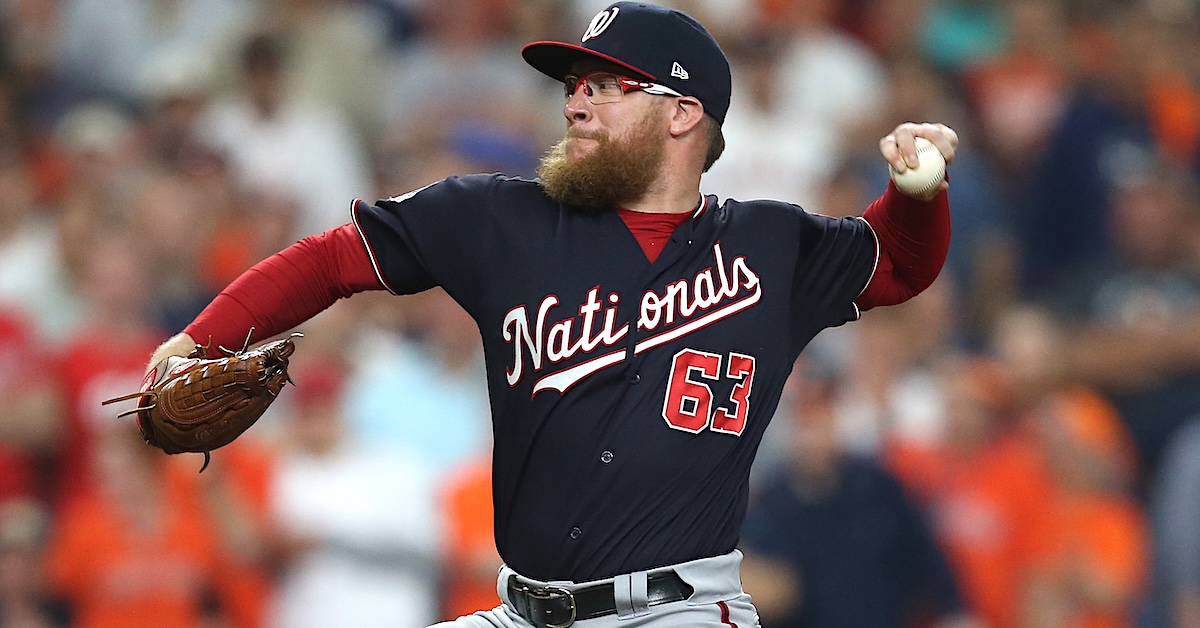
Thomas B. Shea-USA TODAY Sports The Washington Nationals haven’t pitched well this season. Employing 41 different hurlers — the most in the majors — the NL East club ranks fourth from the bottom in both ERA and FIP, and has the fifth-worst strikeout rate. With a handful of exceptions, the often-patchwork staff has been mediocre at best. The future is nonetheless promising. Under the leadership of Paul Toboni, who was named president of baseball operations 11 months ago, the Nats have cast aside their old-school ways and adapted an analytically driven approach to securing outs. Bringing on board Simon Mathews as pitching coach and Grayson Crawford as director of pitching were especially meaningful steps in the organization’s much-needed retooling. Retaining Sean Doolittle was likewise a shrewd move. Now the assistant pitching coach after serving as pitching strategist in 2024 and 2025, the 39-year-old former closer is simpatico with Toboni, Mathews, and Crawford when it comes to modern-day methods. Data savvy while also bringing a been-there-done-that understanding of what translates to success on a big league mound, Doolittle is an important part of what the Nationals are working to build. Doolittle sat down to talk pitching when the Nats visited Fenway Park earlier this summer. ——— David Laurila: The organization overhauled its pitching infrastructure this year. What are some of things you, and the staff as a whole, have been focusing on? You Aren't a FanGraphs Member It looks like you aren't yet a FanGraphs Member (or aren't logged in). We aren't mad, just disappointed. We get it. You want to read this article. But before we let you get back to it, we'd like to point out a few of the good reasons why you should become a Member. 1. Ad Free viewing! We won't bug you with this ad, or any other. 2. Unlimited articles! Non-Members only get to read 10 free articles a month. Members never get cut off. 3. Dark mode and Classic mode! 4. Custom player page dashboards! Choose the player cards you want, in the order you want them. 5. One-click data exports! Export our projections and leaderboards for your personal projects. 6. Remove the photos on the home page! (Honestly, this doesn't sound so great to us, but some people wanted it, and we like to give our Members what they want.) 7. Even more Steamer projections! We have handedness, percentile, and context neutral projections available for Members only. 8. Get FanGraphs Walk-Off, a customized year end review! Find out exactly how you used FanGraphs this year, and how that compares to other Members. Don't be a victim of FOMO. 9. A weekly mailbag column, exclusively for Members. 10. Help support FanGraphs and our entire staff! Our Members provide us with critical resources to improve the site and deliver new features! We hope you'll consider a Membership today, for yourself or as a gift! And we realize this has been an awfully long sales pitch, so we've also removed all the other ads in this article. We didn't want to overdo it. Sean Doolittle: “One thing that we’ve paid a lot of attention to this year is getting guys to use both of their fastball shapes, even to off-handed hitters. For our group, that’s been new. We don’t have a ton of velocity, so we have to be really conscious of our combos and our sequencing. I think it’s helped a few guys in our group quite a bit this season. Guys like Brad Lord have thrown a lot more sinkers this year to lefty batters. It’s still not a high-percentage-usage pitch for him, but overall it’s been a big part of our education process with helping our pitchers and our catchers read swings and sequence. Game calling and stuff like that.” Laurila: I believe Andrew Alvarez is throwing more two-seamers this year? Doolittle: “Yeah, that’s another guy who has thrown more. Especially for a guy like him who can create that outlier angle — his release height and his VAA — with his two-seam. He throws from a weirdly high slot. With in-zone sinkers he can get down into the negative-8, negative-9 range with his approach angle. That’s part of his superpower. He can create some weird angles and shapes from that high slot. “Other things we’ve been thinking about here… it’s pretty foundational, the stuff we’re doing. There’s been a huge emphasis on education. We’ve got our guys wearing Pulse [monitors]; we’re still learning and refining their routines and workloads, not just in their outings, but also the days they’re not pitching. We’re trying to keep our guys fresh while also making sure they get their work in. A lot of our process is happening behind the scenes. Seam orientation has also been a big emphasis for our group.” Laurila: Just how differently are things being done compared to recent seasons? Doolittle: “It’s incredibly different, and in a good way. This is my third year here, and we have people up and down the organization now that can spot things like pitches that aren’t being optimized with seam orientation, and we can start to make these adjustments even before guys get here. Then we have the ability to continue that process once they are here, whether it’s spin-axis balls or using Edgertronic to track that kind of stuff. On a daily basis, we’re trying to move things on the margins. We’re really leaning into those kinds of things.” Laurila: How much of a learning curve has it been for you? Doolittle: “The seam-orientation stuff has been probably the area I’ve learned the most about. I think I already had a pretty good understanding of a lot of the other stuff. And another area of education has been continuing to learn about being a coach. There is an art to it, to teaching and earning the trust of a player. It’s not just getting them to buy into the adjustments, but also to go out in a big league game and trust the things we’ve been working on. “I trained under Simon when I was still a player. He had just transitioned himself from playing to coaching during the offseason after the 2020 season, and I learned a lot from him in that time. We’ve stayed close in the years that have followed, as he climbed the ladder in the Reds organization and I was transitioning to coaching. He was a big resource for me, and I continue to learn stuff from him all the time.” Laurila: The organization certainly has other knowledgeable people working on the pitching side as well… Doolittle: “Grayson Crawford, our director of pitching, is extremely smart. His superpower is probably the seam-orientation stuff. Simon’s superpower is communication, building trust and relationships. That’s not to discount his knowledge of pitching, his knowledge of technology, of pitch design and biomechanics. The processes he’s been building for our group, including our biomechanics reports, our after-action reports — the stuff that we’re using to monitor our pitchers on a daily basis; he brought Pulse over with him from Cincinnati — have really helped our players understand their routines. The way that his brain works makes him absolutely the right guy to help us lay that foundation and build something special.” Laurila: Changing direction a bit, does anyone on the pitching staff have an outlier pitch? Not necessary in terms of quality, but rather there is something that makes it atypical, if not unique. Josh Hader’s fastball would be an example. Doolittle: “Not really. Cade Cavalli’s sweeper is maybe the closest thing, but it’s a one-seam, seam-shift sweeper and that’s not… I mean, it’s exceptionally good for what it is, but I don’t think it’s quite an outlier like the Hader example.” Laurila: Atlanta’s Dylan Dodd is similar to Hader. Talking to him earlier this season, I learned that he tried a sinker grip because his four-seamer didn’t have good metrics, and the result was a two-seamer that has good four-seam action. Doolittle: “That’s crazy. It’s really interesting, because… I mean, we’ve made some grip adjustments with guys because the orientation was out of whack for the way that they’re biased to move — pronator/supination bias — but I can’t think of anybody quite like that where it was as much of a lightbulb moment. We’ve moved some things on the margins, for sure. But really, Cavalli is the best example here. He didn’t have that last year. “He might be an example, too, with the fastball. Coming off of Tommy John surgery, over the last couple years he was really trying to ride the four-seam, and got to a point where we were like… that was actually one of the things I started working on with him last year. He was so biased to supination that a high-ride four-seam didn’t seem like it was in the cards for him. I told him that we should lean into a cut-ride shape. He’s been able to play with the four-seam and develop an actual cutter off of the cut-ride four-seam. He’s a fun guy to work with. He can get the ball to do almost anything he wants. And then when Simon came in he added the sweeper. That was one of his big projects in spring training. Cade’s ability to spin the curveball made us think he’d be able to pick it up pretty quickly, and he did. He’s made Simon and the rest of us look really smart.” Laurila: To what extent could you make the ball do what you wanted? Doolittle: “Very little. I threw 90% four-seams for my whole career. I tried so many things, especially in the back half of my career, to add a secondary pitch. I was picking player’s brains, I was spending offseasons doing pitch design, but I just didn’t have the hand feel to do it. If I knew then what I know now, maybe I would have been able to make more progress. “That translates to the job I have now. I can use my experience trying all of those different things and being taught all of those different cues, and picking players’s brains on what their thought process was on their pitches. I’m able to teach it at a high level, even though I wasn’t personally able to do it.” Laurila: That said, a pitcher still needs the hand feel, which is something you can’t teach. It’s basically innate. Right? Doolittle: “To an extent. I do think it’s innate, but the lucky thing for me is that nowadays almost everybody at this level has more hand feel than I had. I mean, I was a converted position player. I got super lucky that the fastball I threw was an outlier pitch for the time that I played. There’s a message to that, too. Pitch to your strengths, be great at what you’re good at. Right? If you have something in your arsenal that makes you unique, get f—ing good at executing it at a high level. “It took me a while to understand that it’s OK if a hitter knows, or thinks he knows, that this pitch is coming. If it’s a pitch that you get really good at executing, you can use that to your advantage. You can exploit that. Show them what they want to see and get them to engage with it on your terms. There is something to that, for sure. “Of course, with the things that we have now, like the Edgertronic cameras and spin-axis balls, we can run experiments and get much better real-time feedback than what was available when I played. We’re able to help guys make adjustments. Through the art of coaching, we’re able to get them to verbalize what they’re thinking and feeling, and then make adjustments off of that, start to train the hand feel for a specific pitch type.” Laurila: You had a lot of pitching coaches over the course of your playing career. Do any of them stand out in terms of being ahead of the curve? Doolittle: “Yes. My first pitching coach [in MLB], and the one I was probably with the longest in my career, was Curt Young, in Oakland. I was with him before we had an understanding of analytics and how those things were tracking. I really appreciated everything that he did for me, helping me establish myself in the league. “More recently, in 2021 I signed a free agent deal to go to Cincinnati specifically because of Derek Johnson. He was Simon’s mentor. My understanding of pitching grew exponentially under him. Like Simon, his superpower was his communication, his ability to motivate players and meet them where they’re at in their career. He could get high-level concepts across to them in an accessible way. “I was also with Pete Woodworth in Seattle, although only for about five or six weeks in 2021, so I didn’t have as much time with him. He’s outstanding. But I would say that DJ is the guy. When I took this job, I told Simon that I’m trying to do a Derek Johnson impression.”
Sean Doolittle Talks (Washington Nationals) Pitching
Full Article
Original Source
Read the full article at Blogs →KhanList aggregates and links to publicly available news content. We do not host full articles from third-party sources. Always verify important information with original sources.