
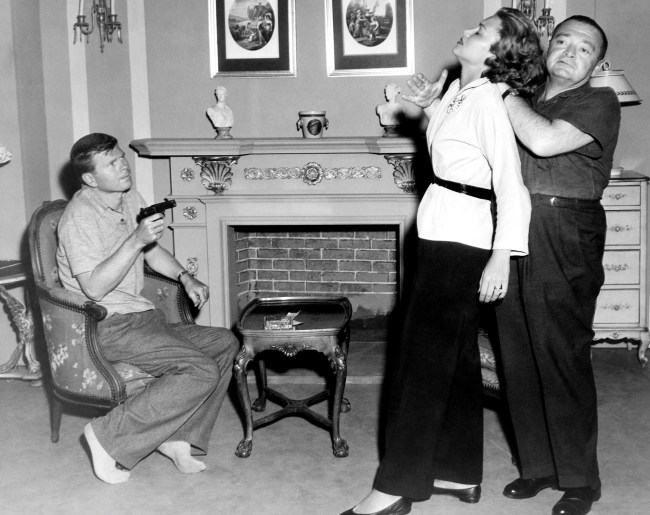
Ever since George Lazenby first replaced Sean Connery as James Bond in 1969’s “On Her Majesty’s Secret Service,” fans have argued over who makes the best 007 — and those arguments are likely to resume once Robert Pattinson takes the screen as the latest Bond in director Denis Villeneuve’s new iteration. Although Craig has his partisans, Connery tends to be the consensus choice for the best Bond, though I’ve argued here for the merits of 1970s and ’80s Roger Moore. All the Bonds have their virtues, but Connery benefited from being there first — for anyone who discovered the series in its initial heyday, Connery simply is James Bond. Yet Connery actually wasn’t the first actor to play Bond. That honor goes to journeyman MGM contract player Barry Nelson, who played Bond in a “Casino Royale” adaptation eight years before Connery made the character famous in “Dr. No.” Connery may have been the first 007 to grace the big screen, but Nelson established Bond on the small screen in an episode of the CBS anthology series “Climax!” opposite Peter Lorre in the Le Chiffre role that would later be inhabited by Orson Welles (in the goofy 1967 “Casino Royale”) and Mads Mikkelsen (in the 2006 adaptation that introduced Craig to the series). The 1954 “Casino Royale” is a fascinating artifact that includes elements that would go on to characterize future James Bond movies, while also going in a few other very different directions. The key difference is in the scale, stripped down by necessity for television production. The hour-long “Climax!” episode is all interiors, taking place entirely in the hotel and casino of the title. It’s more a James Bond play than a movie, with Bond and Le Chiffre facing off in a series of verbal — and ultimately physical — jousts in confined spaces, and it’s surprisingly effective. It’s also a very strange beginning for a franchise that would come to be known for its globetrotting locales and elaborate action set pieces. Not that this “Casino Royale” was officially part of the James Bond franchise as we know it. In fact, although there have been three adaptations of Ian Fleming’s first James Bond novel, only the third incarnation with Daniel Craig was from EON Productions, the company that controlled the character from “Dr. No” through the Craig era before selling the rights to Amazon. The 1954 “Casino Royale” came about when producer Gregory Ratoff optioned the rights to Fleming’s novel in May of that year. The novel wasn’t yet a hit, and Fleming was sorely in need of cash, which led him to make one of the worst deals in movie-rights history when he sold the book outright to Ratoff for $6,000 after the TV episode aired. This left “Casino Royale” out of the deal when EON secured the screen rights to James Bond as a character, so Bond producers Albert Broccoli and Harry Saltzman could only sit back and grit their teeth when Ratoff turned “Casino Royale” into a comedy in 1967 and cast Peter Sellers, David Niven, Woody Allen and others as rotating Bonds. EON ultimately made a deal to bring “Casino Royale” under their umbrella and used the novel to reboot the franchise with Craig, but in 1954 it served as the source for a much more modest affair. The biggest similarities between the 1954 “Climax!” episode and the Daniel Craig movie come in the time spent on extended gambling sequences, and the centering of a brutal torture scene. Given censorship restrictions of the time, Nelson’s torture in a bathtub is considerably less graphic than the mallet to the testicles inflicted on Craig, but it’s rough enough stuff for a 1950s TV production. Certain aspects of Nelson’s characterization, like Bond’s mix of sexual swagger and icy indifference, would later be adopted by most future 007s, to varying degrees. The biggest difference between Nelson and future Bonds is a simple one: He’s American. Although Broccoli and Saltzman flirted with the idea of an American Bond throughout the series’ history (going so far as to cast James Brolin in “Octopussy” before Moore decided to return at the last minute), to date they’ve never actually pulled the trigger on casting outside the UK. Nelson is probably best known to modern audiences as the affable hotel manager Stuart Ullman in Stanley Kubrick’s “The Shining,” but in the 1950s he was a sturdy character actor and occasional leading man who bounced around television after an initial sojourn as a studio contract player. As a young man, he appeared in several important MGM films, including “Shadow of the Thin Man,” “Bataan,” and “A Guy Named Joe” (the source material for Steven Spielberg’s “Always”). Later on, he popped up in “Airport” and had a successful Broadway career. He was nominated for a Tony acting opposite Liza Minnelli in Martin Scorsese’s 1977 production “The Act.” In 1954, though, he was in the middle of a prolific and productive era as a TV stalwart, both as a series regular (on “The Hunter” and “My Favorite Husband”) and a frequent guest star. He doesn’t exhibit a ton of range as American “Combined Intelligence” agent “Jimmy” Bond, but that too is in keeping with the overall conception of the character, at least until Craig tried to bring a little more emotional depth to the role. In Americanizing Bond, the “Climax!” edition of “Casino Royale” ends up making a number of related changes that are small but make the film feel just a bit off for fans of the EON productions. American Felix Leiter (later played by Jeffrey Wright) becomes Brit Clarence Leiter, for example. Although there’s none of the Bond gadgetry that would become famous later, there are hints of what’s to come in the form of props like a villain’s cane that hides a gun, and the opening credits for the “Climax!” series itself feature a gun barrel pointed at the viewer that predicts the iconic graphics of later Bond title sequences. The 1954 “Casino Royale” is noteworthy for another reason: its composer, Jerry Goldsmith, who would ultimately score hundreds of major films, including “Planet of the Apes,” “Chinatown,” “Basic Instinct,” and most of Joe Dante’s work. Yet in some ways what’s fascinating about “Casino Royale” is how unremarkable it is — it’s a decent, solid piece of entertainment from an era when proliferating anthology shows provided similar programs every week. If Fleming had his way, it would have only been the start for 007 on television; he wrote several outlines for episodes of a James Bond series before CBS canceled the project. Luckily, he repurposed most of what he wrote as short stories for his 1960 book “For Your Eyes Only,” and television’s loss was cinema’s gain. By 1962, James Bond belonged to the movies — and to Sean Connery.
Sean Connery Wasn’t the First James Bond: Meet Barry Nelson in the ‘Casino Royale’ You’ve Never Seen
Full Article
Original Source
Read the full article at Indiewire →KhanList aggregates and links to publicly available news content. We do not host full articles from third-party sources. Always verify important information with original sources.