
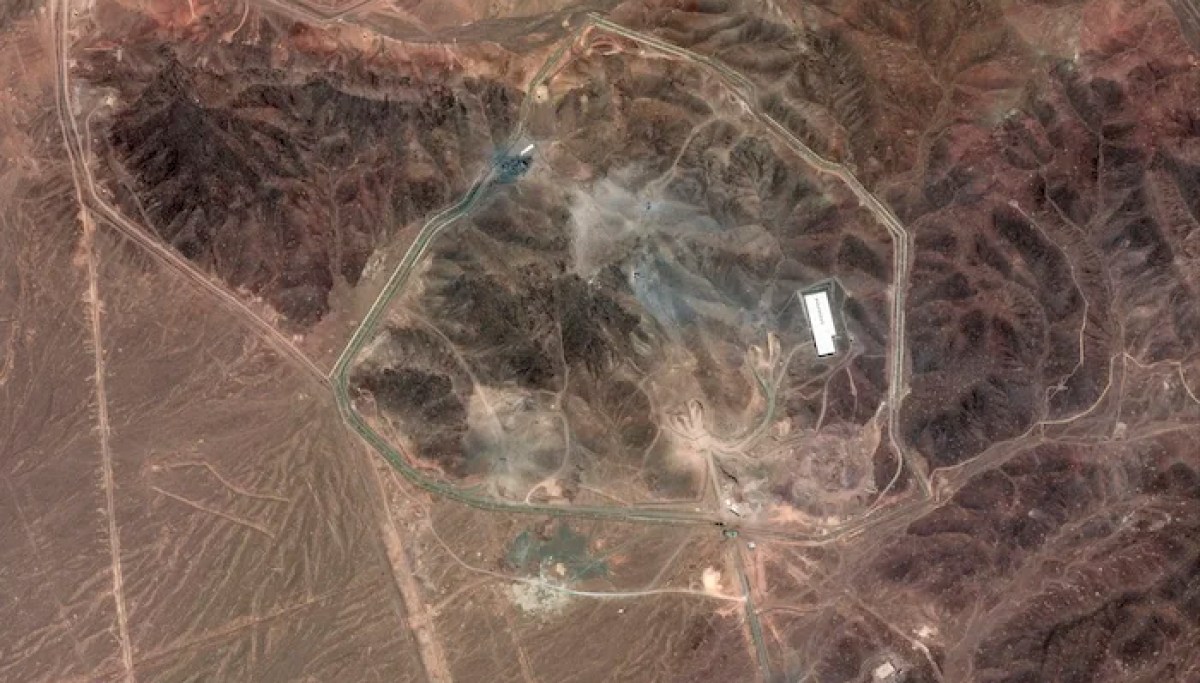
While the strategic threats posed by the Fordow nuclear facility and Pickaxe Mountain are well-known fixtures of Western security debates, it is a dangerous oversight to ignore Eagle 44, an underground Iranian air force base engineered to withstand precision airstrikes and project lethal power directly over the Persian Gulf.Recent satellite imagery reveals that Tehran has already finished the upper concrete layer of a new western taxiway section and is actively pushing a second segment across stabilized soil. Iranian engineers have cleared runway obstacles and stripped debris from the pavement, though impact craters still pockmark the ground near the western tunnel entrances and surface buildings remain in ruins. Situated deep in the Zagros foothills of Hormozgan province, this complex sits a mere 100 miles northwest of the critical Strait of Hormuz. Because the tunnels excavated here since 2013 shelter IRIAF F-4 Phantoms, strike drones, and heavy munitions, the base represents a vital node in Tehran’s regional strategy. First unveiled in February 2023, the subterranean fortress is now receiving a redundant taxiway precisely so aircraft can still reach the 2.5-mile runway if a primary access route is cratered.This strategic positioning places protected aircraft and drones within minutes of a maritime chokepoint that carries roughly 20% of global oil shipments. From this mountain stronghold, Iran directly menaces U.S. naval forces operating in the Persian Gulf and threatens partner facilities along the Arabian shore. Restoring the base is central to Iran’s doctrine, allowing Tehran to regenerate air and drone power even after absorbing the initial waves of precision strikes under Operation Epic Fury. Although surface routes were heavily damaged during those strikes and assets were temporarily isolated, the tunnels themselves show no structural collapse. Tehran is investing heavily in infrastructure redundancy for one specific reason: to ensure sortie generation can continue unabated under heavy bombardment. Ultimately, the base’s strategic value depends less on how many flyable airframes sit inside the mountain than on whether those assets can actually exit and return. Allied planners confronted this exact geometric dilemma at Germany’s Mittelwerk complex near Nordhausen in early 1945. At the time, conventional bombing could not collapse the V-2 production halls buried deep inside the Harz mountains. Effective denial instead required sealing the northern and southern tunnel portals while simultaneously interdicting the connecting rail lines, ensuring finished missiles could not leave and raw materials could not enter. When a mountain protects military machinery, only its mouths and arteries determine whether the site retains its utility. Today, Eagle 44 presents an identical problem for modern U.S. military planners. While the mountain ridge shields Iran’s aircraft and munitions, the taxiways and tunnel entrances remain the only vulnerabilities that determine whether those assets can ever deploy.Thus, American and Israeli military strategists must treat Eagle 44’s tunnel portals and both taxiway alignments as a permanent, high-priority set of access-denial targets. Operationally, the strike sequence must start with ordnance that craters the taxiways to immobilize all surface movement. Immediately thereafter, the focus must shift to heavy penetrating weapons aimed directly at the lips of the tunnel mouths, collapsing unstable rock and soil into a thick rubble plug that is far harder to clear than a standard surface crater. Continuous high-resolution satellite and signals monitoring of those exact coordinates, paired with predelegated restrike authority, will turn any Iranian attempt to clear debris, open an improvised path, or pave a new connection into an automatic trigger for a follow-on strike.HEGSETH FIRING SYLVIA ISN’T OFFICE POLITICS — HE SMOKED OUT A WARTIME MOLEThe same unyielding logic must govern how these strikes are executed and sustained. To achieve this, an AI-enabled cell fusing commercial high-revisit satellite constellations with automated change-detection algorithms can validate Iranian repair activity against preloaded strike packages on carrier strike groups or in Israel, executing missions inside a tight, sub-12-hour window. At the same time, the United States must deploy specialized munitions packages, combining initial kinetic penetrators with delayed-fuse secondary charges, to trigger cascading rockfall and unstable overburden at the portals as soon as clearing operations begin. By extending this parallel interdiction to the specific Hormozgan contractors, concrete plants, and heavy-equipment suppliers feeding the reconstruction, the West can transform the engineering effort itself into a targetable node rather than an after-action repair problem.Permanently denying Eagle 44’s exits completely removes Iran’s ability to regenerate air and drone power at the edge of the Strait of Hormuz. Conversely, leaving those exits intact preserves a hardened sanctuary that earlier strikes have already proven surface damage alone cannot neutralize. The geometry is clear, the required measures are undeniable, and the choice is stark: The U.S. and Israel must either treat the mouths and arteries of Eagle 44 as the decisive targets they are or watch Iran project power from the safety of the mountains.Jose Lev Alvarez is an American–Israeli scholar specializing in international security policy. A multilingual veteran of the Israeli special forces and the U.S. Army, he holds three master’s degrees and is completing a doctorate in intelligence and global security in the Washington area.
Sealing Eagle 44: Why Washington and Jerusalem must bury Iran’s subterranean sanctuary
Full Article
Original Source
Read the full article at Washingtonexaminer →KhanList aggregates and links to publicly available news content. We do not host full articles from third-party sources. Always verify important information with original sources.