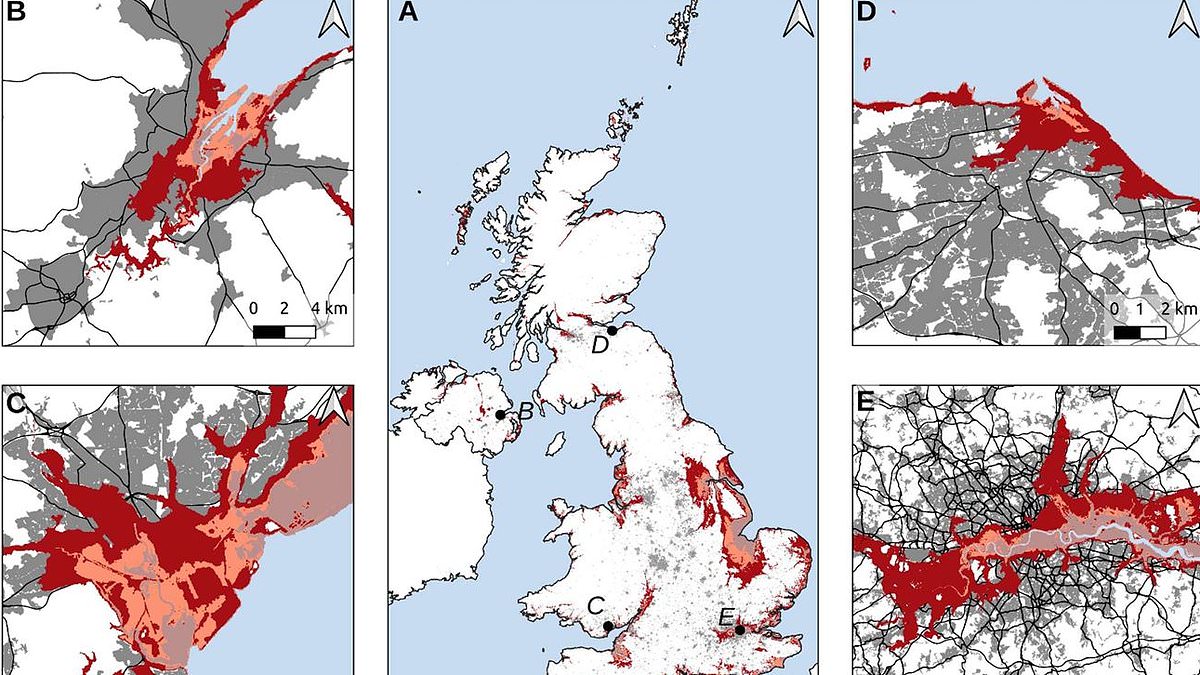
Rising sea levels could plunge 1.7 million more Brits' homes underwater by 2300 and render parts of the UK uninhabitable, scientists have warned.Researchers from the Met Office and the University of Bristol used computer models to see how many people will be at risk of coastal flooding by future climate change.Their chilling results show that at least half a million more people will be exposed to floods by the end of the next century.Concerningly, the researchers warn that these dramatic changes are now all–but certain and will happen unless dramatic measures are taken in the coming decades.Even if all the world's carbon emissions pledges are met, over 1.4 million people will be at risk of flooding by 2200, rising by a further 0.3 million by 2300.This is especially bad news for people living in the Wash and the Humber Estuary, which stand out as 'hot spots' for future coastal flooding.Lead author Professor Matt Palmer, of the University of Bristol, says: 'The oceans and ice–covered parts of the world respond very slowly to global warming, which makes sea–level rise the "sleeping giant" of climate change.'The result is that sea–level rise is "locked–in" for centuries to come.'This map shows areas of the UK that are at risk of coastal flooding by 2200 even if the world meets current climate pledges (Storyline B) or in a reasonable worst–case scenario (Storyline H2) As the climate gets warmer due to human–caused climate change, sea levels are gradually rising at an ever–accelerating rate.Globally, the average sea level has risen by 3.64 millimetres per year since 1999, for a total of 9.38cm over the last 26 years.About 30 per cent of that increase comes from the ocean expanding as it warms, while the remaining 70 per cent mainly comes from melting glaciers and ice sheets.While this trend has been relatively stable for decades, recent satellite data shows that this increase rapidly accelerated after 2012, jumping to 4.1mm per year.In their study, published in Nature Communications, Professor Palmer and his co–authors use the latest data to predict how much sea levels will rise around the UK.They estimate that sea levels will increase between 0.4 and 0.6 metres across British coastlines by 2100, exposing 13 per cent more land to flood risk.New maps produced by the researchers show that the damage will largely be focused on low–lying areas such as the Wash, the Humber Estuary, and the Bristol Channel.However, there will also be some limited increases in flood risk for cities such as Edinburgh and Cardiff. This map shows the areas at risk of coastal flooding by 2300 if climate pledges are met (Storyline B) and in a scenario where runaway ice sheet instability leads to more sea level increase (Storyline H2) The UK areas at risk of coastal flooding in the future The WashThe Humber Estuary The Bristol Channel The River Mersey The Thames Estuary Hull CardiffEdinburgh BelfastLondon BlackpoolLiverpool NorfolkYork Southeast coast By 2300, sea level rise is expected to triple, with the average increase around the coast reaching somewhere between 1.2 and 1.8 metres.That translates to a 56 per cent increase in the area of land affected by coastal flood risk.Maps show that this will lead to widespread increases in flood risk, including in areas that had previously been considered safe.A large part of the Southeast, Norfolk, and the northwest coastline will be plunged underwater, with extensive flooding likely around Blackpool and Liverpool from the River Mersey.Densely populated major cities will also bear the brunt of the flooding, as a significant chunk of West London is submerged by rising sea levels.Professor Palmer told the Daily Mail: 'Sea–level rise could make some areas uninhabitable, especially where the economic assessment doesn’t support maintaining the current position of the coastline.'Again, the area of The Wash and fast eroding East Coast of England are a particular concern.'According to experts, some change on this scale is now almost certain and mitigating the impacts will be extremely costly. In the 'reasonable worst–case scenario', coastal flooding could extend as far as Hull, which has already suffered severe river flooding in recent years (pictured), and plunge large parts of London underwaterDr Joanne Williams, an expert in sea–level extremes at The National Oceanography Centre who was not involved in the study, says: 'Even if we were to achieve net–zero tomorrow, further sea–level rise will happen as it takes many years to stabilise the effects of an already warmer sea.'Lower levels of flooding are defensible, and there are many such examples in low lying parts of the UK, including in London.'But to upgrade existing flood defence lines to the levels required by these high–end scenarios would be extremely challenging. Even existing flood defences take resources to build and maintain.'However, as scientists look further to the future, the planet's reaction to climate change becomes increasingly uncertain.To account for this, the researchers also considered a 'reasonable worst–case scenario' in which runaway ice sheet instability leads to a chain reaction of rising sea levels.In this scenario, sea levels would rise by over 15 metres by 2300, overwhelming 99 per cent of current flood defences.This would result in extensive flood risk to areas of critical infrastructure, including the M25 motorway and the financial district of London.During a large coastal flooding event, large areas of West and North London would be swept under as much as one metre of water. Scientists predict that 1.7 million people will be at risk of coastal flooding by 2300 even if current climate pledges are met (Storyline B)Co–author Prof Jeffrey Neal, Professor of Hydrology at the University of Bristol, says: 'The worst–case sea–level rise outcomes would pose massive challenges for the UK in the coming centuries and the need for large–scale movement of populations and settlements away from the coast.'Worryingly, experts also note that this scenario is not as far–fetched as it might seem.Dr Rob Larter, a marine geophysicist at the British Antarctic Survey who was not involved in the study, says that scientists previously thought that runaway ice sheet instability was only likely in 'high warming' scenarios.However, there are big uncertainties concerning how the Antarctic and Greenland ice sheets react to warming, and new data shows this catastrophic reaction could occur with significantly less warming.Dr Larter says: 'Observations over the past few years show that some ice shelves are in a state of terminal decline due to melting at their base alone, raising the possibility that such greatly increased rates of sea–level rise could occur even without a high warming scenario.'Therefore, the higher impact storylines presented in this study need to be considered as genuine possibilities rather than unlikely scare stories.'GLACIERS AND ICE SHEETS MELTING WOULD HAVE A 'DRAMATIC IMPACT' ON GLOBAL SEA LEVELSGlobal sea levels could rise as much as 10ft (3 metres) if the Thwaites Glacier in West Antarctica collapses. Sea level rises threaten cities from Shanghai to London, to low-lying swathes of Florida or Bangladesh, and to entire nations such as the Maldives. In the UK, for instance, a rise of 6.7ft (2 metres) or more may cause areas such as Hull, Peterborough, Portsmouth and parts of east London and the Thames Estuary at risk of becoming submerged.The collapse of the glacier, which could begin with decades, could also submerge major cities such as New York and Sydney.Parts of New Orleans, Houston and Miami in the south on the US would also be particularly hard hit.A 2014 study looked by the union of concerned scientists looked at 52 sea level indicators in communities across the US.It found tidal flooding will dramatically increase in many East and Gulf Coast locations, based on a conservative estimate of predicted sea level increases based on current data.The results showed that most of these communities will experience a steep increase in the number and severity of tidal flooding events over the coming decades.By 2030, more than half of the 52 communities studied are projected to experience, on average, at least 24 tidal floods per year in exposed areas, assuming moderate sea level rise projections. Twenty of these communities could see a tripling or more in tidal flooding events.The mid-Atlantic coast is expected to see some of the greatest increases in flood frequency. Places such as Annapolis, Maryland and Washington, DC can expect more than 150 tidal floods a year, and several locations in New Jersey could see 80 tidal floods or more.In the UK, a two metre (6.5 ft) rise by 2040 would see large parts of Kent almost completely submerged, according to the results of a paper published in Proceedings of the National Academy of Science in November 2016.Areas on the south coast like Portsmouth, as well as Cambridge and Peterborough would also be heavily affected.Cities and towns around the Humber estuary, such as Hull, Scunthorpe and Grimsby would also experience intense flooding.
Sea level rise could plunge 1.7 MILLION Brits underwater by 2300, scientists warn - so, is your home at risk?
Full Article
Original Source
Read the full article at Dailymail →KhanList aggregates and links to publicly available news content. We do not host full articles from third-party sources. Always verify important information with original sources.