
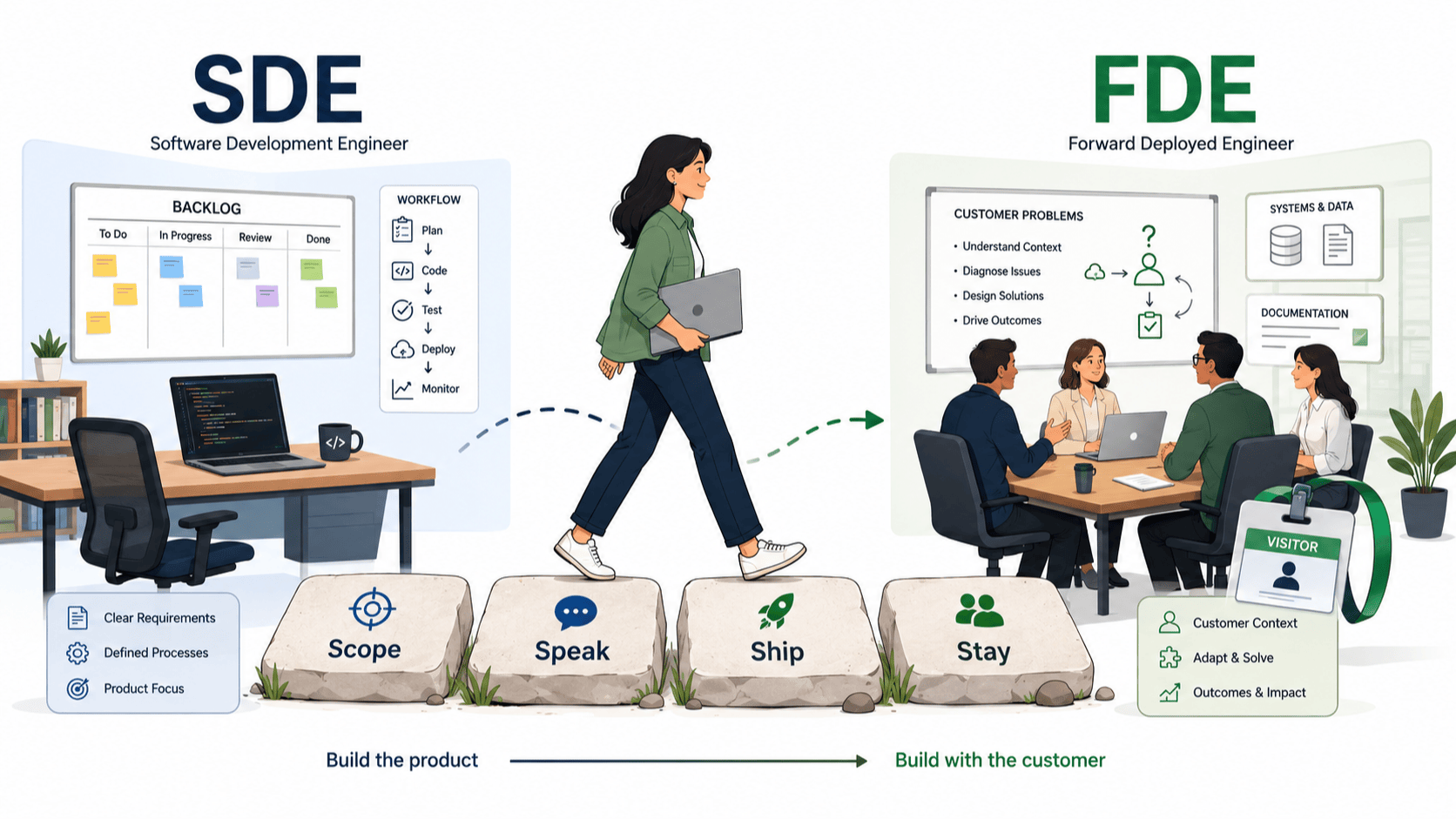
The SDE career ladder was built around a groomed backlog. The fastest-growing senior role in AI has no backlog at all — and crossing over is a skill you can practice from your current desk.The Move Is Cheap Right Now, and That Won't LastLook at the supply side, because that's the part career advice usually skips.FDE job postings grew more than 800% between January and September 2025, with Live Data Technologies putting year-over-year growth at 1,165%. The recruiting platform Paraform reports its own FDE postings up 350% year over year from Q1 2025 to Q1 2026. Palantir, which invented the role, is still scaling its FDE org; OpenAI, Anthropic, Google, Databricks and Scale AI are all hiring into it, and the fastest growth is at vertical AI startups — 59% of FDE-hiring companies on Paraform are Seed through Series A.Now, the number that actually matters. Back in 2024, postings grew about 300% while the candidate pool grew roughly 50%. Demand went up six times faster than supply, and nothing since has closed that gap.That's the whole opportunity. This is a senior-comp role where the applicant pool is still thin, because most engineers qualified to do it don't know the title exists or assume it's sales.A word on the salary screenshots you've seen, since they contradict each other and it's worth knowing why. Paraform's platform data shows FDE base salary clustering at $150K–$217K with an industry-wide median around $173,816. Perspective AI's analysis of ~1,000 postings shows mid-level total comp at $300K–$450K, senior at $450K–$550K, and staff or principal at frontier labs clearing $600K–$1.2M+. Both can be true: equity is now 55–70% of total comp at the top of the market, up from an estimated 35–45% in 2024. When you compare FDE offers, compare the same layer of the cake. A frontier-lab number is mostly equity; a Series A number is mostly a promise.An SDE is measured by whether the ticket closed. An FDE is measured by whether the customer's number moved.What Actually ChangesMost "SDE vs FDE" explainers list technologies. Wrong axis — the tech overlaps almost completely. What changes is where work comes from and what counts as done.SDEFDEWhere work originatesa groomed backloga room with a confused customer in itUnit of workthe ticketthe deploymentDefinition of donemerged, tests greena business metric movedPrimary riskbuilding it wrongbuilding the wrong thing, correctlyWho you optimize forthe codebaseone customer, then the productWhat kills youscope creepambiguity you never resolved out loudRead the second column again and notice how little of it is about typing. That's reflected in what companies now ask for. Across those ~1,000 postings, core engineering (Python or TypeScript, SQL, cloud, containers) appears in 95%+ and AI-specific work (LLM applications, RAG, prompt and eval workflows, agent orchestration) in 80%+ — table stakes you probably already have. The differentiator is the third bucket: customer discovery, requirements extraction, and stakeholder management now appear in over 70% of recent postings, and it's the fastest-growing requirement category in the role.That is a genuinely new demand on a senior engineer, and it's the one nobody trains you for.The Field LadderIn an earlier piece, I described what the role does as the Field Loop — Embed, Translate, Ship, Feed Back. This is the other half: what you have to become to get on that loop. Four rungs, in order, each with an SDE reflex you have to actively unlearn.RungWhat it isThe SDE reflex to unlearnHow to practice it MondayScopeFind the real problem before you write anythingWaiting for a groomed ticketTake the vaguest item in your backlog and go get the requirement yourself, from the person who wants itSpeakTranslate an architecture decision into something a CFO cares aboutExplaining the designWrite the one-pager, present it to a non-engineer, and watch exactly where their eyes glazeShipPut something live in weeks, and know what you're allowed to fakeBuilding it properlyShip a deliberately temporary version, then write the debt down in publicStayOwn it until the customer's number movesHanding off at mergeFollow one feature you shipped into production and read its actual usage dataScope is the rung that fails most SDEs, because the failure is invisible. Discovery isn't asking "what do you want?" — the answer to that question is always a feature request wearing a trench coat. It's extracting the requirement the customer has rather than the one they stated. A good FDE walks out of the first meeting knowing which of the customer's three complaints is the one their VP will be judged on, because that's the only one worth shipping in eleven days.Speak is the rung engineers dismiss as soft and then lose jobs over. One of the five competencies FDE employers screen for is literally translating a technical architecture decision into language a CFO cares about. This is learnable and mechanical: name the business risk first, the architecture second, the tradeoff third, and stop.Ship requires a permission structure most SDEs don't have internally. In a forward-deployed context, a messy solution that works beats a pristine architecture that doesn't, and the judgment being tested is which shortcuts are recoverable versus which ones damage the relationship. "Ship it, document the debt, migrate it at contract renewal" is a legitimate senior decision in this role. It gets you dinged in a design review at a product org.Stay is what separates the role from consulting, and it's the rung that makes it a career rather than a tour of duty. You don't hand off at merge. You stay until the thing you built is load-bearing for someone's job — and then you carry what broke back into the core product, which is where the Field Loop picks up.Figure 1: The Field Ladder feeding the Field LoopFour rungs — Scope → Speak → Ship → Stay — climbing into the Field Loop (Embed → Translate → Ship → Feed Back), with the Feed Back arrow leaving the loop into a box marked "Core Product." The ladder is how you get on the loop. The loop is the job.The reason to draw them together: an SDE who practices only Scope becomes an annoying PM, and one who practices only Ship becomes a contractor. The rungs only compound in order.What the Interview Loop Is Actually TestingFDE loops vary by company, but the same five tests keep showing up in hiring writeups for the role, and each one maps to a rung. Knowing what's being measured is most of the preparation.A 24–48-hour take-home integration build. Measures Ship. Speed and judgment outweigh elegance, and the documentation is scored as a proxy for customer communication. Candidates who spend 40 of the 48 hours on architecture fail this.Live system design with ambiguity injection. Measures Scope. Requirements shift mid-interview on purpose. Passing looks like asking clarifying questions before redesigning; failing looks like silently rebuilding.Operator behavioral questions. Measures Stay. Have two or three stories where you owned an outcome across a boundary nobody had assigned. Not "I led the project" — "ownership was unclear, and I shipped it anyway."Code review under fire. Measures judgment. You're handed deliberately flawed code and scored on triage: security and correctness first, nice-to-haves never. Finding every issue is not the win. Ranking them is.Customer roleplay. Measures Speak. Usually a frustrated VP with an unreasonable timeline. The goal isn't winning the argument — it's leaving the room with a next step and the relationship intact.Notice that only one of the five is a conventional coding exercise. If you prepare for this loop the way you prepare for an SDE loop, you will fail four-fifths of it while being an excellent engineer.The 90 Days You Can Do Without QuittingYou do not need permission to build this profile, and hiring managers in this role weigh portfolio and interview performance far above credentials. Compressed:Days 1–30 — build the artifact. Ship a retrieval-augmented system end to end against public data, and write the architectural decisions down as if a customer's CTO will read them. The decision log is the point; the repo is the container.Days 31–60 — manufacture customer reps in the job you already have. Volunteer for the technical walkthrough. Take the integration handoff nobody wants. Be the engineering voice on one call with a real stakeholder. This is the only rung you cannot practice alone, and it's the one that's in 70% of the postings.Days 61–90 — ship one integration against a real external API with a plausible enterprise use case, then write the brief for it. Compliance automation, document analysis, ticket routing — pick a domain where messy data is the actual problem.Then reframe the resume around what this role screens for: customer-facing technical work, ownership that crossed a functional boundary, and AI systems you deployed rather than trained. The typical successful candidate isn't exotic — it's someone with a few years of real engineering who kept volunteering for the solutions work nobody else wanted."Isn't This a Demotion?"Let's name the fear, because it's the real reason most qualified engineers never apply.The fear is that leaving core product engineering for customer-facing work is a step off the serious track. That you'll lose your depth, spend your thirties in airports, and come back in three years having written glue code and slide decks while your peers built the platform.Consider what got cheap. Code generation collapsed in cost. Producing a plausible implementation of a well-specified thing is now something a model does while you're in a meeting. I've argued before that vibe coding gets you about 80% of the way and that the remaining 20% is where all the real engineering lives — this role is what that last 20% looks like when it's a job title instead of a code review. What did not get cheap is standing in an unfamiliar business, figuring out which problem is worth solving, and being the person a nervous VP will let touch their data. Every rung on the Field Ladder is a judgment rung. Judgment is exactly the part that doesn't compress into a prompt.So the depth question inverts. FDEs are frequently the highest-context people in the building — they've watched the product survive contact with fifty different realities, which is knowledge that exists nowhere in the codebase and cannot be read off a dashboard. That's why the role feeds promotions. You're not leaving engineering. You're moving to the end of the pipeline where the remaining hard problems live.The hardest part of the job isn't the code. It's that nobody will tell you what to build.The TakeawaySDE isn't dying, and FDE isn't a rebrand of solutions architect. What happened is narrower and more useful: the industry discovered that the scarce skill in deploying AI is not building the system; it's closing the distance between a capable system and one specific company's mess — and it started paying senior money for people who can do that without a ticket.The ladder is short. Scope, Speak, Ship, Stay. You can climb three of the four rungs from the desk you're sitting at, this quarter, without telling anyone.The ticket queue was never the job. It was just the part of the job somebody else had already decided for you.
SDE to FDE: The 4 Skills That Matter More Than Coding
Full Article
Original Source
Read the full article at Hackernoon →KhanList aggregates and links to publicly available news content. We do not host full articles from third-party sources. Always verify important information with original sources.