
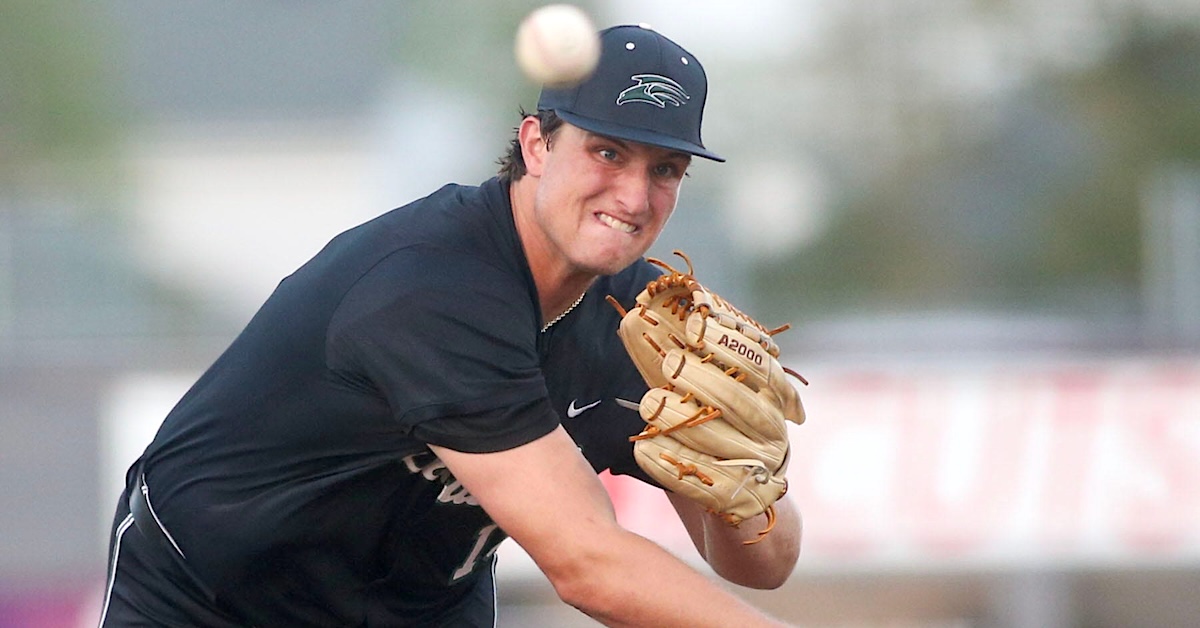
USA TODAY Network via Reuters Connect Late last week, I arrive at Peoria, on the opposite corner of the Phoenix Metro, where Padres first-round pick Coleman Borthwick is making his uniformed debut against the Rangers. I’ve settled on “uniformed debut” rather than “pro debut” for these kinds of box score-free backfield outings that precede the player’s first real game at an affiliate. The second I walk across the threshold between the parking lot and the field, I spot Ramón Laureano playing catch with a softball, and then with a regular baseball. He looks incredibly strong, like he’s taken outstanding care of himself as he rehabs from a labrum tear. I’m one of the first interested parties here, with former big leaguer Ernie Young among the scouts who have beaten me to the field. Several Padres players and personnel make their way behind home plate, including Lucas Giolito, whose upper arm/tricep hair rivals that of your author’s. Borthwick takes the field and looks enormous, like an SEC tackle. I hear one of the Padres folks say he weighed in at 295 pounds when he signed. I had him listed, pre-draft, at 255, 10 pounds heavier than he’s listed at on his actual MiLB player page. Borthwick isn’t carrying 295 like Myles Garrett, but he also isn’t carrying it like Alek Manoah, at least not yet. He’s barrel-torso’d and has tree trunks for thighs tapering down to skinny calves and ankles, maxed out but not ill-composed. I could see him looking like Lance Lynn at maturity, which obviously isn’t dispositive given how Lynn’s career panned out. This is going to be a one-inning look at Borthwick, so the eight or so scouts here are locked in to every breath he takes for the next 10 minutes. Someone in the Padres dugout with an aux cord and makeshift PA system is handling walkup and warmup music. Borthwick warms up to NBA YoungBoy’s “Make No Sense” — which I like but have to Shazam to identify — and throws four-seamers, a two-seamer, and a couple of sliders as he gets loose. These pitches turn out to be important to monitor because Borthwick throws all fastballs until the final pitch of the inning. He sits 92-95 across the entire frame (mostly 93-94, touching 95 twice with 95.8 his apex), usually with around 15 inches of vertical movement and about 9 inches of horizontal break. The tablet I’m looking at over a baseball ops intern’s shoulder does not have “extension” on its pitch data dashboard, but Borthwick’s looks short for an athlete of his size. Borthwick blows away his first hitter with fastballs, induces a groundout from the second, then surrenders an opposite-field double to Braulio Cavero, a 20-year-old Mexican outfielder who slashed .413/.529/.680 in the DSL before a late-summer promotion to Arizona. In four looks at Cavero, I still haven’t seen him pull the baseball. Borthwick’s mechanical consistency is impressive for his size. He attacks hitters with both versions of his fastball until he has two strikes on 2025 Rangers high school draftee, Jack Wheeler. On his final pitch, Borthwick serves Wheeler a hellacious 83-mph slider with fantastic two-plane movement and depth. It garners an ugly whiff, the inning ends, and I write and underline, “SLD 83 (60)” in my notebook. Here’s his outing: A couple innings into the game, I learn the Padres have only four innings’ worth of pitching available, and that we’ll have a co-op style scrimmage for the final few innings; Texas will have a guy pitch against his own teammates while San Diego fielders play defense. Then we’ll change sides like usual and a Rangers pitcher will face (mostly) Padres hitters. Here is a brief glimpse of what that looked like: You Aren't a FanGraphs Member It looks like you aren't yet a FanGraphs Member (or aren't logged in). We aren't mad, just disappointed. We get it. You want to read this article. But before we let you get back to it, we'd like to point out a few of the good reasons why you should become a Member. 1. Ad Free viewing! We won't bug you with this ad, or any other. 2. Unlimited articles! Non-Members only get to read 10 free articles a month. Members never get cut off. 3. Dark mode and Classic mode! 4. Custom player page dashboards! Choose the player cards you want, in the order you want them. 5. One-click data exports! Export our projections and leaderboards for your personal projects. 6. Remove the photos on the home page! (Honestly, this doesn't sound so great to us, but some people wanted it, and we like to give our Members what they want.) 7. Even more Steamer projections! We have handedness, percentile, and context neutral projections available for Members only. 8. Get FanGraphs Walk-Off, a customized year end review! Find out exactly how you used FanGraphs this year, and how that compares to other Members. Don't be a victim of FOMO. 9. A weekly mailbag column, exclusively for Members. 10. Help support FanGraphs and our entire staff! Our Members provide us with critical resources to improve the site and deliver new features! We hope you'll consider a Membership today, for yourself or as a gift! And we realize this has been an awfully long sales pitch, so we've also removed all the other ads in this article. We didn't want to overdo it. This is a creative solution to an increasingly common problem, one I’ve written about ad nauseam for the last couple of years. Domestic roster reserve limits put pressure on pitching up and down teams’ systems, and especially down on the complexes where players are constantly being sent out to affiliates as injury replacements. The warm bodies only flow in that direction, though, not back to the Complex League. We end up with a lot of position players pitching down here, or (in the case of scrimmage/developmental settings like Extended Spring Training and Bridge League) we get canceled games. Teams end up playing impromptu intrasquad games or take live BP. It can get monotonous. This cooperative setup creates something closer to a real game environment. Together, the teams have enough arms for a six-inning game, which is better than a three-inning intrasquad. More Debuts On Saturday, the Giants drive to North Scottsdale to face the Rockies, with two of their high school draft picks from this year’s class set to make their uniformed debuts: lefty Carson Bolemon and righty Kaden Waechter (Doug’s son), both of whom signed for a bit more than $3 million. Bolemon was a Wake Forest commit from South Carolina before he was drafted 29th overall, while Waechter was committed to Florida State before the Giants took him with the 55th pick. Bolemon gets a bunt groundout on his first pitch and then quickly induces grounders to the right side of the infield against the next two hitters. His fastball sits 92-93 and he liberally folds in cutters in the 86-89 range. Despite showing a curveball and changeup during his warmup, Bolemon navigates his inning so fast that he throws neither of them in the actual game. His inning is so quick and easy that those of us in the scouts section are hoping we’ll hear, “Stay out there!” from the Giants dugout so we can get an opportunity to see a few more pitches. Though he doesn’t have premium arm strength, Bolemon has a short, deceptive arm stroke, and his cutter breaks late. He is forced to come off the mound and play some defense on each of the three balls in play, and looks quick and athletic doing so. This isn’t a long enough outing to write a full, fresh report on Bolemon, but it is a positive first impression of his athleticism and ability to throw strikes. Waechter, on the other hand, struggles in his outing. His fastball has vulnerable movement despite sitting 94-95 for the bulk of his inning. His cutter is firm (87-89 mph here), and some of his changeups have a ton of lateral movement, but Waechter isn’t getting into counts where he can use it. If there is a tangible thing to be concerned about after this first appearance, it’s that his fastball movement looks hittable. Many of his heaters have roughly the same amount of vertical movement as they do horizontal, in the “dead zone” that tends to run right into barrels. His fastball is generating plus-plus miss on the showcase circuit, so this is a data point to revisit early next year when he has generated more pitch data at an affiliate. A few Giants hitters show out in this one. This is my third Joniel Hernandez game, and he’s done exciting stuff each time. Below, he turns on a chest-high fastball and singles to left. This is a much more physical, hard-swinging infielder than is typical for this age, and his ability to turn on a pitch like this is very encouraging. Two batters later, rehabbing outfielder Jakob Christian (who was striking out at a 33% clip in the Northwest League this year) vaporizes a fastball on the inner half. He’s physical and has huge juice, but his strikeouts against age-appropriate competitors are a red flag. Here are those swings:
Scouting the Uniformed Debuts of Early-Round Padres and Giants Draft Picks
Full Article
Original Source
Read the full article at Blogs →KhanList aggregates and links to publicly available news content. We do not host full articles from third-party sources. Always verify important information with original sources.