
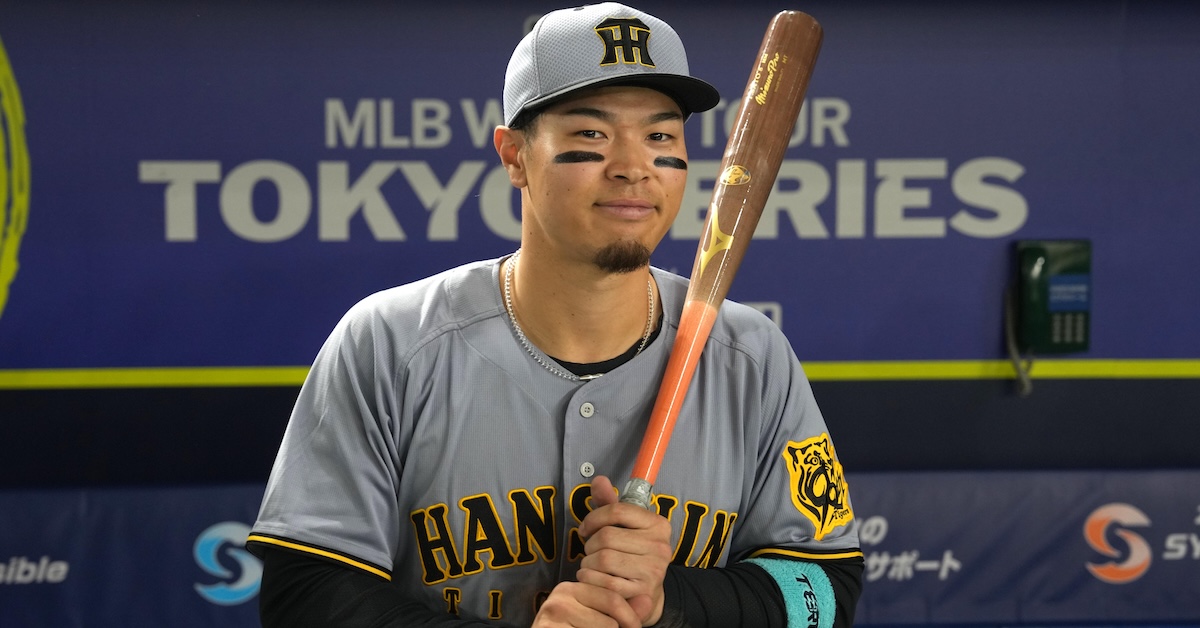
Darren Yamashita-Imagn Images With the 2026 season in the books and a narrow window of transaction time upon us before an inevitable lockout, it’s time to start a new player evaluation cycle at FanGraphs. This includes 30 farm system deep dives, and updates to next year’s domestic draft and international amateur scouting reports on the site. But first, as has become tradition, it’s time to examine the notable pro players in Asia. Every offseason there are several fellows who are either native Asian players attempting to make a transition to MLB, or former MLB-affiliated players who are attempting to come back after some time abroad. Players in both camps tend to make a meaningful impact on the following MLB season, be it Munetaka Murakami, Foster Griffin, Kazuma Okamoto, Robert Suarez, or Drew Anderson. My goal at the start of every offseason is to give readers a thorough report on the players whose matriculation is imminent, as well a spyglass look at who lies over the horizon. In this piece I’ll have the players clustered into buckets dictated by their anticipated arrival and write a bit about them in each section, but my preferential list of all the players and their full scouting reports are over on The Board. You should open The Board (seriously) in a new tab and traffic back and forth between it and this article. Also, remember we now have NPB and KBO leaderboards on the site, which I used heavily (along with DeltaGraphs and Yakyu Cosmopolitan) to sift through statistics and flag players to ask my sources about and/or perform my own visual scouting assessment via Synergy or TruMedia, whatever I can get my hands on. To give readers as thorough an understanding as possible, I’ve got video linked and embedded throughout this post for the players I think are most visually striking. Here are the rules for true NPB/KBO free agency and the posting systems. I tend to project players’ ETAs for immediately after they’re exempt from MLB’s amateur bonus pool, because it’s rare I have actionable intel from team sources multiple years out. Teams send scouts and front office personnel to Asia with scouting targets whose matriculation might be a couple years away, in addition to the couple of guys we tend to know are coming over. This helps me collect names before Brendan Gawlowski (who worked on KBO players for this exercise) and I start scouring data for more. There is an increasing trend of the elite Japanese amateurs either opting to play college ball in the U.S., or who are signing deals as international amateurs when they’re done with high school. Currently, teams are courting teenage righty Shoki Oda, who doubled down on his desire to skip NPB and come to the U.S. even after the Tokyo Giants made him their first-round pick two weeks ago. The bonus for the top picks in NPB’s draft tends to be right around $600,000, which is part of why the best teenagers are leaving. Even in international amateur free agency where the best players are getting less than the top domestic draftees, Oda will command a seven-figure bonus. He’s talented enough that he’d be a virtual lock to go in the first round of the domestic draft and get a bonus in the $3-4 million range. My sources tell me Oda is more likely to sign after the new international signing period begins in 2027 rather than try to sneak in before the end of 2026. It means we’ll likely have dominos fall like we did with Roki Sasaki, where the Dodgers had to break agreements with other players to sign him, and other teams with uncommitted money were able to benefit as they scrambled to see and agree to terms with the players Los Angeles cut loose. There’s a high school pitcher who might opt for a similar track next year, though that delivery is not as clean as Oda’s. I think there’s some risk that a version of what has happened to the talent pool in Cuba might befall Japan, as the players coaxed to North America are getting younger and younger over time, but that’s another article. Let’s scout. At Length on Teruaki Sato and Kaima TairaYou Aren't a FanGraphs MemberIt looks like you aren't yet a FanGraphs Member (or aren't logged in). We aren't mad, just disappointed. We get it. You want to read this article. But before we let you get back to it, we'd like to point out a few of the good reasons why you should become a Member. 1. Ad Free viewing! We won't bug you with this ad, or any other. 2. Unlimited articles! Non-Members only get to read 10 free articles a month. Members never get cut off. 3. Dark mode and Classic mode! 4. Custom player page dashboards! Choose the player cards you want, in the order you want them. 5. One-click data exports! Export our projections and leaderboards for your personal projects. 6. Remove the photos on the home page! (Honestly, this doesn't sound so great to us, but some people wanted it, and we like to give our Members what they want.) 7. Even more Steamer projections! We have handedness, percentile, and context neutral projections available for Members only. 8. Get FanGraphs Walk-Off, a customized year end review! Find out exactly how you used FanGraphs this year, and how that compares to other Members. Don't be a victim of FOMO. 9. A weekly mailbag column, exclusively for Members. 10. Help support FanGraphs and our entire staff! Our Members provide us with critical resources to improve the site and deliver new features! We hope you'll consider a Membership today, for yourself or as a gift! And we realize this has been an awfully long sales pitch, so we've also removed all the other ads in this article. We didn't want to overdo it. In case you didn't read all that, here's the short version. Membership includes:✓Ad-free browsing✓Unlimited FanGraphs & RotoGraphs articles✓Historical & platoon projections✓Leaderboard & player-page stat heatmaps✓One-click data exports✓Customizable player-page dashboards✓Dark & Classic site modes✓Weekly Members-only mailbag✓FanGraphs Walk-Off, your year in review✓Optional homepage photo removal✓Gift articles to non-Members✓Full postseason coverage Teruaki Sato, 3B/RF, Hanshin Tigers Sato was arguably the best prospect in NPB’s 2020 draft, as four teams put his name in as their first-round nominee (an uncommonly high number), with Hanshin winning the lottery for his rights. A college draftee, Sato broke camp with the big club right away in 2021, and had a strikeout-prone (38%) rookie season, followed by three more stable years, and then finally an enormous power-hitting breakout in 2025. For the last two seasons, Sato has averaged 40 homers and 80 extra-base hits. He won the NPB MVP in 2025 and, after notching the first triple crown since Munetaka Murakami in 2022, is the presumptive favorite to win it again in 2026. Sato has show-stopping low-ball power, at times rotating with full-body verve and huge finish behind him, while at others relying purely on the strength in his hands to do damage. He’s powerful enough to inside-out fastballs the other way for doubles, but most of his slugging damage comes via pull-side contact against softer stuff that doesn’t quite finish below the zone. All of Sato’s 2026 power metrics reinforce his visual scouting report and are plus across the board; 56% hard-hit rate, 108 EV90, and 116 max. He has 30-homer MLB power. Will he make enough contact to weaponize it? Sato had a 67% contact rate in 2026, both overall and against fastballs. The fastball miss is of particular concern, as Sato swings through fastballs at the same rate Cam Schlittler’s heater misses bats, up above 30%. His swing doesn’t allow him to cover a lot of pitches up and away from him, including in a big chunk of the strike zone. There are only a couple productive third basemen from the past few years with sub-70% contact rates. Nolan Gorman (66%), Jake Burger (69%), and Mark Vientos (69%) are the only three, while Kazuma Okamoto, Ryan McMahon, Max Muncy and Eugenio Suárez are all right at 70%. Here is a data rundown of third basemen since 2023, and you can see most of the good ones don’t whiff nearly as much as Sato does. There is, however, a growing number of successful sub-70% contact rate hitters in MLB, including Munetaka Murakami (60%, lowest in baseball), whom I had bust concerns about last year. So long as Sato is getting to big power (which he seems likely to do, as he’s on time enough to make airborne pull-side contact) he should be a useful, if flawed, offensive player who can hit in the heart of a good batting order. Sato’s defense is also a bit flimsy. He struggles with throwing accuracy from third base and at times with high hoppers, though Hanshin has a unique, all-dirt infield that makes it tougher to assess infielders. Sato’s a fine athlete capable of making some tough plays as he goes to the ground, and his max-effort arm strength is more than sufficient for third base (and right field, his other position), but teams are going to live with him being prone to errant throws if indeed he plays only third base. More likely he should play both third base and right field (he’s below average at both spots), wherever the ball is less likely to be hit that day. For what it’s worth, Hanshin seemed to prefer Sato at third base, as the last time he played the outfield was on July 28. Does all of this add up to an impactful player? It’s not without risk, but probably yes. Though Sato isn’t a five-tool superstar – he’s going to strike out a lot and play below-average defense – he should hit for enough power to be a productive, heart-of-the-order power hitter with 25-30 home runs, and though he’s not a great fielder, he is somewhat versatile. Kaima Taira, SP/RP, Saitama Seibu Lions Taira was a nasty power reliever from 2019 through 2022, then dealt with stuff regression and forearm issues in 2023 and 2024, respectively, when the Lions first tried to move him into the rotation. When he returned from the forearm injury late in 2024, he was again used in relief; his velocity rebounded into the 95-99 range, and he was left in the bullpen in 2025. Taira entered 2026 having never thrown more than 60 innings in a single season, but the Lions again gave him another shot in their rotation, and he responded by working 146 regular-season innings and maintaining his velocity into the postseason. At a catcherly 5-foot-8, 220 pounds, Taira is a freaky, mold-breaking athlete with remarkable arm speed and pitchability considering how much effort it takes for him to throw as hard as he does. For a stout little guy, his stride down the mound is enormous. This drop-and-drive style delivery creates a flat angle on Taira’s elevated pitches, giving him the ability to miss bats at the belt with his fastball. Taira has pitches that finish in all four quadrants of the zone. He can elevate his fastball, which averaged 95 mph and touched 99 in 2026, to his arm side, and mix in sinkers and changeups below that. To his glove side, he can command a low-90s cutter around the hands of lefty batters, and his slider finishes beneath them. His splitter, the pitch that garnered the most whiff and chase for him in 2026, drops beneath the zone entirely and should be a plus big league pitch. He fields his position well and exudes poise and confidence on the mound. The risk here is that Taira has had just one healthy and productive season as a starter, and now MLB teams targeting him have to decide whether they think he can repeat it. If he can, he’ll be a mid-rotation starter. While I’d draft Sato ahead of Taira if that were the means of acquisition, in a free agent market I’m more likely to be competitively priced for Taira than I am for Sato, because I’m fearful of Sato’s floor (in which his outcome looks more like Yoshi Tsutsugo rather than Murakami because of all the strikeouts), whereas Taira’s perceptible floor (a late-inning reliever on a contender) is still pretty exciting. Other Players Attempting an MLB Transition Hiromi Itoh, SP, Hokkaido Nippon-Ham Fighters Si-hwan Roh 노시환, 3B/1B, Hanwha Eagles As I wrote for the site’s top 50 free agents post, Itoh’s stuff is pretty light. He’s durable (at least 146 innings pitched in every year since 2021) and throws strikes (fewer than two walks per nine innings in each of the last three years), but he sits 92 mph and generates roughly average-or-below miss and chase on all of his pitches. He’s a high-floored backend starter, but he’s not the type of guy who moves the needle on a postseason staff. Roh is in an interesting spot because he recently signed an 11-year, approximately $23 million deal with Hanwha that kicks in next season. His deal includes a provision that he’ll be posted this offseason and that, if he signs with an MLB team and then later goes back to the KBO, he’ll return to the Eagles. MLB teams have a pretty good idea of what kind of deal it would take to incentivize Roh’s transition; something shorter term but with a sufficiently high AAV to offset whatever money he gives up later due to the exclusivity clause with Hanwha should his original contract be voided. If Hanwha and Roh have a handshake agreement in place to strike a new deal at the same AAV as his looming 11-year contract dictates, then he’s more likely to sign. Despite his power, Brendan doesn’t think Roh will hit enough to justify a significant big league role, and if we had to guess we’d say he’s more likely to return to Korea. Additional Players Sources Told Me To Keep Tabs On Shugo Maki, 2B/1B, Yokohama BayStars Hiroto Saiki, SP, Hanshin Tigers (video) Andrés Machado, RP, Orix Buffaloes (video) Darwinzon Hernández, LHP, Fukuoka SoftBank Hawks Austin Dean, 1B, LG Twins Late during the regular season, a couple of my sources mentioned Maki and Saiki as potentially being posted. Maki projects as an everyday second baseman in the Brandon Lowe mold, and you could make a pretty good argument that his hit-tool stability (Maki has a single-digit miss rate against fastballs compared to Sato’s whopping 32%) makes him a superior “prospect” when compared to Sato, and I have Maki first on The Board right now. Next year will be his seventh NPB season, so the clock is ticking for Yokohama to recoup a posting fee for losing him. It’s my educated guess that he’ll be posted during one of the next two offseasons. Saiki, who led NPB in strikeouts in 2026, requested to be posted last offseason but was not. Teams tend not to post multiple players in the same offseason, so Sato’s posting all but ended Saiki’s chances of coming to MLB this offseason, even before more recent scuttlebutt that he indeed would not be. Foreign pros are no longer subject to the posting system after nine seasons in foreign leagues. Saiki has been a pro since 2018 (nine years ago) but didn’t pitch in 2021 while recovering from Tommy John surgery, so perhaps that’s why he’s still subject to posting restrictions. I’d bet on him matriculating next year. Machado and Hernández are former MLB relievers who might be in demand on our shores again. A former National and Royal, Machado got better in Japan. Sources have cautioned me that his fastball will be more hittable with the MLB ball, but he throws really hard, has a great changeup, and starred for Venezuela during this year’s WBC. Hernández has gotten heavy, but changes to his delivery (he’s a super short strider now) have made the angle of his slider really tough on lefties, and he’s still sitting 95. Former Marlin and Cardinal Austin Dean has hit well in Korea for four seasons and is coming off a 41-homer, 1.062-OPS campaign. Brendan is skeptical that he’ll hit enough to transition back. He’s made about $1.5 million in each of the last few years. Could Be a Big Deal Soon Rui Muneyama, SS, Rakuten Golden Eagles (video) Do Yeong Kim 김도영, 3B, KIA Tigers (video) Shunpeita Yamashita, SP, Orix Buffaloes (video) Taisei Ota, RP, Tokyo Yomiyuri Giants (video) Been Gwak 곽빈, SP, Doosan Bears (video) Muneyama and Kim are only 23. Muneyama has been a well-regarded prospect since before he was drafted and looks as though he’s going to deliver on the hype. He’s a potential five-tool shortstop who does a bit of everything well. Kim returned from an injured 2025 to hit .308/.413/.647 with 45 homers in 2026. He has plus-plus power and speed, but might not make enough contact for it to matter. Brendan is more optimistic about Kim’s power translating than I am. Next year will be his sixth pro season and he’ll be eligible to be posted without being subject to the amateur bonus limitations after 2028, when he’ll be 25-years-old. Muneyama was drafted out of college and next year will only be his third pro season, so unless he takes the Roki Sasaki track and comes over sooner, Muneyama is more likely in play at the end of the decade. Yamashita, 24, has been injured or wild for most of the last few years. At his best, the 6-foot-2 power-pitching prototype will touch 100 and bend in plus-plus, 2,900-rpm breaking balls. Prior injuries to his back led to mechanical tweaks entering 2026 to take some pressure off of it, and then with the new delivery his elbow barked and he had internal brace UCL surgery. Ota, 27, also missed much of 2026 with elbow issues. He’s a future MLB closer with a delivery that looks like Paul Sewald’s, except he sits 96-98 and has touched 100. He’ll have accrued six years of service in NPB after next season and is, at least at this stage, the big name to file away for next offseason. Gwak has maybe the best stuff of the Korean arms and is creeping up on true free agency, so Doosan may post him next year. Are You in a Crazy Dynasty League? Taisei Kudo, RP, Hanshin Tigers (video) Ju Won Kim 김주원, SS, NC Dinos (video) Taiga Kojima, C, Saitama Seibu Lions (video) Dong Ju Moon 문동주, SP, Hanwha Eagles (video) Woo-jin An 안우진, SP, Kiwoom Heroes (video) Jo-Hsi Hsu, MIRP, Fukuoka SoftBank Hawks (video) Sowa Yokota, 3B, Saitama Seibu Lions (video) Yi-Lei Sun, RP, Hokkaido Nippon-Ham Fighters (video) Kudo, 25, initially went undrafted in 2023 and then had such a huge velo spike that, a year later, he became Hanshin’s first-round pick. He is a supreme athlete whose fastball touches 101. He needs to develop a starter’s stamina and flesh out his secondary pitches, but he’s gotten so good so fast that it’s likely he’ll keep improving. Because his career got off to kind of a late start, he’s likely not going to come to MLB for a while. Kim is Korea’s less powerful version of Muneyama, a really good all-around player and compact switch-hitting shortstop who seems less likely to have meaningful power at peak. Kojima is an athletic 23-year-old catcher with exciting bat speed. Moon is about to turn 23 and, though his stuff was down a tick in 2026, has been up to 100 in the past and has a starter’s frame and delivery. Ahn has dealt with a myriad of off-field issues and injuries (too much to recount here, go read his blurb), but showed something close to his best stuff again in 2026. Hsu is a Taiwanese pitcher who, at his best, has looked like a really nasty long reliever. He had a herniated disc in 2026. Yokota was a fifth rounder out of high school in 2025 and led Japan’s minor leagues in hitting in 2026. Sun is a Taiwanese lefty who came to pitching late in high school. Now he’s 21 and bumping 98. Players Who Probably Won’t Ever Transition Livan Moinelo, SP, Fukuoka SoftBank Hawks Raidel Martinez, RP, Tokyo Yomiyuri Giants These Cubans have both established themselves as among the best pitchers in NPB. Moinelo has now won six championships with Fukuoka SoftBank since joining them in 2018, the last two as a starting pitcher. At his peak, he looked like a reliable no. 3 in MLB. After two healthy years in the rotation, Moinelo (who had more serious arm issues several years ago) dealt with a shoulder injury and missed several months of 2026. When he returned late in the year, his velo was down about a tick and a half and closer to three ticks beneath his peak. His apex window has likely come and gone. Martinez, too. He looked like a setup man or closer at his peak, but his strikeout rate has been in the 27-31% range the last three years, beneath the 33-35% range of his pinnacle. This might be the last year these fellas are on the International tab of The Board if these trends continue. They’ve both had remarkable careers. Everyone Else on The Board I’m listing everyone who I haven’t mentioned yet, but who is on The Board, so that they can get tagged in this post and a link to this article will appear on their player pages. You’re encouraged to go read their scouting reports over on The Board. Included in here are several pitchers who could have a no. 4 starter impact in a few years, a Dominican righty who was released by the Cardinals just after the pandemic and has resurfaced as a good relief prospect, a hard-throwing lefty who was the youngest player on Mexico’s WBC roster but is struggling to stay healthy in Japan, and several other prospects who the sickest of sicko readers will want to know about. Hiroto Takahashi, SP, Chunichi Dragons Tatsuki Mizuno, SS, Hokkaido Fighters Haruto Inoue, SP, Yomiuri Giants Chihiro Sumida, SP, Saitama Lions Shota Morishita, RF, Hanshin Tigers Rito Kinoshita, SIRP, Hanshin Tigers Atsuki Taneichi, SP, Chiba Lotte Marines Shion Matsuo, C, Yokohama BayStars Hiroya Miyagi, SIRP, Orix Buffaloes Hansel Marcelino, SIRP, Yokohama BayStars Taek Yeon Kim 김택연, SIRP, Doosan Bears Jyun-Yue Tseng, SIRP, Fubon Guardians Hyeong Jun So 소형준, SP, KT Wiz Shuto Ogata, SIRP, Yokohama BayStars Alexander Armenta, SIRP, Fukuoka Hawks Zach Logue 잭로그, MIRP, Doosan Bears Riley Thompson 라일리, MIRP, NC Dinos Ryusei Terachi, 3B, Chiba Lotte Marines Seong-pin Yoon 윤성빈, SIRP, Lotte Giants Baek-ho Kang 강백호, 1B, Hanwha Eagles Woo Joo Jeong 정우주, SIRP, Hanwha Eagles Still More Names None of the following players are on The Board, they’re deeper cuts who I want to bookmark for myself so I have a good foundation when I do this exercise again 12 months from now. You’re welcome, Future Eric. My God, you’re handsome. I have a slew of other interesting players listed below; team-by-team for the NPB guys and a handful of Koreans below them. Think of these like the “Others of Note” section you’d see on a prospect list. Fukuoka SoftBank Hawks Yugo Maeda, LHP There were only two pitchers under 23 years old in all of NPB who worked 100 or more innings in 2026, and Maeda (who was only 20) was one, with 111 innings pitched. Fukuoka SoftBank’s first rounder in 2023, Maeda is an athletic mover and throws a ton of strikes, but sits 88-92 and only generates plus miss with his splitter. Saitama Seibu Lions Natsuo Takizawa, SS Shinya Hasegawa, 1B/OF Shinnosuke Hada, LHP Jorge Gonzalez, RHP An Ko Lin, LF Takizawa is a little 23-year-old shortstop with plus contact ability but almost no power. There are players like him on the fringe of big league rosters (think Andrew Velazquez) and players like this aren’t exactly dying to come to MLB to play that kind of role when they can get paid to play every day in Japan. Hasegawa had a power-hitting breakout in 2026, his age-24 season, but he’s successfully selling out for pull power in a way I don’t think would play against MLB breaking balls. He has uncommon physicality for an NPB hitter and is versatile, with many games at all three outfield positions and first base. Hada is a slender 22-year-old southpaw who has really struggled with walks for nearly a half decade of pro ball, and he only worked eight innings in 2026. But in his peak form, he’s a lefty with nasty breaking stuff and who sits 96-97, so let’s monitor him as he enters his mid-20s. Gonzalez, 24, used to be in the Dodgers system and now is a hard-throwing minor leaguer for the Lions who sat 96 across 15 farm innings in 2026. He was the hardest-throwing pitcher who didn’t sniff Japan’s top league. I put Lin on here to use as a barometer of sorts. The 29-year-old Taiwanese outfielder was one of the CPBL’s best hitters for over half a decade, but slashed just .220/.294/.381 in his first NPB season, which is a 98 wRC+. Yokohama BayStars Ryuki Watarai, RF Koichiro Oda, 3B/1B Watarai, 24, is a gifted contact hitter who has started to develop enough power for his hit tool to play at his actual skill level, rather than below it. Thrust into NPB’s big league at age 21, Watarai has never run a strikeout rate above 15.8%, but his contact has been so light that he hadn’t hit above .251 until 2026, when he slashed .274/.334/.380 and got some early-season exposure to third base. He could be a Sal Frelick or Ryan Sweeney type of hitter who makes enough contact to be good even though he doesn’t slug much, and now we wait to see how strong Watarai can get in his mid-20s, or if he can actually add third base to his profile (he looks fair there on tape). Oda, 23, was Yokohama’s 2025 first rounder and is a stout lefty contact bat who was among the most productive hitters in the minors during his debut season. Rakuten Golden Eagles Shoma Fujihira, RHP Fujihira, 27, has struck out at least a batter per inning as a reliever in each of the last three years, and became Rakuten’s full-time closer in 2026. He has a plus splitter, sits 94-95, and throws strikes. His fastball has some “round down” elements, but he could probably be a solid middle reliever if he ever matriculates to the U.S. Hokkaido Nippon Ham Fighters Haruki Hosono, LHP Reo Shibata, RHRP Kota Tatsu, RHSP Daiki Shimizu, RHP Taisei Yanagawa, RHRP Ren Fukushima, RHRP Kane Edokpolo, OF Junki Shibuya, LHP The Fighters have a relatively young pitching staff full of guys with traits that indicate they might one day really pop, but as of yet, they have not and they are merely worth following. Hosono is the most athletic of them, with a loose arm and drop-and-drive delivery that helps him elevate his fastball. It also makes it tougher for him to get on top of his slider and splitter, which tend to have more lateral movement than depth. He’s 24 and sitting about 93, but is athletic enough to project for better command and secondary consistency. He has the most favorable starter forecast of this group. Shibata, 20, had a velo spike in the middle of the year and was ripping fastballs at 96-97 mph in September compared to 94-mph heaters throughout the season. If he can hold that into next year, the 2024 first rounder will make the main section of the list. Tatsu, 22, has MLB starter size at a broad-shouldered 6-foot-4, and good arm strength (sitting 93, up to 98) but pedestrian secondary stuff and below-average athleticism. He worked 124 innings in 2026 and, stamina-wise, has demonstrated way more than the other same-aged NPB arms. Shimizu, 20, is the protozoan version of this profile who threw about 30 innings in the farm league. He’s 6-foot-4 and sits 93. Tanagawa, 22, is a fastball-heavy (70%) reliever who sits 95 and will touch 98, but the rest of his repertoire is below average. Fukushima, 23, is similar at a spindly 6-foot-3, up to 97, but with an uglier delivery and worse command. All of these guys could use better strength and conditioning programs to build up their lower bodies. Hokaaido has the deepest group of interesting young arms in NPB by a lot. Edokpolo, 23, is the younger brother of 6-foot-8 undefeated Japanese MMA heavyweight, King Edokpolo. Both boys were born in Japan to Korean and Nigerian parents. Kane is a huge-framed outfielder who was one of the farm league’s most productive hitters despite striking out 30% of the time because he has so much power. He’s the new Julian Tima (whose feel to hit has sadly regressed) at this website. Shibuya, 19, spent the entire year in the minors, where he held opponents to the lowest contact rate (59%) of any pitcher with at least 20 innings pitched. He creates tunneling ride on his 89-90 mph fastball and depth on his curveball, but he lacks the physical projection to throw harder and needs to curb his walks. He’s a data-driven follow for the time being. Yakult Swallows Hideki Nagaoka, SS Souma Uchiyama, 2B/OF Ruito Nishimura, LF Yakult allocated a lot of playing time to younger position players, much more than most other NPB clubs, but none of them played especially well. Nagaoka, 25, is the most established of them, and has been the Swallows’ everyday shortstop since 2022. He has genuinely great barrel feel, and a much more discerning eye than the average NPB hitter. Snappy hitting hands and barrel precision make him an exciting contact hitter (11-13% strikeout rate in each of the last several seasons), but Nagaoka is less of a shortstop than the other speedy little NPB infielders. He’d become really interesting if he leaned into getting strong and wound up at second base. Uchiyama has played catcher, outfield, and (in 2026) second base, and was one of Yakult’s five most productive hitters at age 24 Nishimura, 22, has good lefty power, but he struck out at a 27% clip in 2026. Hanshin Tigers Ryosuke Jingu, RHP Masahiro Tateishi, 3B/LF Jingu, 23, is a supremely athletic sidearm righty who split his first pro season between the farm league and big league, and worked 20 innings of 2.21-ERA ball in the latter. This is a classic “look” reliever in the Brad Ziegler mode, as Jingu commands a horizontal attack with a low-90s fastball and low-80s slider. He makes it tough to cover both sides of the plate in the extreme, and locates well enough to thrive even though he doesn’t throw hard. Could there be a changeup here one day, too? Or a velo spike? Jingu has a well-composed frame and is an athletic mover, so there’s a chance for either or both of those. Tateishi was several teams’ first-round pick nominee in 2025, but he had a sketchy debut season in which he struck out in 32% of his Central League plate appearances and in 26% of his farm league tries. The 23-year-old has power, but it doesn’t look like he’s going to hit, or at least his feel to hit is too crude right now for me to do more than mention him. Hiroshima Toyo Carp Daisuke Moriura, LHP Moriura is a 28-year-old low-slot lefty with some of the best swing-and-miss data in NPB, with a paltry 62% contact rate allowed. This is thanks to his funky mid-80s changeup, which plays a huge role in his strike-throwing efforts because his fastball (92-94 mph) command is more scattered. He could be a good MLB reliever, but I have reservations about his command, enough to keep him here rather than on the main section of The Board. Chiba Lotte Marines Misho Nishikawa, CF Genki Ishigaki, RHP Kaishu Takahashi, RHP Nishikawa, 23, was Chiba Lotte’s 2024 first-round pick and slashed .290/.353/.391 in 2026. He’s a mature-bodied 23-year-old who’ll need to develop an unexpected amount of power to move onto the main list. Ishigaki, 19, was the Marines’ 2025 first rounder. He threw 20 innings in the minors this year and two in the big league, with a fastball that sits about 93 mph and a mid-80s slider and splitter. Takahashi, 20, was their second rounder and, at this point, looks like a better prospect. He’s more projectable, athletic, has better arm speed, and made Lotte’s playoff roster in a relief role. Takahashi also sits about 93 and can spin his breaking stuff (a low-80s slider and low-70s curveball) around 3,000 rpm at peak. Chunichi Dragons Yumeto Kanemaru, LHP Kanemaru, 23, is a classic pitchability lefty with below-average stuff. He sits 93, touches 95-96 once per start, and generates what would in MLB be average-or-below miss with each of his pitches. But he’s young and athletic with good command, and he worked 160 innings of 2.91-ERA ball in just his second NPB season in 2026. Matsuyama is a beer-bellied reliever with a nasty splitter who was sitting 97 in the middle of the summer, but whose stuff slipped late and was closer to 94-95 in September and October. Yomiyuri Giants Kazuyuki Takemaru, LHP Shosei Togo, RHP Yusei Ishizuka, 3B Shunsuke Urata, 2B Tomoki Tamura, RHP Takemaru, 24, was Yomiyuri’s first pick in the 2025 draft and instantly became the team’s Opening Day starter. He worked 126 innings of homer-prone ball in his rookie season. Above-average secondary stuff (80ish-mph sliders and changeups) and command spearhead a potential MLB rotation role for him, but he isn’t especially projectable and sits just 91-92 with his fastball. His heater does have uphill angle, and he was sitting more 93-94 during the playoffs, but I’m too scared of this pitch getting shelled to include Takemaru on The Board right now. Togo is a reliable and prominent NPB sinkerballer with surgical command, and a three-year streak of 170-plus innings that ended in 2026 due to a hamstring strain. His stuff peaked during international play in 2023 and 2024, but hasn’t been quite as good the last couple of years. Rather than a potential impact guy who you need to know about multiple years in advance, readers only need worry about Togo in the event that he ends up coming over one day. He’s still only 26. A 20-year-old third baseman who was the Giants’ first rounder in 2024, Ishizuka had a 172 wRC+ in the minors this year, though he struggled in limited big league action. He’s a compact athlete with an extreme opposite-field tendency, not the toolsiest or most projectable guy, but he’s young, has draft pedigree, and raked down on the farm. Urata is a little slash-and-dash second baseman who posted a 93 wRC+ in his age-23 season, the first in which he got extended Central League run. Tamura had a huge velo spike that began during the 2025-2026 offseason while he was in the Australian Baseball League, where he threw three times as many innings as he did during the 2026 minor league season. He’s 22 and is now sitting 95. KBO Sleepers Hyun Min Ahn 안현민, OF, KT Wiz Min Suk Kim 김민석, CF, Doosan Bears Jae Hyun Park 박재현, OF, KIA Tigers Jun Soon Park 박준순, 2B/3B, Doosan Bears Ahn is a power-hitting 23-year-old outfielder whose strikeouts took a step back in 2026, his third pro season. He’s much more mature and has been more productive than the rest of this bucket, but Min-Suk Kim was the third-overall pick in 2023 and was traded from Lotte to Doosan after the 2024 slate. He had his first productive offensive season in 2026. He’s very projectable, at an angular 6-foot-2 or so, and had impressive contact feel. Both Parks had breakout offensive seasons in their second years. Jae Hyun is a 19-year-old outfielder who has the look of a slender fourth-outfield prospect, but let’s see how much power he can develop in his early 20s. Jun Soon is a more physical, 20-year-old 2B/3B whose swing looks less viable. They were the only two under-20 players in the KBO to get more than 170 plate appearances.
Scouting Players From Asia: 2026-2027 Offseason Update
Full Article
Original Source
Read the full article at Blogs →KhanList aggregates and links to publicly available news content. We do not host full articles from third-party sources. Always verify important information with original sources.