
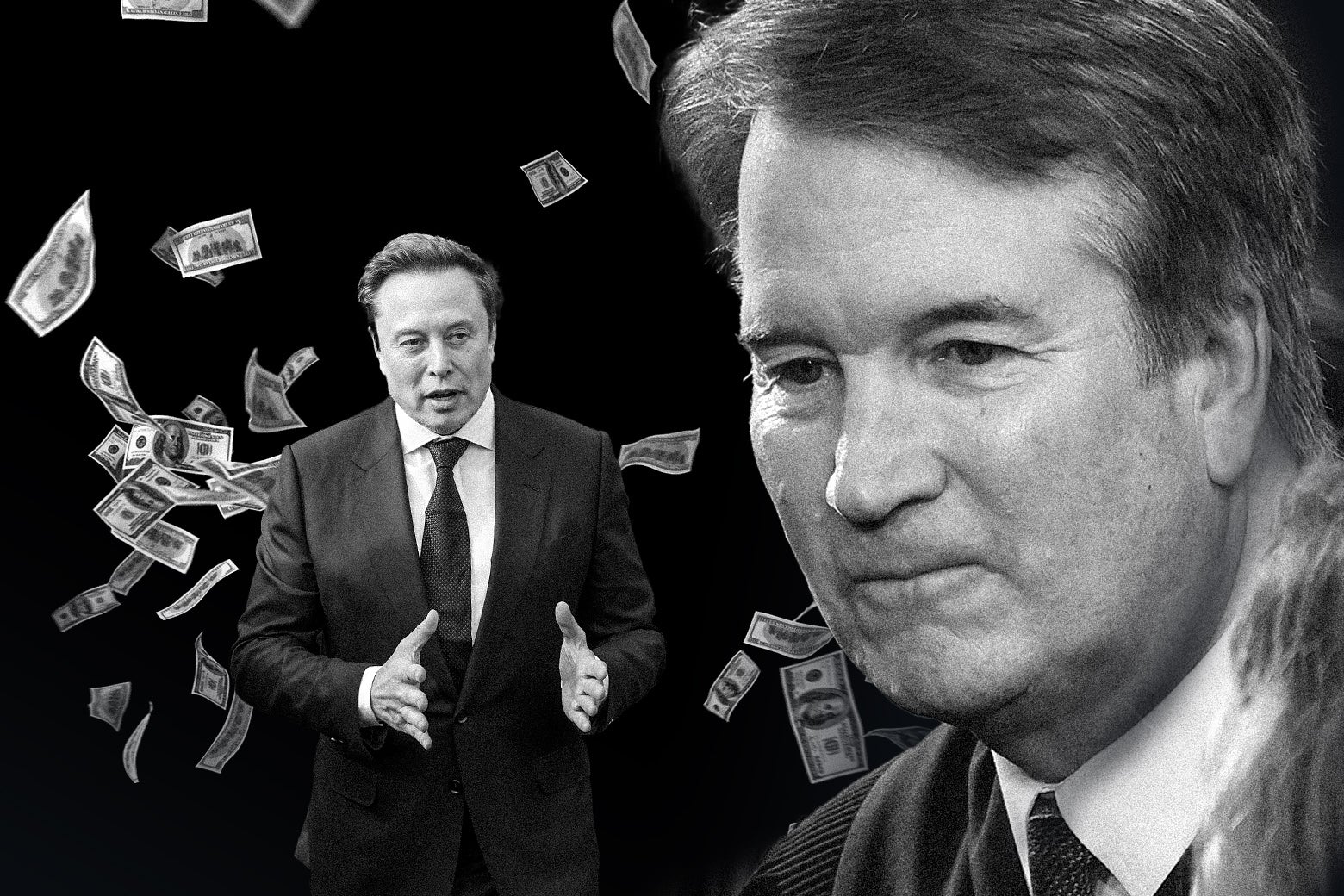
Jurisprudence As acting chair of the FEC, let me tell you how I know. The Supreme Court itself underestimates how much money it let into our federal elections. Photo illustration by Slate. Photos by Win McNamee/Getty Images, gt29/Getty Images Plus, and Kevin Dietsch/Getty Images. Sign up for Executive Dysfunction, a weekly newsletter that highlights one under-the-radar story about how Trump is changing the law—or how the law is pushing back—and keeps you posted on the latest from Slate’s Jurisprudence team. Record-breaking amounts of money have once again poured into our country’s elections, taking place on Tuesday. An old story is that the Supreme Court opened the floodgate with a number of recent decisions, most notably the 2010 Citizens United decision that laid the groundwork for our system of super PACs. That’s not nearly the whole story, though. Even the Supreme Court itself underestimates how much money it let into our federal elections. As a commissioner at the Federal Election Commission, I’m professionally obliged to let the public, and the court, know the true extent to which its most recent major campaign finance decision has opened the door to millions of dollars in additional funds that risk further corruption in our federal campaign finance system. In June, the court’s majority in National Republican Senatorial Committee v. Federal Election Commission effectively allowed political parties to give unlimited amounts to their preferred candidates. In an opinion by Justice Brett Kavanaugh, the court’s conservative majority struck down “coordinated party expenditure limits,” which were caps set on spending by a national party committee in coordination with, and to benefit, the party’s preferred federal candidate. In other words, each political party committee (such as the Democratic National Committee or the Republican National Committee) may now give unlimited amounts to their preferred federal candidate, including by paying for television advertisements that support the candidate. And that’s why we’re seeing so many more campaign ads on TV and social media this election cycle. While the majority and dissenting opinions disagreed about the risk of corruption, all nine justices agreed that striking down the limits would increase money in politics. In her dissenting opinion, Justice Elena Kagan illustrated the consequences of eliminating these limits with the example of a single check from one individual for $551,300. With this check, the individual contributes $7,000 to a candidate’s campaign committee, $44,300 to the national party committee, and $10,000 to each of the 50 state party committees. Justice Kagan further explains that $544,300 of that check will go to the national party committee because the state parties can give their $500,000 to the national party committee. Therefore, that single $551,300 check, from a single person, can now be used by the political party to help a single candidate win an election. Unfortunately, Kagan’s example didn’t go far enough. That $551,300 number does not actually come close to the maximum amount an individual can give to the political party committees in a two-year election cycle. First, Kagan’s example includes the contribution limits for only one year. But an election cycle is two years, so one person can give twice the annual limit, so we can immediately double the amount of Kagan’s check. But there’s even more money on the table here. In fact, one person can actually give their preferred political party $3.1 million. And now, thanks to the court’s recent decision, that entire $3.1 million can be spent on one candidate. Here’s the breakdown of the permissible contributions to the parties for 2025–2026: One person gives $265,800 total to the three party committees for general expenses. This includes the DNC or the RNC (the national committees that help elect the presidential candidate and support candidates nationwide), the Democratic Senatorial Campaign Committee or the National Republican Senatorial Committee (the Senate campaign committees that help elect candidates of the party to the U.S. Senate), and the Democratic Congressional Campaign Committee.That same person also gives $797,400 to the three national party committees for expenses for legal proceedings, including recounts and contests, or for paying the committees’ lawyers.And that person gives another $797,400 to the three national party committees for expenses for party headquarters buildings, like a local office in a candidate’s district.That one person also gives $265,800 to the national party committee only, like the DNC or RNC, for expenses related to presidential nominating conventions.Finally, that same person gives $1 million to the state party committees because an individual can give $20,000 to each of the 50 state party committees, which the state party committees can then transfer to the national party committees. In all, that’s $265,800 plus $797,400 plus $797,400 plus $265,800 plus $1 million for a total of $3,126,400, all of which could be spent by a political party in support of a single federal candidate, who just may happen to be the original donor’s preferred candidate. The court’s majority didn’t think striking down coordinated party expenditure limits would be a problem. Justice Kagan noticed the problem, but underestimated it. Based on my nearly 20 years of experience at the FEC, I’m concerned the FEC’s remaining rules and enforcement tools are ill-equipped to address the corruption risks from one wealthy donor contributing to a party to evade contribution limits to a single candidate. At minimum, the FEC needs its quorum restored so we can resume using what means we have left to maintain our federal campaign finance system, regardless of how much money floods our elections. Jurisprudence Supreme Court Campaign Finance Brett Kavanaugh 2026 Midterms
SCOTUS Justices Said They Knew How Much Money They Were Letting Into Politics. They Were Wrong.
Full Article
Original Source
Read the full article at Slate →KhanList aggregates and links to publicly available news content. We do not host full articles from third-party sources. Always verify important information with original sources.