
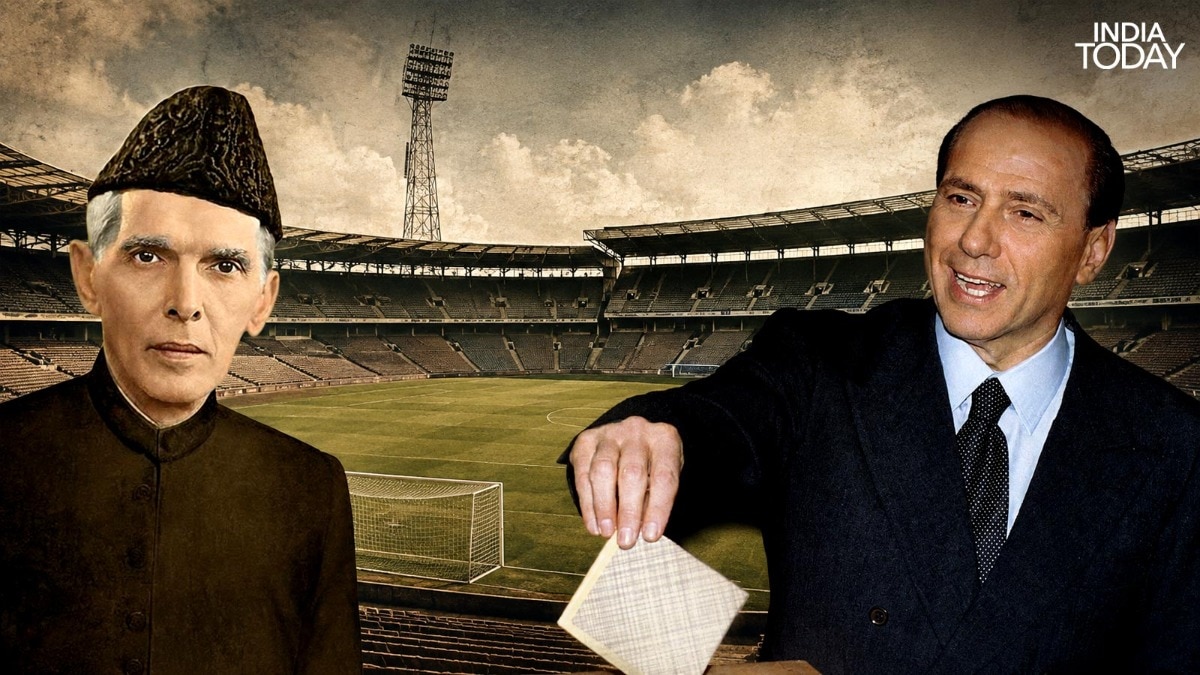
Two leaders. Two countries. Two football clubs. Yet both recognised the same truth: success on the football field could reshape public perception and advance political ambition.Football helped Mohammad Ali Jinnah and Silvio Berlusconi to shape their political careersIn the wake of the Soviet Union's collapse, Italy found itself at a crossroads. Hit by the Tangentopoli (Italian term for Bribesville) scandal, the largest in the country’s history, it was on the verge of witnessing its first Leftist government in the 1994 General Elections. However, history had some other plans. Between the Left’s first major political success and a radical change in Italy’s political structure stood Silvio Berlusconi, a media tycoon, whose party Forza Italia and the centre-right coalition won the majority of the seats in the Chamber of Deputies.Analysts have attributed Berlusconi's rise to several factors. He projected himself as the leader who could rescue Italy from a decade of corruption while preventing the Left from coming to power. Within sections of Italy's conservative political establishment, the Left was still viewed with deep suspicion. However, the discussions will be left incomplete without analysing his mammoth success as the president of the Italian football club AC Milan, something that elevated him as a leader who could deliver success.To understand this, one needs to look at the importance that football holds in Italy’s socio-political life. Football has always been used as a political vehicle in the country, with Benito Mussolini using it as a tool to strengthen his aggressive nationalistic ideas. During the Fascist regime, SS Lazio, a club infamous for its far-right fans and some players, benefited significantly. Even in the present day, football fan groups are used by political organisations to attract their workers.Berlusconi was clever enough to understand how football could be harnessed as a powerful instrument of influence. The extraordinary success of AC Milan under his leadership transformed him into the public image of a winner—someone who pursued victory relentlessly. That reputation would later become a valuable political asset during his rise to power. THE RISE AND RISE OF BERLUSCONI AND AC MILANWhen Berlusconi acquired AC Milan in 1986, the club was already in deep trouble. Burdened by huge debt, bankruptcy, and poor footballing performances (The club was relegated twice in the early ‘80s), the club was nowhere close to claiming itself as a top side contesting the Italian title (Serie A) and the European Champions Cup. Not even its biggest supporter thought that it would have a major makeshift and become one of the most dominant sides in the world.Yet, the miracle happened. After taking over AC Milan, Berlusconi signed some of the big names in Europe and formed a dream team consisting of the late Franco Baresi, young Paolo Maldini, Roberto Donadoni, Carlo Ancelotti (who later became the club’s coach), and three amazing Dutchmen, Ruud Gullit, Marco van Basten, and Frank Rijkaard. Coached first by Arrigo Sacchi and later by Fabio Capello, the club went on to win four Scudettos (Serie A titles) and three European Champion Cups. It also created revolutionary footballing tactics by breaking free from the old-school Italian defensive football to an all-out attacking style. It not only provided results but also helped the club create a distinct footballing identity that would influence many in the upcoming time. As Milan reached new heights, Berlusconi became immensely popular not only in Milan but also in other parts of the country. Italy, at the same time, was torn by the Bribesville scandal. The Christian Democratic Party, which ruled the country for the longest time, was losing its grip on the people and was facing immense heat from the masses. In this context, the country was looking for a leader who could fix it out of all the crises.Using this opportunity, the media tycoon announced his name for the Prime Minister’s office in the upcoming 1994 elections. His newly formed party, Forza Italia (the name was influenced by a common chant used by the supporters of the Italian football team), created ripples among the masses.In an attempt to use his successful administrative role in football, Berlusconi, in his nine-minute-long US-style Presidential address, said, “I have chosen to take to the field” ahead of the election. The phrase is often used by football coaches and players to define their struggles. He even took a jab at Luigi Spaventa, an economist who contested against him in the Roma 1 constituency, by saying, “Before running against me, go and win yourself two Champions Cups.”The message was clear. The multi-billionaire wanted to appeal to people who were charmed by his skills as a football administrator. It worked as well. Defying all odds, he was elected as the country’s next Prime Minister, marking a new beginning in Italian politics.MOHAMMEDAN SPORTING AND THE TWO NATIONS THEORYThe distance between Milan and Kolkata is more than 7,400 kilometres. However, football barely cares about boundaries, and it creates realities that leave a lasting impact on socio-political and economic conditions.Much before AC Milan paved the way for Berlusconi, a club in Kolkata (then Calcutta) helped Muslim League leaders, including Mohammad Ali Jinnah, to bolster their demand for a separate nation. Mohammadan Sporting, a club dominated by Muslims, reflected the rising sentiments of the Muslim community from the mid-thirties to the partition. Bengal, at this time, was going through a major political turbulence and transition as the Pakistan proposal, presented at the Lahore Congress in 1940, started gaining momentum. Many Muslims, who fell for Jinnah’s demand for a separate nation, also became hardcore supporters of the club as it carried the sentiment on the football pitch.To understand this, one needs to look at the socio-political situation of Bengal in the early 20th century. The undivided Bengal was becoming a hub of nationalistic movements at that time, and football only fueled it further. In 1911, Mohun Bagan Athletic Club created history as it became the first Indian football club to lift the prestigious IFA Shield by beating East Yorkshire, a well-advanced team compared to the 11 Bengali players, who could not even afford boots for the majority of the players.Despite the shortcomings, Mohun Bagan emerged victorious, and it delivered a strong message to the people: The Empire could be defeated. Not only on the football field but also on the political scene. After the victory, when the Mohun Bagan team was passing from a road (It was later named Mohun Bagan Lane), a Hindu priest approached Sudhir Chatterjee (the only player who played wearing a boot), “You have defeated the British football team; when will the Union Jack be lowered from the Calcutta High Court?” Chatterjee smiled and said, “When Mohun Bagan will win the Calcutta League.”Mohun Bagan, however, could not fulfil the assurance. It failed to win the Calcutta League in the next two decades. A vacuum was created in Bengal’s football circles as no club was able to clinch the prestigious title. To fill the vacuum, Mohammedan Sporting emerged. A club that is often called the Black Panthers in Kolkata’s football circles.In 1934, it ended a two-decade-long drought for Indian clubs by winning the Calcutta League as the first Indian side. It also clinched the league trophy in the subsequent years till 1938. In 1936, it clinched a double by winning both the Calcutta League and the IFA Shield.The success fostered a strong sense of pride and enthusiasm among a vast section of the Muslim population in Calcutta and the moffussil areas as they started identifying the club as their own. In her research work, ‘Football, Mohammedan Sporting Club and enthusiasm of Bengali Muslim Society in Colonial Bengal: 1891- 1947 ', scholar Amrita Haldar points out that during the Mohammedan Sporting matches, thousands of Muslims began gathering in the galleries from morning to see the Muslim footballers.The club authorities also left no stone unturned to promote a pan-Muslim identity represented by the club. In the thirties, SA Aziz, the legendary official, appealed to all the Muslim players to play for the club. His appeal did not go in vain as some of the bigshots left their clubs in places like Rajasthan, Bengaluru and others and decided to play for Mohammedan Sporting.The list included Kallu Khan, Jumma Khan, Hafeez Rashid, Mohiuddin, Rahamat, and Samad. Later, players like Ali Hosain, Bachi Khan, Jumma Khan, Bashir, Rashid Khan, Masoom, Noor Mohammed (Jr), Karim, Hafiz Rashid, Saboo and Rahaman also joined the team. Many of them came from several parts of the undivided India to represent the black and white side (Mohammedan Sporting’s team jersey).The popularity of the club did not go unnoticed among the leading Muslim politicians and businessmen in Bengal. Many of them started associating themselves with the club. American academic Paul Dimeo, in his writing, ‘With Political Pakistan in the Offing...': Football and Communal Politics in South Asia, 1887-1947’, argued that hundreds of thousands of people and eminent Muslim politicians from Calcutta, Dacca, and Bhopal travelled to New Delhi to see Mohammedan Sporting play against the Royal Warwickshire Regiment in the Durand Cup final in 1940. Mohammedan Sporting became the first Indian club to win the title by beating the English side 2-1.The victory changed the club’s fortune permanently and influenced the political scenario. Jinnah’s ground for a separate nation was gaining momentum, and the victory fueled it. The club was honoured by several Muslim organisations, where Muslim League leaders like Khwaja Nazimuddin (a strong Jinnah loyalist) and Fazlul Huq (who first tabled the Pakistan proposal) were also present.The success also inspired Jinnah in many ways. After the club won the Rovers Cup in 1940, Jinnah used the momentum to influence a section of Muslim students in Mumbai (then Bombay) by saying, “Discipline which sports teaches must be harnessed for the benefit of the Muslim community as a whole.”He also chose Khawaja Nazimuddin, the club’s president and an ardent supporter of his Pakistan plan, as Bengal’s Prime Minister in 1943 after the coalition government of Huq and Syama Prasad Mookerjee fell apart (It is to be noted here that Huq was expelled from the League months after he proposed the Pakistan plan). A year later, Jinnah also inaugurated the Jinnah Football Tournament and kicked a ball to enhance socialisation among the Muslim youths.The Muslim League's separatist politics under Muhammad Ali Jinnah reached a decisive phase in 1946 when he called for Direct Action Day to press the demand for Pakistan. The call was followed by the Great Calcutta Killings, as the city witnessed widespread communal violence amid slogans such as "Ladke Lenge Pakistan." During this period, Mohammedan Sporting was used as a platform to mobilise sections of the Muslim community in line with Jinnah's political campaign.Talking about the situation, historian Suranjan Das writes in his book, Communal Riots in Bengal, 1905-1947, “Reverses suffered by the Mohammedan Sporting Club in football matches enraged Muslim feelings which were expressed in sporadic violence against the Hindus.”Berlusconi and Jinnah never shared a similar political ideology, a country or even an era. Yet both benefited from football's extraordinary capacity to shape collective identity. In Italy, the success of AC Milan became a symbol of Berlusconi's promise to restore a nation in crisis. In colonial India, Mohammedan Sporting's rise strengthened a shared Muslim political consciousness that increasingly aligned with the demand for Pakistan. Their stories demonstrate that football has never been merely a game; at crucial historical moments, it has also been an instrument of power.- EndsPublished By: Akash ChatterjeePublished On: Aug 16, 2026 08:00 IST
'Scoring off the field:' How football helped two global leaders to achieve their goals
Full Article
Original Source
Read the full article at Indiatoday →KhanList aggregates and links to publicly available news content. We do not host full articles from third-party sources. Always verify important information with original sources.