
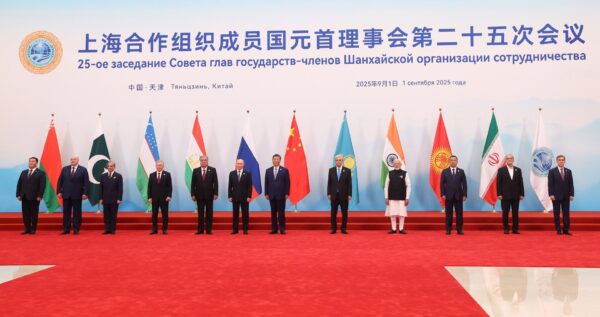
When the leaders of the Shanghai Cooperation Organization (SCO) gather in Bishkek on September 1, 2026, they will be celebrating a quarter-century journey: from an original six members in 2001 to now the world’s largest regional organization comprising 10 members – China, Russia, India, Pakistan, Iran, Belarus, and four Central Asian republics – with Afghanistan and Mongolia as observers, plus 15 dialogue partners stretching from from the South Caucasus to the Middle East, South, and Southeast Asia. But the 25th anniversary will also be an occasion for a reality check. At first glance, persistent intra-SCO tensions are clear: Russia has dragged Belarus into its war with Ukraine; Iran’s war with the United States has seen it attacking Bahrain, Qatar, Kuwait, the UAE, and Saudi Arabia; Afghanistan and Pakistan are engaged in a cross-border conflict; India and China have an unresolved border and occasional military tensions; India and Pakistan have a deeply adversarial relationship; and Cambodia just last year was embroiled in a border war with Thailand. All of these states are either members, observers, or dialogue partners in the SCO. Given that SCO specifically does not address bilateral problems, it has made no contribution to mitigating conflicts that, nevertheless, continue to complicate SCO deliberations. The question, therefore, is inevitable: what has the SCO achieved in the last 25 years? The answer may not be spectacular yet it remains critical for understanding Eurasia’s future trajectories. The SCO has institutionalized a unique experiment in building coexistence without convergences. The SCO’s expanded membership and agenda surely remain its most visible source of relevance. Its original purpose was comparatively narrow: confidence-building and border management among China, Russia, and the Central Asian states. But today it operates across a variety of areas: countering terrorism, separatism, and extremism; addressing narcotics and organized crime; cybersecurity; energy; transport and connectivity; trade and investment; finance; science and technology; artificial intelligence; culture; tourism; education; and youth empowerment. The SCO’s Regional Anti-Terrorist Structure (RATS) began in Tashkent in 2004 and its Peace Mission military exercises from 2003. Today, its ecosystem includes a secretariat, working groups, and other specialized mechanisms covering businesses, banking, youth, and academia. But its expansion has not translated into trust building. The SCO’s Charter itself stresses principles of sovereignty, non-interference, and equality, while seeking common positions only on matters of mutual interest. It is therefore structurally ill-equipped to mediate bilateral disputes that continue to undermine convergences. It is also important to underline that the SCO has evolved less as a NATO-like alliance or EU-like union and more as a security community. The ideal type of security community, in the vein of Karl Deutsch, grows around the “expectation” that members would settle disputes through “peaceful change.” Emanuel Adler and Michael Barnett placed trust, mutual identification, communication, and dependable expectations at the heart of “mature” security communities. For decades, ASEAN has been striving to achieve this dream. For the SCO as well, building that kind of trust has remained an arduous undertaking. Managing Distrust Without Resolving It International relations experts usually assume multilateral forums will produce a virtuous progression: repeated interactions create familiarity; familiarity encourages confidence-building; confidence generates trust; trust facilitates cooperation; cooperation gradually creates convergences. The SCO’s track record offers a strikingly different trajectory: from distrust to institutionalizing predictable interactions to selective cooperation, all while distrust persists. The SCO has not solved the trust deficit; it has papered over it with bureaucracy. Rivals continue to meet through councils of heads of state and foreign ministers, national coordinators, working groups, security agencies, military exercises, and sector specific forums. RATS remains its most enduring mechanism for counterterrorism cooperation. The Peace Mission exercises and anti-narcotics cooperation have become increasingly robust. The SCO reported that its August 2025 Spider Web operation resulted in the seizure of more than 9 tonnes of narcotics and more than 21 tonnes of precursors. This institutionalization gives adversaries routines and avenues to keep interacting. They have not forgotten their conflicts but do not allow those conflicts to destroy this institutional rhythm. It speaks to the SCO’s inherent strength and solidarity, granting it resilience even as its members include states that are simultaneously competitors, adversaries, and security partners. The glue is not trust but a shared habit of institutionalized interactions where distrust is often factored in and endured. The SCO has evolved less as a conventional organization and more into an ecosystem for building a security community. Its extraordinary diversity, especially of regime types and size, makes consensus its greatest constraint but also its core asset. Consensus prevents any single power from converting the SCO into a geopolitical instrument. It allows China, Russia, India, Pakistan, and Iran to remain inside the same framework despite profound differences. But consensus also has its costs. The SCO can accommodate disagreement because it rarely requires members to give up their core interests. The result? It produces open-ended declarations with few binding collective actions. The SCO does not ask for common strategic identity or shared political values, nor interfere in members’ bilateral disputes. This is by design and undergirds SCO’s longevity. The SCO’s network of specialized bodies, observer missions, business and banking institutions, security mechanisms and external relationships matter more than the formal organization itself. The SCO, for instance, has managed 76 election-observer missions since 2004 and maintains close relationships with the U.N. and multiple other regional organizations. The SCO may not have produced convergence but it has ingrained among its members a habit of meeting, consulting, and exchanging information despite distrust. Tianjin to Bishkek: Summitry vs. Delivery This approach should moderate our expectations from Bishkek. At the Tianjin SCO summit last year, leaders agreed to establish an Anti-Drug Center in Dushanbe and a Universal Center for Countering Security Challenges and Threats in Tashkent. They decided to replace separate categories of “observer” and “dialogue partner” with a single “SCO partner” status. The Bishkek summit is expected to deliver on each of these proposals. The Tianjin summit kickstarted negotiations to ratify the required amendments the SCO’s legal frameworks but this may take some time. The idea of an Anti-Drug Center has moved into the preparatory implementation stage and, by May 2026, SCO anti-narcotics officials had approved a working draft to be submitted to the Bishkek summit. The Tianjin summit had also agreed in principle to the establishment of an SCO Development Bank, but it continues to face consensus-building challenges as it has since it was first suggested in 2010. It is tempting to expect the Bishkek summit to turn these promises into reality. But should the SCO’s credibility be judged by this yardstick alone or how many new declarations emerge from Bishkek? Remember, the SCO’s real strength lies in its members having “moved” from old fashioned leaving-the-room when interests diverge to innovative ways of keeping the door open. The Bishkek summit should not be judged by whether the SCO can resolve the dispute over Kashmir or the India-China border, whether it can settle Afghanistan-Pakistan tensions or address wider conflicts involving Russia and Iran. Nor should its success be measured simply by counting members, partners, summits, or declarations. Its greatest success is that, after 25 years, the SCO has created something distinctive: an institutional architecture in which strategic competitors can coexist without converging. SCO members and partners may not have become friends. They have, however, built enough institutional resilience to keep their tensions from automatically destroying their shared forum. This may sound rather modest. But in an international system increasingly characterized by strategic distrust, contested borders, fragmented and overlapping alignments, this capacity to communicate with one’s rivals remains critical for conflict management. The SCO’s achievement, thus, may not be what it has brought its members to agree upon. It instead lies in how the SCO has trained them to live together, even without trust.
SCO at 25: Institutionalizing Coexistence Without Convergence
Full Article
Original Source
Read the full article at Thediplomat →KhanList aggregates and links to publicly available news content. We do not host full articles from third-party sources. Always verify important information with original sources.