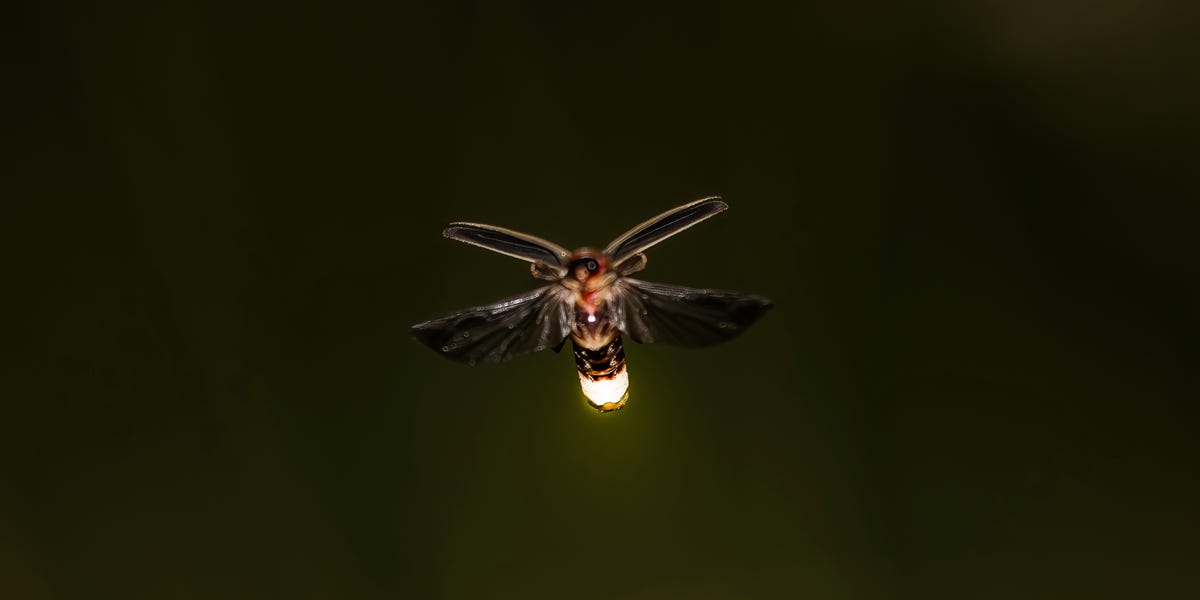
2 min readHere’s what you’ll learn when reading this story:For more than a century, the amount of light produced by a firefly has been translated through different units, eventually arriving at 1013–1014 photons per flash.In a new study, scientists reanalyzed these numbers and discovered that the number is off by two orders of magnitude. This updated figure tells us that other long-standing figures, since translated into modern units, might also need updating.One of the most stunning displays of bioluminescence in the animal kingdom belongs to the humble firefly, found throughout North America. A firefly’s light-emitting organ, also known as its “lantern,” contains specialized cells called photocytes that contain the organic compound luciferin and the enzyme luciferase. Fireflies control oxygen intake, and the interaction of this oxygen with calcium and adenosine triphosphate (ATP)—along with luciferin and luciferase—produces a “cold” light (which is good news, because any heat produced by process would likely kill the insect).This incredible light display has dazzled humans since time immemorial, but it wasn’t until 1912 when American physicist William Coblentz—a pioneer in radiometry and spectroscopy—decided to quantify how much light fireflies (specifically in the species Photinus pyralis) produce.At the time, Coblentz described the firefly’s light-producing power in “candles,” placing P. pyralis’s light producing ability at around 1/50th to 1/400th the power of a candle. But, as you’ve likely noticed, candles are no longer a standard scientific unit. Eventually, the power was described as one milliwatt, which is closer to 1/40th of a candle. Today, bioluminescence is measured in absolute photon counts, and translating from one milliwatt (or 1/40th of a candle),that measurement comes out to 1013–1014 photons per flash.However, in a new study, David Silver—a machine-learning researcher with Remiza AI in New York—decided he wanted to check those numbers, and found that the power of a firefly’s light has been drastically overestimated. That study is published in the American Journal of Physics.“The textbook brightness didn’t match the biochemistry by two to three orders of magnitude,” Silver told the American Institute of Physics (AIP), “and a number off by that much for a century is worth knowing about.”Silver’s experimental set-up wasn’t particularly complicated. With a photographer in tow, Silver brought a $30 lux meter—a device designed to detect the intensity of light—and walked out into a field to analyze Malaysian fireflies. Silver calculated the quantum yield of luciferin-luciferase reactions and re-read Coblentz’s original report (along with subsequent studies). In doing so, he found striking differences between the two calculations.“Even if every enzyme fires once and every reaction makes a photon, you cap out near 1011,” Silver told AIP. “There is simply no biochemical room for 1014.”While this study demonstrates that old observations translated to relative units may need re-examination, it also provides new information about a firefly’s visual system, as their courting displays can likely operate on less light than originally assumed.Darren lives in Portland, has a cat, and writes/edits about sci-fi and how our world works. You can find his previous stuff at Gizmodo and Paste if you look hard enough.
Scientists Were Wrong About Fireflies’s Light. The Impact Could Ripple Across All of Science.
Full Article
Original Source
Read the full article at Popularmechanics →KhanList aggregates and links to publicly available news content. We do not host full articles from third-party sources. Always verify important information with original sources.