
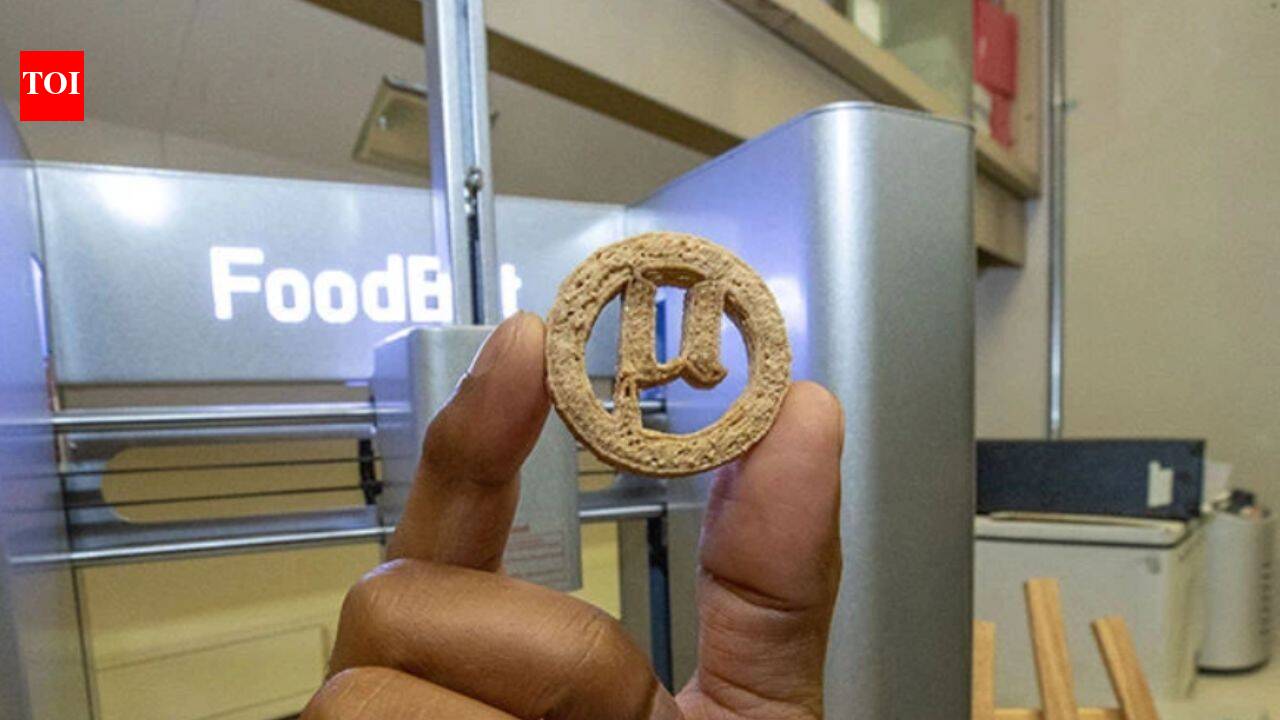
The technology could also potentially be used in places such as submarines and future human settlements on the Moon or Mars (American chemical society photo)Researchers at Southern Illinois University Carbondale (SIU Carbondale) are working on a technology that turns plastic waste from a water bottle into part of a cookie. For this, they programmed yeasts to convert material from plastic waste and agricultural waste into proteins, fats, acids, vitamins and flavouring molecules.The protein-rich cookies have been named 'µBites', pronounced 'microbites'. According to the American Chemical Society, the main materials used to make them include polyethylene terephthalate (PET) plastic, the type commonly used for soda and water bottles, along with discarded corn stalks and leaves.Researchers of the project say the approach could also help address plastic waste, apart from food shortages. Lahiru Jayakody, an associate professor at SIU Carbondale, said the team was initially looking at ways to turn plastic waste into more valuable products. “We thought, why not focus on making food? Because plastic is carbon and food is carbon,” he explained.The research was presented at the fall meeting of the American Chemical Society (ACS), in Chicago. The project was funded by the NASA Deep Space Food Challenge and a National Science Foundation Faculty Early Career Development Program grant.Plastic turns into food PET contains carbon-rich molecules. The researchers wanted to break these molecules down into smaller pieces that microbes could use. Instead of relying only on chemical processes, the team used programmed yeasts.First, PET plastic, discarded corn plant material and other biomass are processed using a method called oxidative hydrothermal dissolution. The method uses water and oxygen at high temperature and pressure. This breaks down tough materials into smaller pieces that can be accessed by microbes.Those pieces are then given to specially programmed yeasts. Yeast has long been used by scientists as a kind of biological factory for producing useful molecules. In this project, the researchers programmed different types of yeast, including baker’s yeast, to rebuild material from the waste into food-related compounds.The yeasts can produce proteins, fats and acids from the processed waste. These ingredients are then combined with other materials to make the cookies.The researchers add fibre, starch and sweetener to the mixture before putting it through a 3D printer. The printer forms the mixture into cookies.Jayakody said the approach relies on the natural abilities of microbes. “Microbes are very clever. So, we are using their traits to solve the problems we created,” he said.Yeast adds flavour, vitaminsThe team is also working on making the cookies more appealing. Graduate student Sandhya Jayasekara has developed yeasts that can produce additional food ingredients from waste material. For example, baker’s yeast has been programmed to produce vanilla flavouring from plant biomass. Another yeast strain can use ethylene glycol from PET to produce beta-carotene. Beta-carotene is important because the human body can convert it into vitamin A.The researchers say the cookie have passed safety testing and are considered safe to eat. However, the team is still waiting for institutional approval before carrying out formal taste tests.For now, researchers have tested how the cookies smell. Most participants said they would be willing to eat them in situations where food and other resources were limited.That response has encouraged the team to continue improving the product. The goal is to make it into something people could choose to eat, rather than food that would only be considered during an emergency or when other options were unavailable.Food for spaceThe researchers are particularly interested in places where bringing large amounts of food is difficult. On long space missions, astronauts have limited access to fresh supplies from Earth. A system that could use available waste and convert it into new food ingredients could be an asset there.The researchers say the technology could also potentially be used in places such as submarines and future human settlements on the Moon or Mars.The work is still under development, however, and the team has not yet said that the cookies are ready for routine public consumption. Jayakody and his team also want microbes to produce more of the ingredients currently added to the cookie. Their future plans include producing the starch, fibre and sweetener through microbial processes as well. They hope the cookies could be ready for public consumption within a few years.
Scientists turn plastic bottles and corn waste into protein-rich cookies
Full Article
Original Source
Read the full article at Timesofindia →KhanList aggregates and links to publicly available news content. We do not host full articles from third-party sources. Always verify important information with original sources.