
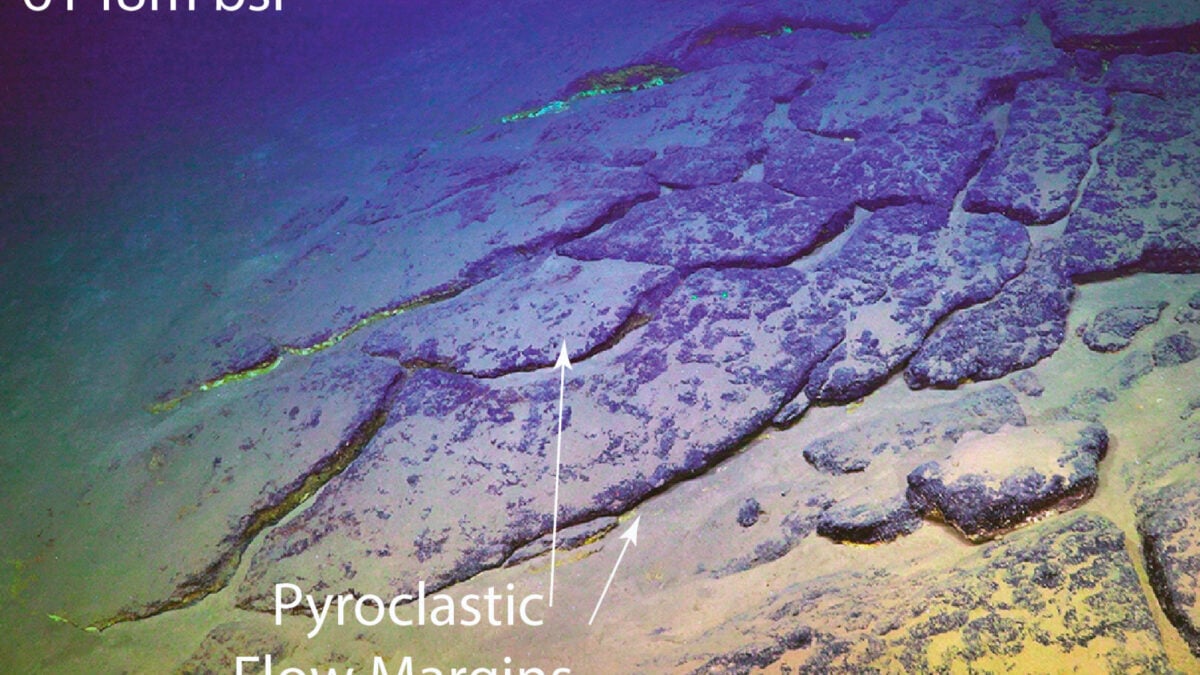
Despite significant advances in humanity’s spaceflight capabilities, the deep sea on our own planet remains woefully underexplored. But when scientists do find ways to sleuth the deep, the discoveries are often deeply surprising. According to geoscientist Ignacio Pujana, sending anything down to explore the deep sea—especially the trenches—is an expensive and difficult task. Pujana, of the University of Texas at Dallas, was part of the team that sent Jason/Medea, a remotely operated vehicle capable of diving up to 4 miles (6.5 kilometers) below sea level. That technically wasn’t enough to directly probe Challenger Deep—the deepest known point of the seabed—at 6.8 miles (11 kilometers). Still, the vehicle was able to sample the wall of this trench. And during its journey, Jason/Medea retrieved clear evidence of ultra-deep volcanic eruptions: pyroclastic rocks. A paper published today in Frontiers in Earth Science describes the expedition and its findings in further detail. “We sampled and are studying both mantle rocks and the young volcanic rocks,” Pujana told Gizmodo. “[What’s] especially interesting is that we discovered that explosive volcanism occurs much deeper and closer to the trench than anybody previously imagined.” Deeper than deep When we think of the deepest point of the ocean, we think of the Mariana Trench. Challenger Deep is the deepest point of that deepest point. According to Royal Museums Greenwich, Mount Everest’s peak “wouldn’t just disappear beneath the waves: it would lie more than a mile underwater.” And with depth comes crushing pressure, at about 1,000 times the standard pressure at sea level. This is (literally) crushing news for ROVs but a fascinating thought for scientists. Assuming geophysical processes common to other parts of the seafloor apply to these deep, high-pressure regions, we could reasonably expect they’d look considerably different. Volcanic eruptions, for instance, might be subdued since the pressures would prevent the gases in the magma from expanding too much, Robert J. Stern, the study’s lead author and a geoscientist at the University of Texas at Dallas, said in a statement. An ultra-deep explosion That was why Jason/Medea’s souvenir from down under was so significant. Pujana explained to Gizmodo that the ROV can stay underwater for very long periods while sending back high-res imagery of its view. It can also collect real samples, so the team back on land can confirm what the ROV saw. The team subdivided the forearc ridge north of the Challenger Deep into two segments. A fish that Jason/Medea observed at 6,297 meters (20,659 feet) below sea level. Credit: Tomoyo Okumura The eastern segment had exposed mantle rocks and traces of 50 million-year-old crust, whereas the western side was “dominated by young volcanic rocks,” Pujana said. When the researchers physically studied the rocks, they found an abundance of volcanic fragments and volcanic glass. These elements were relatively sturdy and suggest there was enough heat to weld them together into a rock. In other words, the team was fairly confident that the rocks came from a deep ocean volcanic eruption—some of the deepest that we know of. The east-west difference of the canyon—although further sampling and radiometric dating is needed—also hints at why the Challenger Deep is, well, so deep. In the statement, Stern explained that the two plates at the region’s subduction zone seem to be weakly attached and are generally narrow and short. This lets the plate easily slide under and bend more tightly than normal, leading to a steeper dip. The team is currently working on a proposal to return to Challenger Deep; perhaps next time, an improved ROV could travel even deeper. “The deep ocean is one of the least explored parts of our planet, yet it plays an important role in Earth’s systems,” Pujana said. “Continued exploration remains essential for understanding our world and its biodiversity.”
Scientists Thought Volcanic Blasts Couldn’t Happen This Deep. This Robot Just Pulled Up Something Unexpected
Full Article
Original Source
Read the full article at Gizmodo →KhanList aggregates and links to publicly available news content. We do not host full articles from third-party sources. Always verify important information with original sources.