
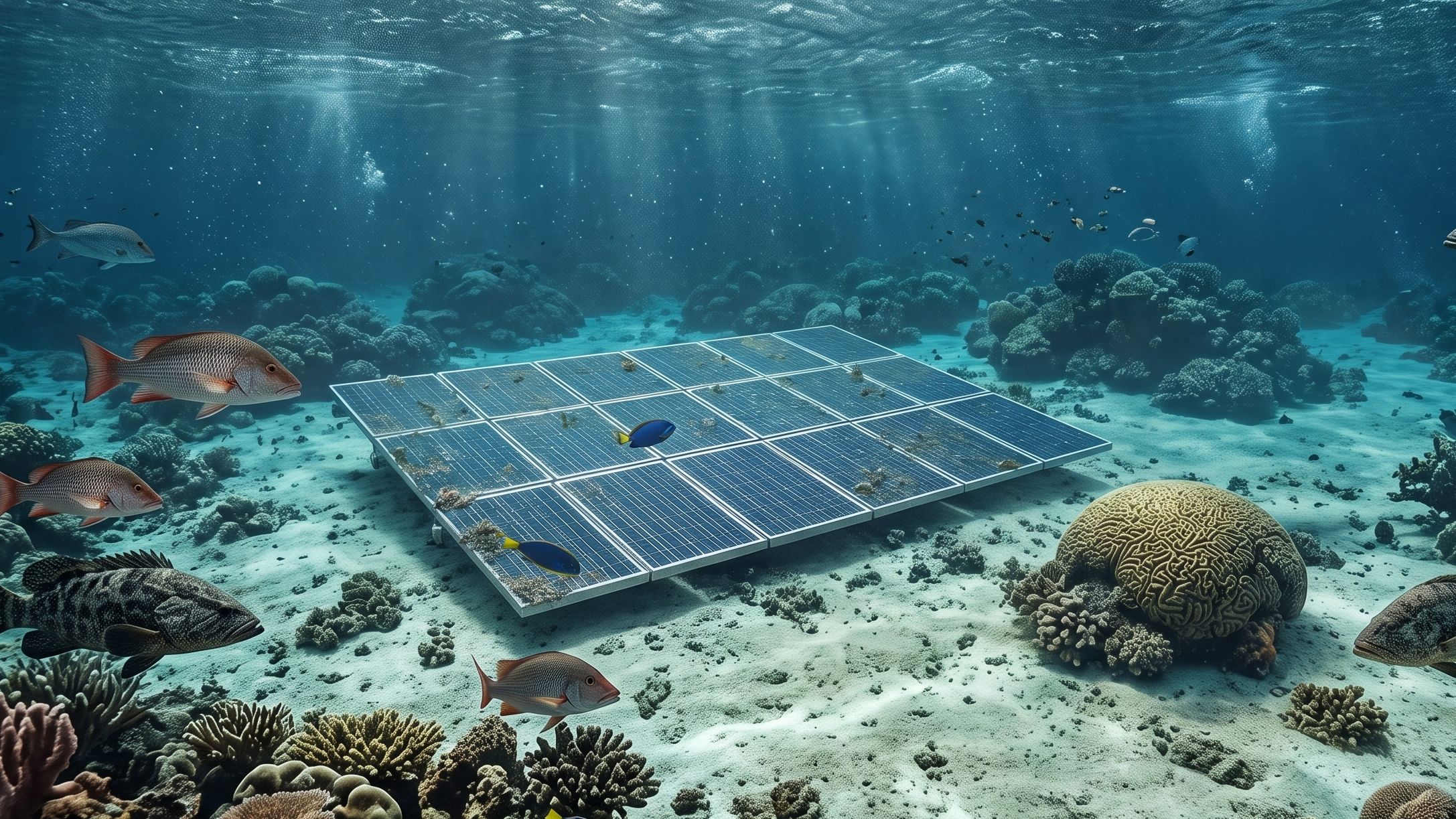
An AI-generated impression of the underwater solar panels tested by scientists from Yunnan University in China. (Image credit: Gemini Nano Banana) Scientists have developed solar panels that can work up to 10 meters underwaterThe panels can capture up to 324 mWh of energy at that depthEach device is expected to last up to five and a half years at a timeA lot of devices are deployed underwater for research and exploration purposes, but powering them all can prove to be difficult, especially if they’re under the waves for a considerable period of time. A new scientific paper, however, has shown that solar panels can be successfully used at depths of up to 10 meters, potentially presenting a new way to keep underwater tech powered up and ready for action.The paper was published in the Joule periodical and accompanied by a press release explaining its advances. The research was conducted by a team of scientists from Yunnan University in China, who said that a series of solar cells placed 32 feet (10 meters) below the water’s surface in the South China Sea were able to collect enough energy to power up a set of lithium-ion batteries in two hours.The cells were made from lead halide perovskite with a polymer called polyhexamethylene guanidine hydrochloride added into the mix. This additive helped to enhance the effectiveness of the panels.According to Wen-Hua Zhang of Yunnan University, “Very few studies have been reported on underwater solar cells, and all of them are focused on very shallow water depths of only two meters or less, a scenario far from catering for requirements of practical application.” A photo of the prototype solar cells being tested in the South China Sea. (Image credit: Joule)“This work presents the first functional validation of submerged solar cells practically operating at a water depth of up to about 10 meters, greatly broadening their application scope,” Zhang added. The researchers stated that each cell could be deployed for around five and a half years at a time.The panels captured 1,416 milliwatt-hours (mWh) of electricity at a depth of two meters. This decreased to 752 mWh at six meters and 324 mWh at ten meters. During separate lab testing, the solar panels had a power conversion efficiency of just under 35%.Paving the way Solar panels could one day be used to power ‘self-sustained marine energy systems and autonomous underwater devices,’ researchers believe. (Image credit: datacenterdynamics)The idea behind this research is that underwater solar panels could be used to power devices such as sensors, cameras, communications systems, and more.Sign up for breaking news, reviews, opinion, top tech deals, and more.Many of these objects are stationary for much of the time, so nearby solar cells could help keep them topped up and working without necessarily requiring extensive human intervention.One question that remains unanswered is how exactly solar panels like this would interact with their environment. For example, it’s likely that they would accumulate biomatter that could hinder their operation, potentially requiring regular cleaning in order to remain fully functional. After all, the sunlight that will power these cells could also promote the growth of plants and animals — a process known as biofouling.Still, the research seems to have potential. As the authors noted, “This work paves the way for the practical deployment of perovskite photovoltaics in underwater environments, offering a promising route toward self-sustained marine energy systems and autonomous underwater devices.” Follow TechRadar on Google News and add us as a preferred source to get our expert news, reviews, and opinion in your feeds. Alex Blake has been fooling around with computers since the early 1990s, and since that time he's learned a thing or two about tech. No more than two things, though. That's all his brain can hold. As well as TechRadar, Alex writes for iMore, Digital Trends and Creative Bloq, among others. He was previously commissioning editor at MacFormat magazine. That means he mostly covers the world of Apple and its latest products, but also Windows, computer peripherals, mobile apps, and much more beyond. When not writing, you can find him hiking the English countryside and gaming on his PC.
Scientists test underwater solar panels that work 10 meters beneath the waves —breakthrough perovskite tech could support self-powered marine drones
Full Article
Original Source
Read the full article at Techradar →KhanList aggregates and links to publicly available news content. We do not host full articles from third-party sources. Always verify important information with original sources.