
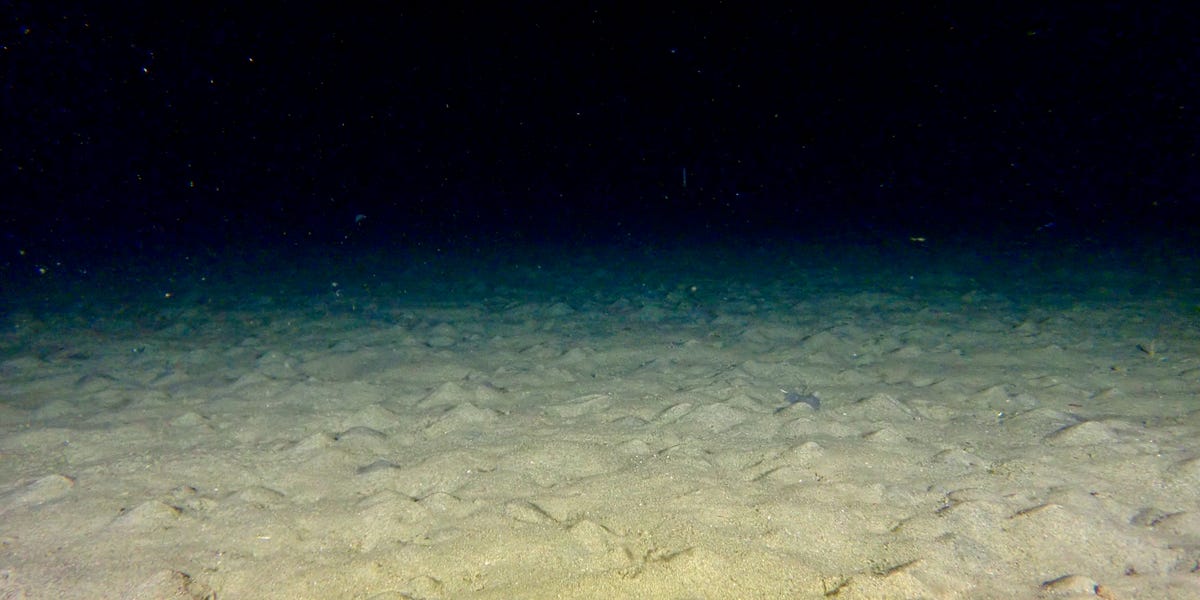
3 min readHere’s what you’ll learn when you read this story:On a 1964 mission to study deep waters in the Antarctic, the National Science Foundation’s (NSF) research vessel Eltanin captured an image of what looked like an artificial antenna on the sea floor. In subsequent years, fringe theories suggested that the antenna was part of a secret operation or an otherworldly monitoring device. It turns out the mystery had been solved more than half a century earlier, and the antenna was actually a strange (yet definitely terrestrial) carnivorous sea sponge.Starting in 1962, the National Science Foundation’s (NSF) Polar Research Vessel Eltanin, which served as a U.S. Navy icebreaker for five years before journeying southward for science, embarked on a mission to explore the oceanic depths as the world’s first dedicated Antarctic research vessel. Two years into that mission, the ship captured one of its most perplexing and enigmatic images some 1,000 miles south of Cape Horn, Chile.Eltanin used a camera and strobe-light system to photograph the ocean floor, and on August 29, 1964, this system—which produced at-best grainy black-and-white resolution of the seabed—picked up something strange: an antenna-like protrusion with twelve spokes radiating from the center, each with a sphere at its tip. Its strange, symmetrical structure made it hard to believe that the object, whatever it was, came from nature. The first detailed report of the image, written by the New Zealand Herald, didn’t arrive until December 5, 1964, when the Eltanin docked in Auckland. The title of the piece? “Puzzle Picture From Sea Bed.”“At that depth there is no light, so photosynthesis could not take place and plants could not live. If it is some strange coral formation then no one on board has ever heard about it before,” Thomas Hopkins, a senior marine biologist who was one the expedition, told the New Zealand Herald at the time. “I wouldn’t like to say the thing is man-made because this brings up the problem of how one would get it there. But it’s fairly symmetrical and the offshoots are all 90 degrees apart. This is why it has been argued over for so long.”In other words, it was unexplainable, and according to a 2004 article in the Fortean Times, a British magazine dedicated to such strange phenomena, it only took a few years for the “Eltanin Antenna” to enter into the annals of alien conspiracy theory. In a 1968 Saga magazine article, Brad Steiger—who Fortean Times describes as a “peddler of popular mysteries”—planted the first seeds of the Eltanin photo as capturing something otherworldly.“One cannot help becoming a bit uneasy knowing that someone—whether they be space visitors or representatives from some undeclared terrestrial organization—knows quite a bit more about the measurements and crucial rumblings of our planet than our top scientists do,” he said.So, what is the Eltanin antenna, if not... well... an antenna?Well, Hopkins wasn’t wrong, but he also wasn’t the first to catch sight of this bizarre object. This weird structure isn’t a coral, plant, or man-made technology. Instead, it’s a carnivorous sea sponge known as the “ping pong tree sponge” or by its scientific name Chondrocladia concrescens. Despite its remote location, this sea sponge was originally described by Swiss-American marine biologist Alexander Agassiz way back in the late 19th century.During an Antarctic expedition aboard the Blake, Agassiz eventually wrote that the discovered specimen contained a “a long stem ending in ramifying roots, sunk deeply into the mud. The stem has nodes with four to six club-like appendages.” He even drew the strange, oceanic creature.So, word to the wise: sometimes, a grainy black-and-white photo of an unexplainable structure might be alien tech or even a covert CIA operation. But it’s probably worth asking: is it just a sponge?Darren lives in Portland, has a cat, and writes/edits about sci-fi and how our world works. You can find his previous stuff at Gizmodo and Paste if you look hard enough.
Scientists Spotted an ‘Alien’ Object on the Ocean Floor. The Reality Is Even Weirder.
Full Article
Original Source
Read the full article at Popularmechanics →KhanList aggregates and links to publicly available news content. We do not host full articles from third-party sources. Always verify important information with original sources.