
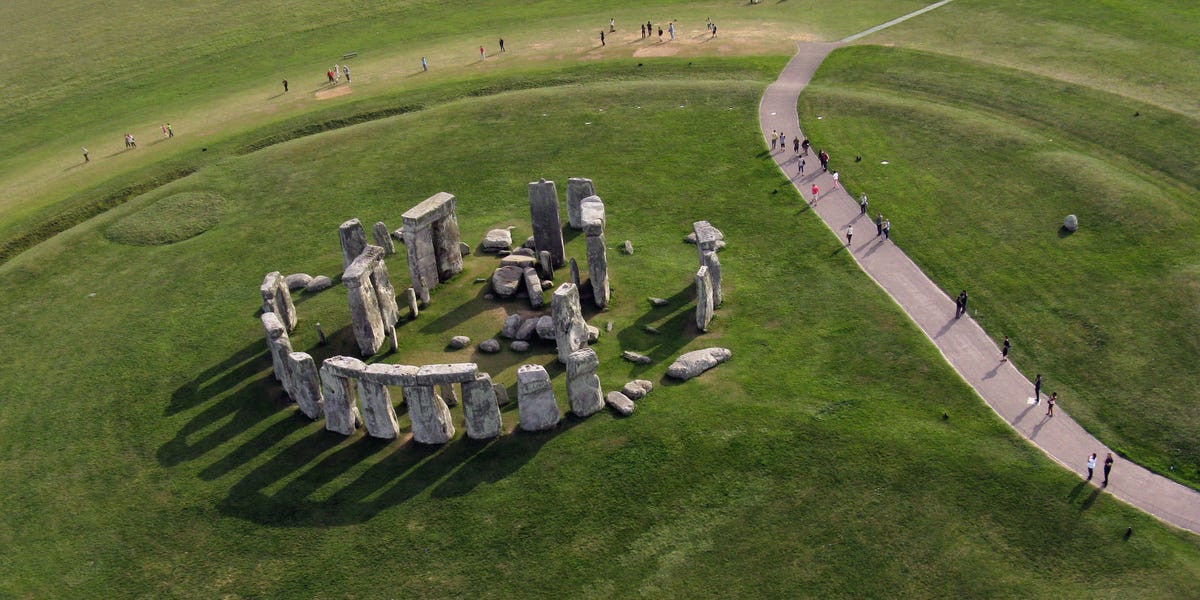
3 min readHere’s what you’ll learn when you read this story:In a new study, scholars claim glacial ice played a role in getting the Altar Stone partway to the Salisbury Plain.The team modeled glacial movements and concluded that the large Altar Stone may have traveled from Scotland to the English shore via ice flow.Even with help from the ice, humans still had to move the 6.6-ton stone 250 miles to the final site. Solving the mystery of how Stonehenge’s massive stones—including the 6.6-ton Altar Stone—arrived on the Salisbury Plain some 5,000 years ago remains a constant juggle of theories and studies. Now we have a new option in the mix, one that combines the power of ice flow with Neolithic ingenuity to explain how the 13,000-pound central sandstone journeyed over 430 miles from Scotland to southwest of London.In a new study published in the Journal of Quaternary Science, researchers admit they haven’t definitively proved how the stone got from the Orcadian Basin in northeast Scotland to southwest England, it probably wasn’t only by ice flow or only by the hands of the Neolithic humans. It might have been both.The team wrote that compatible dispersal rates could have moved the stone roughly halfway from the Orcadian Basin to Stonehenge, suggesting that glacial transport “may have provided an intermediate stage in the stone’s journey but alone cannot account for the final emplacement on Salisbury Plain.”Even that theory leaves additional questions, as the authors readily admit. Remy Veness, lecturer in glaciology at Sheffield Hallam University and an author of the new study, wrote in The Conversation just how the process may have played out. And it would have taken some serious forethought.The Altar Stone is the largest and heaviest of Stonehenge’s bluestones, and it’s thought to have arrived at Stonehenge some 2,000 years before the larger, more local stones that form the monument’s arches. At 13 feet long, though, it’s no trifle to move. Geologists agree the Altar Stone was formed of sandstone from the sediments of ancient Lake Orcadie, in what’s now northeastern Scotland. Leading theories on how the stone made its way to England have included glacial transportation or Neolithic humans moving it by hand, whether over land or by sea.The researchers combined sandstone provenance analysis with ice flow modeling to map potential transport pathways. Veness wrote that at the end of the last ice age, the glacial mass was so thick and prevalent that it flowed from the Orcadian Basin like a slow-moving river to the region of the modern United Kingdom, picking up and carrying rock and debris with it. Using a model that Veness spent five years developing, the researchers determined that the Altar Stone could have been carried around 12,000 years ago to Dogger Bank, a Neolithic site that’s now beneath the North Sea, about 60 miles off England’s northeastern coast. “Dogger Bank represented a local topographic high point within the Doggerland region,” Veness wrote, “rich in archaeological evidence.”But Dogger Bank was the last stop on a “glacial conveyor belt.” Even if the ice flow carried the Altar Stone to Dogger Bank—which Veness said would have looked like a cross between a “building demolition site and an interesting rock museum” 10,000 years ago—it still needed to move another 250 miles to Stonehenge.For the theory to hold up, we have another wrinkle. Doggerland was above sea level only until about 8,000 years ago. Doggerland was once a land bridge connecting Europe and Britain, but rising seas gradually transformed it into a small island before submerging it entirely. In fact, Doggerland disappeared beneath rising ocean waters before the construction of Stonehenge, which means that the Altar Stone needed to move from Doggerland to somewhere other than the Salisbury Plain years before its inclusion in Stonehenge.Veness suggests that the Neolithic people of Britain had the foresight to see the sinking land and move their prized stones to a new site. “Once the Altar Stone was safely on England’s east coast, the idea that it was moved by humans to Salisbury Plain becomes more plausible,” he wrote, adding that the Altar Stone only needed to move about the same distance as Stonehenge’s other bluestones, although that’s still 10 times farther than the more locally-sourced and larger Sarsen Stones.If nothing else, we now have a new Stonehenge theory to consider.Tim Newcomb is a journalist based in the Pacific Northwest. He covers stadiums, sneakers, gear, infrastructure, and more for a variety of publications, including Popular Mechanics. His favorite interviews have included sit-downs with Roger Federer in Switzerland, Kobe Bryant in Los Angeles, and Tinker Hatfield in Portland.
Scientists Say They’ve Solved Part of Stonehenge’s Biggest Mystery
Full Article
Original Source
Read the full article at Popularmechanics →KhanList aggregates and links to publicly available news content. We do not host full articles from third-party sources. Always verify important information with original sources.