
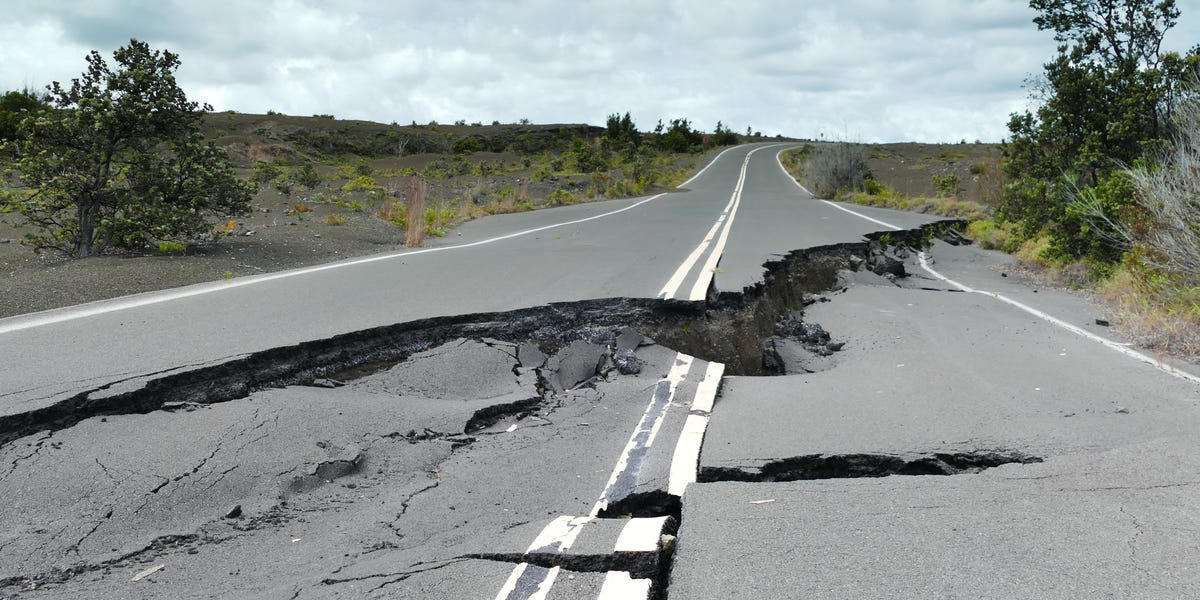
4 min readHere’s what you’ll learn when you read this story:For decades, the Pacific Northwest has lived under threat of the “Big One,” a megathrust earthquake that would devastate the region. A new study suggests that it’s possible such an event could trigger a second earthquake along the San Andreas fault in California, and there’s evidence that such an event occurred within the past 3,100 years. If two earthquakes struck in rapid succession in the West, the natural disaster would undoubtedly be the largest in the history of the U.S. by a wide margin.I’ve lived in Portland, Oregon, for nearly seven years, and I’ve been part of dozens of discussions—whether at bars or book clubs—regarding the “Big One,” the much-anticipated seismic apocalypse that threatens the Rose City along with Seattle, Vancouver, and (to a lesser extent) San Francisco. Scientists have modeled this doomsday scenario dozens of times, entire books have been written about it, and communities across the region have banded together in preparation. In other words, the “Big One” is definitely on people’s minds.Off the coast of the Pacific Northwest, the Juan de Fuca Plate (along with the smaller Gorda and Explorer plates) is plunging beneath the North America plate, forming the Cascadia Subduction Zone. Scientists estimate that this fault contains “megathrust” potential, meaning rumbles could exceed magnitude 9.0 in intensity. In its entire history, the U.S. has only recorded two such earthquakes. One happened in Alaska in 1964. And the other? The Cascadia Subduction Zone. Circa 1700.Over the past 10,000 years, the region has experienced 19 earthquakes above magnitude 8.0, with an average frequency of roughly once every 500 years. The U.S. Geological Survey (USGS) estimates a 10 to 15 percent chance of the Big One striking the west coast in the next 50 years. Even if the Pacific Northwest reaches the end of the century without a major rumble, that likelihood only goes up. In the end, as geological history shows us, it’s not a matter of “if,” but “when.”Now a new study published in the journal Geosphere is complicating matters even further because the “Big One” might actually be a one-two seismic punch. The culprit is a complicated synchronization between the Cascadia Subduction Zone and the lower San Andreas Fault, which runs nearly the length of western California.“We're used to hearing the ‘Big One’—Cascadia—being this catastrophic huge thing," Oregon State University’s Chris Goldfinger, lead author of the study, said in a press statement. “It turns out it’s not the worst-case scenario.”Cranking the tragedy volume to 11, Goldfinger and his colleagues used deep-sea sediment cores to show that earthquakes on these two faults have struck close together within the past 3,100 years. Earthquakes typically trigger underwater landslides, which send turbidity currents— fast-moving slurries of water and sediment—racing down the seafloor. As they settle, those currents leave behind distinctive deposits called turbidites. Slopes can also collapse on their own, but turbidites are often a tell-tale sign of a past earthquake.In their study, the scientists studied sediment cores extracted north and south of Cape Mendocino, the approximate location where the two fault systems converge off the coast of Northern California. Typically, turbidites form with coarse material on the bottom and finer silt material at the top, but south of Cape Mendocino, the researchers found that the reverse was true. That reversal could only be explained by two quakes in sequence. First a Cascadia rupture deposited the fine silt, and soon afterward a San Andreas rupture dumped coarser sediment on top of it.“The time separation between the Cascadia subduction zone and northern San Andreas fault ruptures is not known,” the authors write. “Several doublet beds appear to have the upper unit embedded in the tail of the initial event…imply[ing] minutes to hours of separation.”If the major earthquakes were to occur in rapid succession in the Pacific Northwest and California, the result would undoubtedly be the largest natural disaster in U.S. history, likely surpassing Hurricane Katrina in 2005 by a wide margin. Major population centers, including Seattle, Portland, and Vancouver, B.C., would be decimated. Even if the Federal Emergency Management Agency (FEMA) coordinated disaster relief to absolute perfection (an outcome that’s far from certain), delivering aid would be immensely difficult. For example, the Oregon Department of Transportation estimates at least 60 percent of critical bridges in the region will be unusable.Seattle faces another problem. Large swaths of the city sit on ground prone to liquefaction, in which waterlogged sediment behaves like a liquid during violent shaking. Streets and utilities built on that ground could buckle, choking off aid routes into the city. All of that is before the tsunamis, which would devastate coastal communities along the entire Northwest shoreline. And then there’s the second rupture: a San Andreas quake could leave California in ruins anywhere from hours to months later.While the authors reiterate that such a one-two punch isn’t inevitable, there’s a historical precedent for fault zones interacting in such a way. In 2004 and 2005, Indonesia experienced two interrelated earthquakes: the Sumatra–Andaman earthquake was quickly followed by the Nias–Simeulue earthquake. The two quakes (and their related tsunamis) killed hundreds of thousands of people, and scientists later confirmed that stress changes caused by the first earthquake induced the second one months later.Will something similar happen in the Pacific Northwest? It’s impossible to know for sure, but the ominous, well-worn nickname “the Big One” may not tell the whole story.Darren lives in Portland, has a cat, and writes/edits about sci-fi and how our world works. You can find his previous stuff at Gizmodo and Paste if you look hard enough.
Scientists Say the West Coast’s Worst-Case Earthquake Isn’t the One Everybody Has Been Fearing
Full Article
Original Source
Read the full article at Popularmechanics →KhanList aggregates and links to publicly available news content. We do not host full articles from third-party sources. Always verify important information with original sources.