
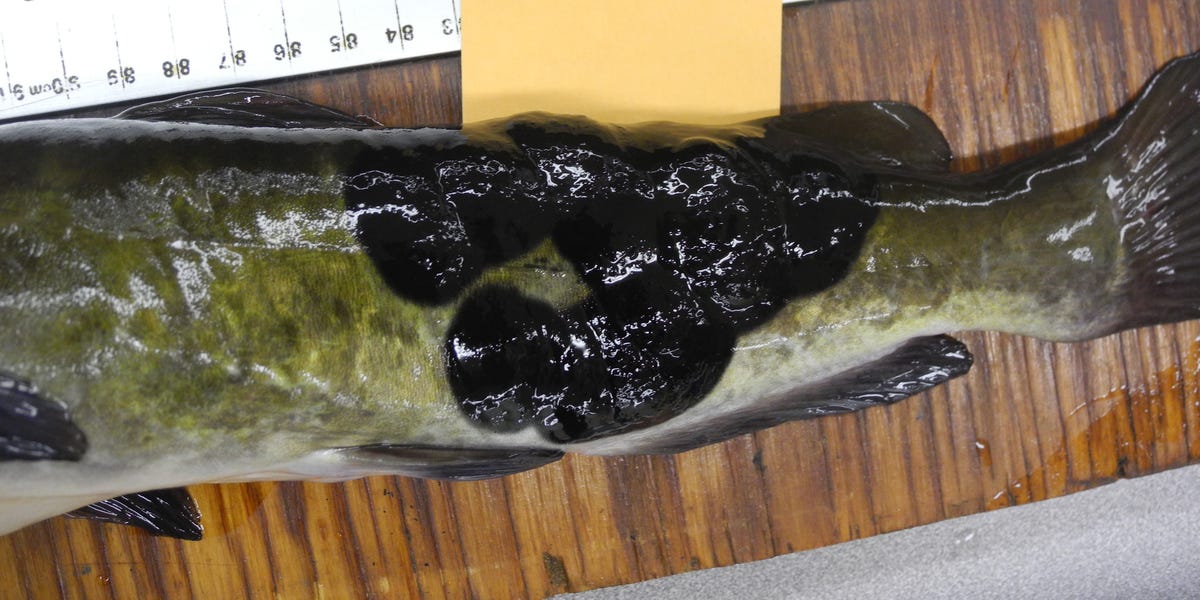
3 min readHere’s what you’ll learn when you read this story:Transmissible cancers are extremely rare but not unheard of in the animal kingdom.A new study highlights the fourth known transmissible cancer, a form of melanoma, impacting a catfish population in Lake Memphremagog on the border of Quebec and Vermont. Scientists discovered the disease after performing whole-genome sequencing on the fish and finding that the cancer cells had more in common with themselves than the fish hosts they were infecting.Cancer is a killer. According to the World Health Organization (WHO), cancer accounted for nearly one in six deaths throughout the world in 2024. But at least the one good thing about cancer is that, at the very least, the disease isn’t communicable. Right?Well, a new study published in the journal Nature details an ultra-rare incidence of a transmissible cancer found among a particular catfish population in Lake Memphremagog, on the border of Quebec and Vermont. In 2012, anglers in the area first spotted catfish with peculiar black spots and bumps on their skin. Vermont’s Fish and Wildlife Department tasked Julie Dragon, a microbiologist at the University of Vermont, to figure out if a virus was causing this strange and ominous affliction. After more than a decade of a trial-and-error process of trying to pinpoint a culprit, Dragon—along with colleagues around the state and the rest of the country—determined that this disease is likely a transmissible cancer, an extremely rare case in the animal kingdom.“Our contention is that maybe it’s not as rare as everyone thinks. We’re just not seeing it,” Dragon said in a press statement. “In the case of transmissible cancers, it may be that we don’t see many simply because we aren’t looking for them.”Certain viruses like HPV and bacteria such as Helicobacter pylori can cause cancer in humans. While these pathogens are contagious between people, the cancers they trigger are not. But so far, scientists have confirmed transmissible cancers in three groups of animals: dogs, Tasmanian devils, and marine bivalves like clams, mussels, and cockles. The brown bullhead catfish (Ameiurus nebulosus) would be the fourth—and the first fish of any kind. While Dragon initially ruled out viruses as the underlying cause, wildlife officials and lakeside residents pointed fingers at a nearby landfill and at the toxic runoff Tropical Storm Irene flushed into the water in 2011. A separate study published in May this year even found increased levels of certain metals in the skin of infected fish. However, Dragon couldn’t rule out that the population was somehow inbred, so she began a genetic analysis of the sickened population, and what she found was a big surprise.“Whole-genome sequencing of tumor and matched non-tumor host tissues revealed that tumor mitochondrial and nuclear genomes are more closely related to each other than to their hosts or unaffected fish,” the authors wrote. “Hundreds of thousands of genetic variants are shared among tumour samples but are absent from host fish, vastly exceeding levels seen in conventional cancers.”This is atypical because most cancers are derived from a host’s cells and therefore are similar to each other. The cancer cells in these fish, on the other hand, resembled each other but not the hosts they’d infected. The cancer sometimes spread into other organs and older fish appeared to have been living with the disease for a long time. But the big question is how the tumors spread through the population in the first place.According to the CBC, the research term hasn’t replicated transmission in the lab, but a leading theory is that fish somehow spread the disease when spawning. This hypothesis is supported by the fact that only adult fish are infected with the cancer.“We always get asked ‘is it still a virus that’s spread the tumors?’’ Dragon said in a video about the study. “It is not. The tumor cells themselves are the infection agent spreading from fish to fish.”Interestingly, famous naturalist and Transcendentalist Henry David Thoreau might have first described such a disease in the mid-19th century in Massachusetts, when he wrote that “one of these large pouts [catfish] had a very large velvet-black spot, which included the right pectoral fin; a kind of disease I have often observed on them.” So it could be that this transmissible cancer has thrived in the region for a century or longer.For now, the disease will be added to an unenviable list of contagious cancers as scientists continue researching what the broader impacts could be on bullhead catfish and the region itself.Darren lives in Portland, has a cat, and writes/edits about sci-fi and how our world works. You can find his previous stuff at Gizmodo and Paste if you look hard enough.
Scientists Saw Strange Spots on Local Fish. The Culprit Was Cancer That Spreads like an Infection.
Full Article
Original Source
Read the full article at Popularmechanics →KhanList aggregates and links to publicly available news content. We do not host full articles from third-party sources. Always verify important information with original sources.