
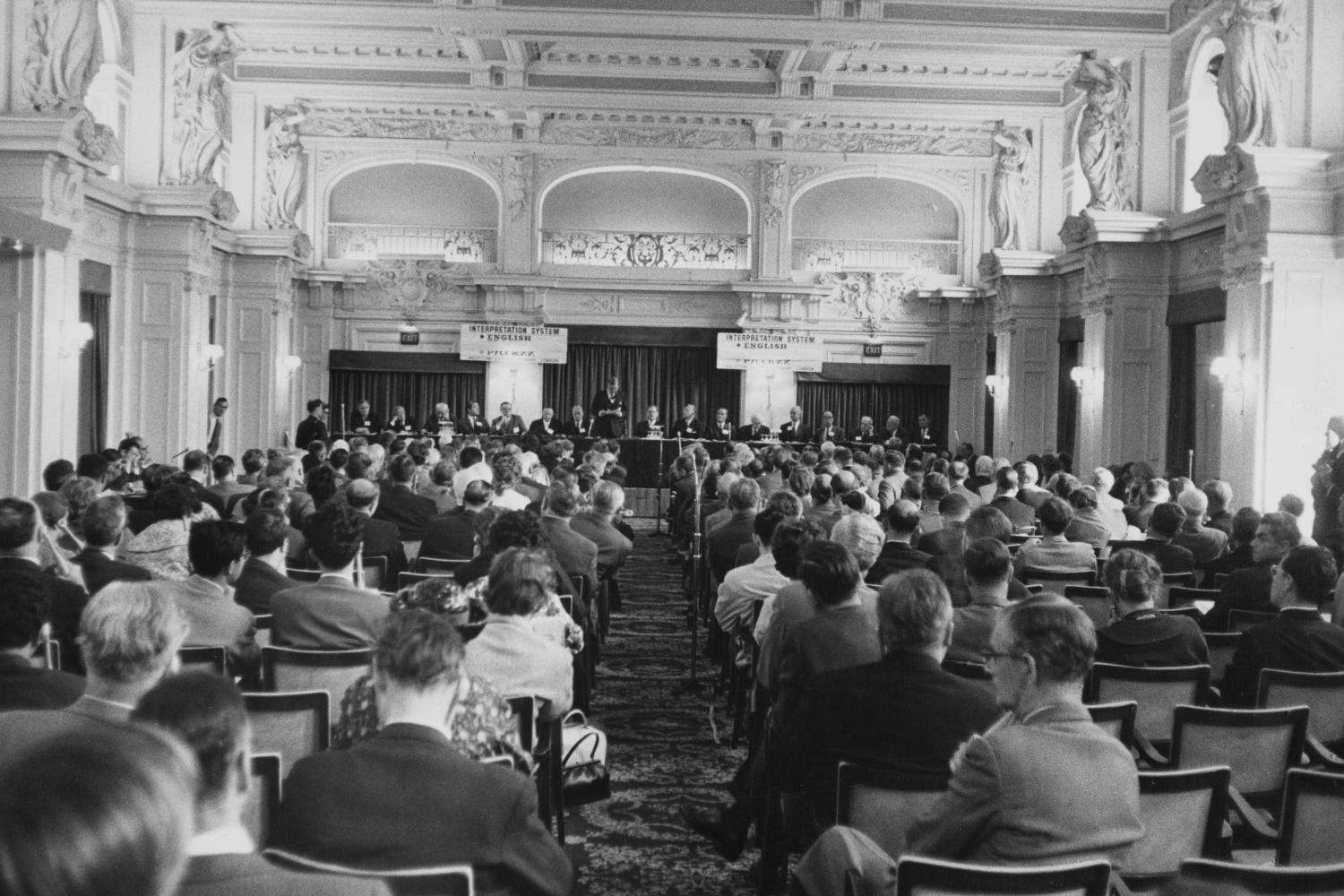
In 1957, at the height of the Cold War nuclear arms race, 22 scientists from 10 countries gathered in the small Canadian fishing village of Pugwash. Many were leading architects of the technologies underpinning their governments’ national security programs, including several who had contributed to the development of the world’s first atomic weapons under the Manhattan Project. Now, they were grappling with the sense that they had lost control over the technologies they had helped create. The founders of the Pugwash conference heeded calls from philosopher Bertrand Russell and physicist Albert Einstein, two of the 20th century’s most prominent intellectuals, to “appraise the perils” arising from the development of weapons of mass destruction. Over the course of the next seven decades, the Pugwash Conferences on Science and World Affairs convened thousands of scientists and experts from around the world in more than 400 symposia and workshops. The movement received the Nobel Peace Prize in 1995. In 1957, at the height of the Cold War nuclear arms race, 22 scientists from 10 countries gathered in the small Canadian fishing village of Pugwash. Many were leading architects of the technologies underpinning their governments’ national security programs, including several who had contributed to the development of the world’s first atomic weapons under the Manhattan Project. Now, they were grappling with the sense that they had lost control over the technologies they had helped create. The founders of the Pugwash conference heeded calls from philosopher Bertrand Russell and physicist Albert Einstein, two of the 20th century’s most prominent intellectuals, to “appraise the perils” arising from the development of weapons of mass destruction. Over the course of the next seven decades, the Pugwash Conferences on Science and World Affairs convened thousands of scientists and experts from around the world in more than 400 symposia and workshops. The movement received the Nobel Peace Prize in 1995. In 2026, the convergence of artificial intelligence and biotechnology poses a similar existential threat—and demands a similar response. In June, AI industry leaders warned that AI could erode the knowledge barriers that have historically kept biological warfare at bay and urged U.S. lawmakers to establish stronger safeguards for synthetic DNA and RNA. A photograph of Joseph Rotblat, the founder of the Pugwash movement, with both hands up upon hearing that he was to be awarded the winner of the Nobel 1995 Peace Prize. Joseph Rotblat, the founder of the Pugwash movement, upon hearing that he was to be awarded the 1995 Nobel Peace Prize. Biosecurity, however, cannot be managed through national action alone. It requires international cooperation, which has been weakened in recent years by stalled and defunded multilateral efforts. As geopolitical rivalry erodes prospects for global cooperation, alternative methods of diplomacy must begin at the source: scientists themselves. Through the Pugwash movement, scientists developed a technical foundation for nuclear risk reduction and arms control that could be implemented when political conditions permitted, building the knowledge and relationships that made later nuclear arms control agreements possible. As modern technological change outpaces governance, track-two scientific engagement can similarly provide a vital safeguard against catastrophic risks. The Pugwash model offers enduring lessons for governing the AI-biotechnology nexus across geopolitical divides—but the global accessibility of the modern threat demands an even more ambitious response. The debate over the regulation of AI and biotechnology is unfolding amid intensifying strategic competition between China and the United States. Chinese President Xi Jinping seemed to reflect a desire for cooperation at the World Artificial Intelligence Conference in July when he said AI development should be a “symphony of global cooperation.” But Xi also criticized U.S. technology restrictions while advancing China’s own Digital Silk Road agenda, ultimately promoting a more active role for Beijing in shaping global AI governance. The United States has also prioritized its own technological leadership: According to a letter written by the State Department and seen by the New York Times, Washington is preparing to press dozens of countries to choose between competing U.S. and Chinese AI ecosystems. In contrast, Pugwash demonstrates the importance of building a collective identity. Over years of interaction, participants from some 50 national groups, including the United States, Soviet Union, United Kingdom, and China, built a rare channel across the Iron Curtain. They developed an identity as “Pugwashites” and saw one another not as adversaries but as colleagues working toward a common cause. According to a declaration following the third conference, delegates were uniquely able to “find a common basis of understanding” because “they use the same concepts and the same methods; they work toward common intellectual goals.” Delegates served as advisors to their governments and maintained high-level state contacts, feeding ideas from the conferences into official negotiations. Soviet Premier Nikita Khrushchev cited a proposal made by British scientists at the first Pugwash conference in 1957 in his correspondence with U.S. President John F. Kennedy, and elements of the proposal fed into the Soviet negotiating position that helped produce the 1963 Limited Test Ban Treaty. Though scientists did not negotiate the treaty themselves, they developed a technical solution for governments to bring to the table. That function would be especially important today. Scholars are urging stronger Biological Weapons Convention (BWC) mechanisms in response to rapid advances in AI and biotechnology—yet the BWC relies on the U.N. Security Council to investigate alleged violations, leaving enforcement vulnerable to political gridlock and U.S. disengagement. Scientific dialogue cannot resolve these political obstacles on its own, but it can preserve the expertise, relationships, and trust needed to develop workable proposals when governments are ready to act. The AI-biotechnology nexus therefore requires a Pugwash-style approach to foster trust, facilitate information exchange, support collaborative risk assessment, and make ethical questions easier to confront. A contemporary Pugwash should bring together leading scientists, technologists, and ethicists to allow experts to explore solutions beyond government interests. A photograph of China's President Xi Jinping appears on a news program speaking at the opening ceremony of the World Artificial Intelligence Conference outside a shopping mall in Beijing seen on July 17, 2026. Chinese President Xi Jinping, speaking at the opening ceremony of the World Artificial Intelligence Conference, appears on a news program broadcast outside a shopping mall in Beijing on July 17.Getty Images/Greg Baker What about corporate and industry interests? Executives have a direct incentive to support collective global action. In June, the U.S. government ordered the suspension of two Anthropic models for all foreign nationals after discovering a possible security bypass. Critics said this action handed Chinese open-source developers valuable time to catch up with the U.S. companies. The situation demonstrates why a Pugwash-style international forum could be invaluable. If the breach had been met with a coordinated restraint strategy facilitated by industry leaders and informed by conference findings, the shared risk could have been addressed without leaving one company uniquely disadvantaged. Companies and individuals developing AI and biotechnology should thus help fund these dialogue efforts. Industrialist and philanthropist Cyrus Eaton, for example, made the first Pugwash conference possible after offering to anonymously finance and host the meeting at his home in Nova Scotia. Today’s tech leaders occupy a more complicated position because they have a direct commercial stake in the technologies whose risks they seek to address. CEOs such as OpenAI’s Sam Altman and Anthropic’s Dario Amodei have sounded the alarm about AI risks more broadly, but they have not yet backed concrete restrictions commensurate with those warnings. Individuals positioned outside the industry itself may be better suited—such as former Apple CEO Tim Cook or eBay founder Pierre Omidyar, whose philanthropy has funded AI ethics and governance research since 2017. But finding a modern-day Eaton is only part of the challenge. In the nuclear age, governments funded and controlled most of the relevant research and had direct security responsibility, while today, private companies drive much of the innovation in AI and biotechnology. Financial motivations could compromise a forum’s intellectual independence. To avoid completely sidelining AI industry leaders, science diplomacy could be complemented with periodic roundtables between participants and those leaders. Pugwash also offers a cautionary lesson. A lack of broad, cross-coalitional support and political pressure from both sides of the Iron Curtain left the conferences vulnerable to politicians’ whims. At the height of the Red Scare in 1960, U.S. Sen. Thomas J. Dodd denounced the meetings as “communist conclaves,” prompting President Lyndon B. Johnson to eventually cut ties between Pugwash and the U.S. government. Soviet delegates were required to report to the KGB after being vetted and selected by the state. As a result, Pugwash’s impact was diffuse and often delayed. When political leaders changed course or left office, the relationships on which scientists’ influence depended vanished with them. The U.S. National Security Commission on Emerging Biotechnology, charged by Congress with assessing how emerging AI and biotechnology should shape defense policy, offers a contemporary, domestic example of the cross-party grounding Pugwash lacked. Broader political support helps shield scientific diplomacy from swings in power and preserve ideas across changes in government. Meanwhile, independent efforts such as Biotic—a nonprofit founded by scientists to build open infrastructure and governance norms for biotechnology—demonstrate what scientific independence and cross-border collaboration can look like outside of government. But without formal channels into policy, that work risks the same political vulnerability that limited Pugwash. The challenge is to combine the strengths of these models: international relationships, scientific independence, and a durable connection to government decision-making. Various international track-two efforts have already formed in response to a need for cooperation within the AI and biotech spheres, including dialogue convened by the Brookings Institution and Tsinghua University, which has supported formal cooperation between the United States and China surrounding the military application of AI. Talks on biotechnology between the two countries have been convened by Washington- and Beijing-based nonprofits, in addition to those established by Johns Hopkins University, which focus on Southeast Asia and the U.S.-India partnership. These efforts, however, remain largely regional or bilateral and tend to draw on policy-heavy rosters. The global accessibility of AI-enabled bioweapons requires broader geographic participation, while the pace of technological change demands solutions that transcend geopolitical divides. Managing the risks of such fast-moving technology requires sustained engagement with the scientists driving that development, alongside the engineers and companies responsible for its application. It also requires governments to have durable channels for receiving and acting on that expertise, balancing competing interests and translating scientific consensus into policy and, ultimately, international rules. Building those channels now can ensure that when the opportunity for collective action arises, the workable proposals needed to act are already in place.
Scientists Saved Us From Catastrophic Risk Before
Full Article
Original Source
Read the full article at Foreignpolicy →KhanList aggregates and links to publicly available news content. We do not host full articles from third-party sources. Always verify important information with original sources.