
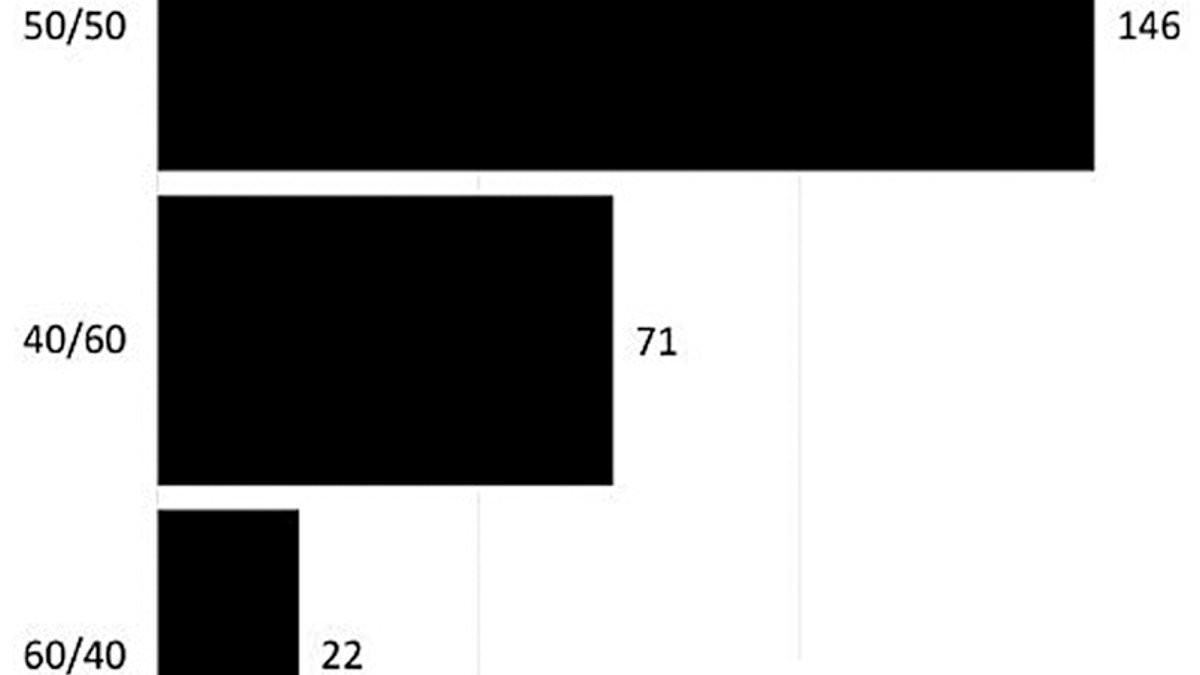
READ MORE: Why women's breasts are so large compared to other animals See more Daily Mail on Google - save us as a Preferred Source Published: 05:37 EDT, 31 August 2026 | Updated: 05:39 EDT, 31 August 2026 When it comes to body confidence, having larger boobs is something many women dream about.But be careful what you wish for – as it turns out bigger isn’t always better.That’s according to a new study, that found symmetrical proportions are key when it comes to the ‘perfect’ breasts.A team from the University of Passo Fundo in Brazil asked 239 university students to view a series of images and select their preferred breast shapes.The pictures depicted different ratios between the upper and lower parts of the breast, showing a 40/60 ratio, a 50/50 ratio and a 60/40 ratio.The 60/40 ratio, which indicates a fuller upper half and therefore a larger overall breast, was preferred by only 10 per cent of the students.However, 61.1 per cent selected the 50/50 ratio, indicating they prefer an equal distribution of tissue between the upper and lower halves of the breast.‘The results demonstrated a preference for symmetry patterns compared to those with some pole deviation or angulation,’ the researchers wrote in the Brazilian Journal of Plastic Surgery. The vast majority of participants preferred a 50/50 ratio, indicating they prefer an equal distribution of tissue between the upper and lower halves of the breastThe study also revealed certain preferences regarding the placement of the nipple and areola.Nearly 60 per cent of participants said they preferred them to be centrally located, rather than sitting closer to the outside of the chest.The majority of students also said they thought the smaller areola and nipple combination looked the best.Overall, the responses of male and female students were largely the same, the researchers said – showing a unified perspective on breast aesthetics.‘In this cross-sectional study, it was possible to identify various aesthetic preferences regarding the breast,’ the researchers said.‘A predominant appreciation for harmonious proportions was observed, especially the 50/50 ratio between the upper and lower poles, the central location of the areola-nipple complex, and the reduced size of the areola and nipple.‘No statistically significant differences were found between genders, indicating agreement between men and women regarding the ideal breast aesthetic.’The team said their findings could be useful for plastic surgeons, and that techniques which improve breast symmetry should be considered. The pictures used in the study depicted different ratios between the upper and lower parts of the breast, showing a 40/60 ratio, a 50/50 ratio and a 60/40 ratioA previous study, carried out by Texas A&M University, found that women who boast larger cup sizes tend to be on the receiving end of more aggression.It suggests that this may be driven by the perception of women with bigger breasts as a threat.'Given the strong importance men place on women's breast morphology, most notably size, women, in general, are attentive to this factor,' the team wrote in the study.'Breast size contributed to rival derogation towards other women, with women with larger breast sizes more likely to be the victims of verbal and indirect aggression.’HOW HAVE IDEAS ABOUT THE 'PERFECT' FEMALE BODY CHANGED? Perceptions of the ideal female body can be linked to representations of women in media, whether found in pop culture, fashion or even politics.These images of feminine attractiveness have changed significantly over the years.1910 The Gibson Girl - An image produced by American graphic artist Charles Dana Gibson depicted the ideal female figure as tall and regal with an S-curve torso shape1920 The Flapper - Cultural change sparked by the suffragette movement gave birth to short hair, knee length dresses and a more rambunctious, yet petite, view of female beauty1950 The Hourglass - Voluptuous curves became important following the end of WWII, which also saw the creation of one of the most influential female bodies, Barbie 1960 The Twig - British cultural icon and model Twiggy brought forward an androgynous look in female ideals where small breasts and thinness were key1990 Heroin Chic - Supermodels like Kate Moss bring their thin grunge looks to the runway Today - Muscular and toned bodies are preferred over slim figures
Scientists reveal what the perfect breasts look like - and say bigger isn't always better
Full Article
Original Source
Read the full article at Dailymail →KhanList aggregates and links to publicly available news content. We do not host full articles from third-party sources. Always verify important information with original sources.