
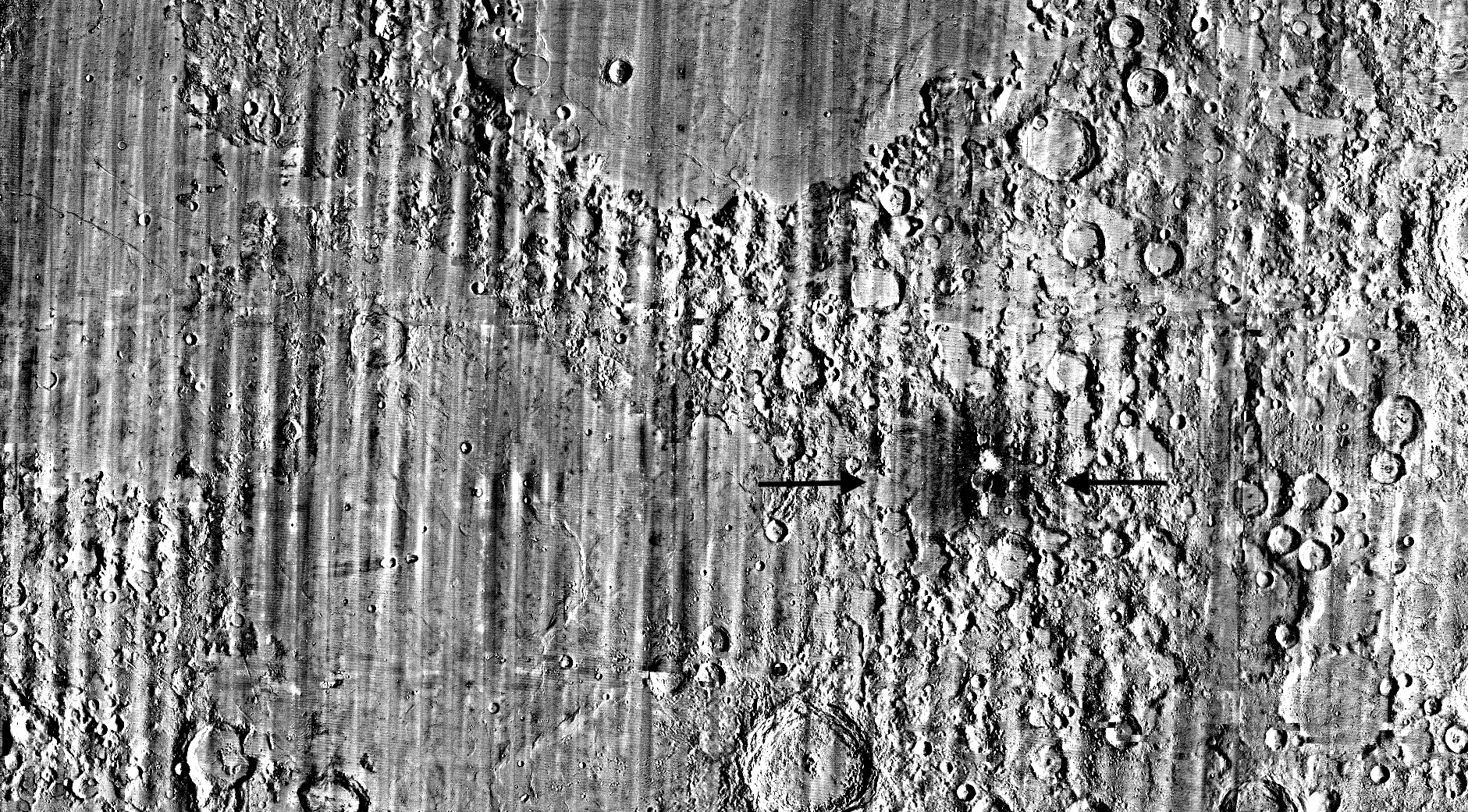
It's easy to think of the Moon as the static constant companion in the night sky. Its face hasn’t visibly changed in millennia, and always faces us with the same side. But looks can be deceiving, as our closest companion is constantly bombarded by asteroids and comets that make small craters across the lunar landscape. While they might not be large enough for us to see with our naked eye, professional Moon watchers can pick up on them. And a recent paper published in Science Advances, describes the largest ever found in modern times. That crater, which is now named McGetchin, after Tom McGetchin, a celebrated lunar scientist, was formed somewhere between April 11th and May 22nd, 2024. But it wasn’t discovered until October of 2025, when Robert Wagner, an image-processing specialist with Intuitive Machines, happened to notice a dramatic change when stitching together a global difference map. Doing so involves comparing “before” and “after” images to see what’s changed on the lunar surface, and according to a quote from a press release, Wagner immediately knew he had found something unique. “I just stopped, dropped everything, and started looking into what that spot was,” Wagner said. “It was by far the most obvious impact debris pattern I’ve ever seen in one of those images.” Fraser reports on the crater found in LRO imaging. The images he’s referring to were taken by the Lunar Reconnaissance Orbiter (LRO), which takes both wide-angle and extreme close-ups of the lunar surface. These are occasionally stitched together to generate the global difference maps, with anything that stayed the same displayed as a dull grey color, whereas changes can show up in either very light or very dark patches. McGetchin stood out like a sore thumb in those images, and prompted a wider effort to characterize what had caused it. After examining some close-ups taken of the impact site, they found the crater was 222m across and around 43m deep. It was likely caused by an asteroid or comet around the size of a three to six story building. And, crucially, they estimated that this size of an impact only happens about once every 132 years. It is certainly the largest new impact site ever discovered in the solar system to date. But its broader impact was even larger. The researchers turned LRO’s thermal imaging system, known as Diviner, towards the crater and discovered a 6.4 km thermal anomaly surrounding the site. During the lunar night, a broad halo around the newly formed crater stayed about 9℃ colder than the surrounding area. Fraser describes how big of a problem meteorites are for the Moon. Most likely, that temperature differential was caused by regolith that had been “fluffed” by the impact. That’s a very nice way of saying that it had been blasted loose from its more compacted counterparts nearby and ended up much less dense than the surrounding area, allowing it to hold on to less heat during the lunar night cycle. Ultimately, studying this larger crater in detail will allow scientists to better understand both how impacts themselves shape the lunar terrain and also the mechanical properties of that terrain itself. As we move towards more intensive lunar exploration, understanding both of those features of lunar life will be critical for everything from designing wheels that grip the ground to habitats that can withstand a direct meteorite hit. It’s really lucky that we got a once in a century chance to look at a big one before all of those design choices were finalized. Learn More: NASA - NASA’s Moon Orbiter Spots New, ‘Once-in-Century’ Moon Crater M.S. Robinson et al - A new 222-m diameter lunar crater UT - The Moon Just Got a New Scar UT - The Man in the Moon Gets a New Scar
Scientists Release Details About Moon's New Massive Crater
Full Article
Original Source
Read the full article at Universetoday →KhanList aggregates and links to publicly available news content. We do not host full articles from third-party sources. Always verify important information with original sources.