
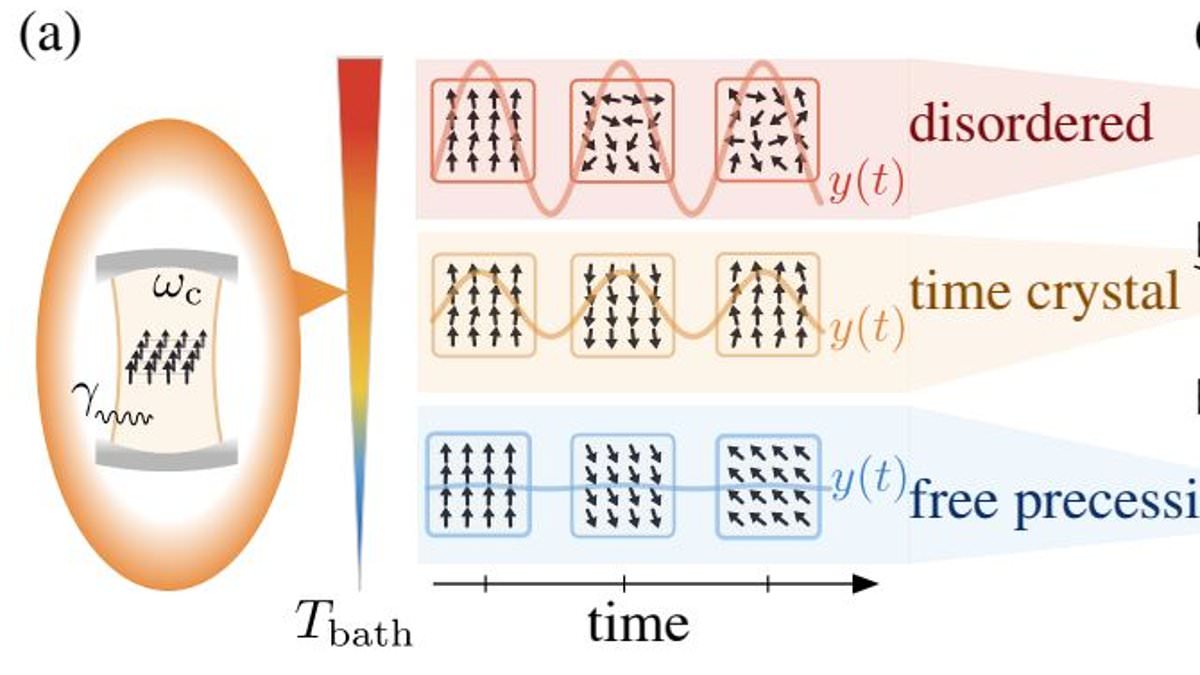
While solids, liquids, and gases make up the familiar world around us, scientists have now proposed a 'new state' of matter that is far, far stranger.According to researchers from the Max Planck Society, there could be a type of liquid which flows not in space, but in time.Appropriately named 'time liquids', these theoretical substances imperfectly repeat patterns through time in the same way that atoms in a liquid loosely hold a pattern in space.Although scientists have not yet encountered this baffling state, mathematical modelling suggests it could exist under certain very specific circumstances.Time liquids are very similar to so–called 'time crystals', a strange state of matter that scientists managed to create in the lab for the first time in 2016.However, time crystals can only form when the conditions are just right and can lose their 'crystal' structures if things aren't perfect.Time liquids, on the other hand, might be able to exist in stable, even temperatures, technically known as a thermal equilibrium.This might mean these strange forms of matter could exist in a wider range of situations, and it might even be possible to create them in the lab. According to researchers from the Max Planck Society, there could be a type of liquid which flows not in space, but in time. This 'time liquid' could help scientists probe how order arises out of apparent chaos. Pictured: A diagram showing how time liquids form Scientists say that time liquids form under very specific circumstances and imperfectly repeat patterns through time in the same way that atoms in a liquid loosely hold a pattern in spaceTo understand what a time liquid really is, you need to start with the concept of a time crystal.If you looked at an ice crystal under a powerful enough microscope, you would see that the atoms are arranged in a repeating pattern that stretches out in space.If the crystal got bigger, this pattern would only repeat and keep on going forever.Time crystals are like an ice cube, which has predictable, repeating patterns that extend out in time as well as space.In practice, these crystals vibrate or 'tick' at constant frequencies, meaning that they are crystallised in four dimensions rather than the usual three.In the lab, scientists have managed to create time crystals that swirl and move when light is shone on them, creating psychedelic tiger stripe patterns that repeat over time.Describing the creation of a new time crystal last year, Dr Hanqing Zhao, from the University of Colorado Boulder, said: 'Everything is born out of nothing. All you do is shine a light, and this whole world of time crystals emerges.'Although they are fragile and sensitive to the environment, time crystals should theoretically be able to keep repeating their patterns forever, like a watch that never needs winding. Time crystals repeat patterns in time in the same way that normal crystals, such as ice, repeat patterns in space. In the lab, scientists have managed to create these by shining lasers at specially created diamonds A time liquid, meanwhile, is essentially what you would get if you 'melted' a time crystal like a chunk of ice.When ice melts into liquid water, the perfect crystal structure breaks down into fluid chaos in which the atoms only maintain a regular structure by interacting with their nearest neighbours.Likewise, a time liquid doesn't have the long–term coherence of a time crystal but does maintain a form of 'short–range' temporal order.If scientists find a way to repeat this in the lab, it could unlock new ways of investigating how matter responds to the environment, and how order can emerge out of apparent chaos.However, the set–up required to create a time liquid is extremely complicated.In their preprint paper, published on arXiv, the researchers describe a 'two–dimensional spin system coupled to a finite–temperature cavity'.To understand what that means, imagine a flat sheet of tiny magnetic compass needles that can spin clockwise or anticlockwise, placed inside a hollow chamber containing a magnetic field.As the chamber is heated, random thermal fluctuations would create an electromagnetic field that would spin the arrows as they interact with their neighbours. This image shows a time crystal seen under a microscope; when light hits the crystal, it produces bars of colour that move in organised patterns Like a bell tuned to a certain note, this cavity has a certain resonant frequency so that the random changes produce an approximate rhythm even if no one is deliberately keeping time.If that pattern just kept on repeating, you might have something close to a time crystal, but that's not what the researchers' mathematical modelling showed.Under some conditions, the spinning needles would keep their rhythm overall but occasionally skip out of order, skipping between two versions of their repeating patterns.These defects disrupt the long–range coherence without destroying the underlying rhythm, just like the atoms in water maintain some of their local structures even if the overall coherence of the crystal has been lost in melting.Right now, this strange construction remains entirely theoretical, but there is reason to think it might become real.When time crystals were first proposed in 2012, many people thought they could never be created, and now labs are even starting to find practical uses for these strange entities.So, it may only be a matter of time before scientists manage to create an even weirder state of matter in the lab.WHAT ARE TIME CRYSTALS? While the atoms that make up crystals such as ice or diamond are arranged in a repeating pattern through space, the pattern behind time crystals repeats in time.These strange crystals are made up of interacting atoms that never ‘settle down’ to thermal equilibrium.Their structure repeats in time as they are ‘kicked’ periodically, similar to the way Jell-O jiggles when it is tapped. ‘Wouldn’t it be super weird if you jiggled the Jell-O and found that somehow it responded at a different period?’ said Berkeley physicist Norman Yao. Last year, scientists revealed the discovery of an astounding new form of matter they claimed breaks the symmetry of time‘But that is the essence of the time crystal. 'You have some periodic driver that has a period ‘T,’ but the system somehow synchronizes so that you observe the system oscillating with a period that is larger than ‘T.’’ But, the researchers explain, repetition alone isn’t enough.To hold it all together and make it 'rigid,' the crystal must have stable enough rhythm.
Scientists propose a 'new state' of matter in which a liquid can flow in TIME
Full Article
Original Source
Read the full article at Dailymail →KhanList aggregates and links to publicly available news content. We do not host full articles from third-party sources. Always verify important information with original sources.