
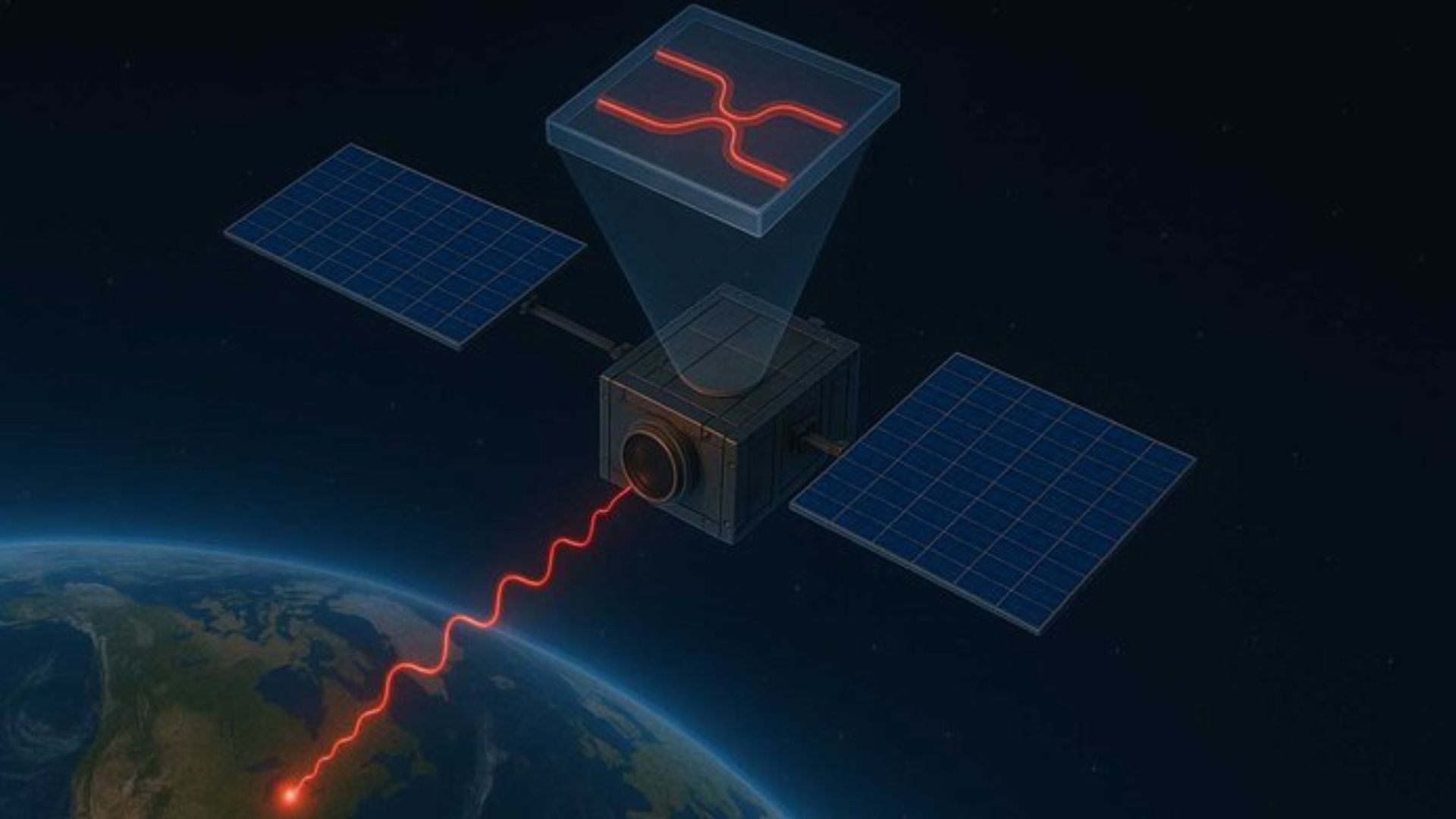
Scientists at the University of Vienna have achieved a global first after operating a quantum computer in space. The computer was launched on a Falcon 9 rocket in June 2025. It could only be operated after much tribulation, showcasing the challenges of operating new technologies in the harsh environments of space. The idea to launch a quantum computer to space was also a response to another challenge being faced in space- the data bottleneck for satellites. While companies like SpaceX have made it easier to launch missions into orbit, the challenges of operating them are much the same. Satellites are great at collecting raw data but do not carry compute that can process it. This means that all captured data must first be sent back to Earth to make sense of it. However, this creates a bottleneck because downlink bandwidth and ground-station availability limit how much data is received. A possible alternative to this is to process the data on the satellite itself, and a quantum solution would be ideal. It is common knowledge now that qubits, or quantum bits that store information in quantum computers, are extremely sensitive to outside disturbances. The orbital environment that satellites operate in does not offer the highly controlled environments of quantum laboratories, which can shield the system. Before a quantum computer can operate, it must be launched on a rocket, and its components undergo severe mechanical stress before reaching orbit. Researchers from the University of Vienna reinforced the computer components using titanium baseplates and fragile optical fibers using epoxy, Even after extensive vibration testing before launch, only three of the six silicon single-photon avalanche diodes (SPADs) on the computer, needed to detect photons, survived the trip. The harsh sunlight of space created huge background noise for the SPADs to make any measurements. So, scientists used the brief 30-minute periods that the satellite passes in the Earth’s shadow to make the measurements. Radiation and Laser problems In case you were of the view that hurdles were now behind them and the team could focus on data processing, that would still have a been a smooth ride to get to this point. Once the sunlight issue was resolved, the researchers faced radiation hurdles from the Van Allen belts created by the Earth’s magnetic field and which traps photons and electrons. The team anticipated this when preparing for put the quantum computer in space and encased the device in centimeter-thick, aerospace-grade aluminum. The casing worked for the electrons but couldn’t keep protons at bay, which degraded the photon detectors. The adhesive used to keep the laser in place also degraded in vacuum and contaminated its optics, which reduced the laser’s output from 20 milliwatts to four milliwatts. Even after much tribulation, the researchers were finally able to test if photons traveling through the instrument’s circuits were indistinguishable. Based on experiments on Earth, this was expected to happen when temperatures of the crystals producing the photons reached 90.5 degrees Fahrenheit (32.5 degrees Celsius), and that’s exactly what the team saw in space. While this doesn’t help process satellite data in space yet, it shows that quantum processors can be compressed, can operate in space, and can be used to establish quantum links between satellites and the ground. The research findings are on the preprint server arXiv. Get the latest in engineering, tech, space & science - delivered daily to your inbox.Ameya is a science writer based in Hyderabad, India. A Molecular Biologist at heart, he traded the micropipette to write about science during the pandemic and does not want to go back. He likes to write about genetics, microbes, technology, and public policy.
Scientists operate quantum computer in space for first time after launch challenges
Full Article
Original Source
Read the full article at Interestingengineering →KhanList aggregates and links to publicly available news content. We do not host full articles from third-party sources. Always verify important information with original sources.