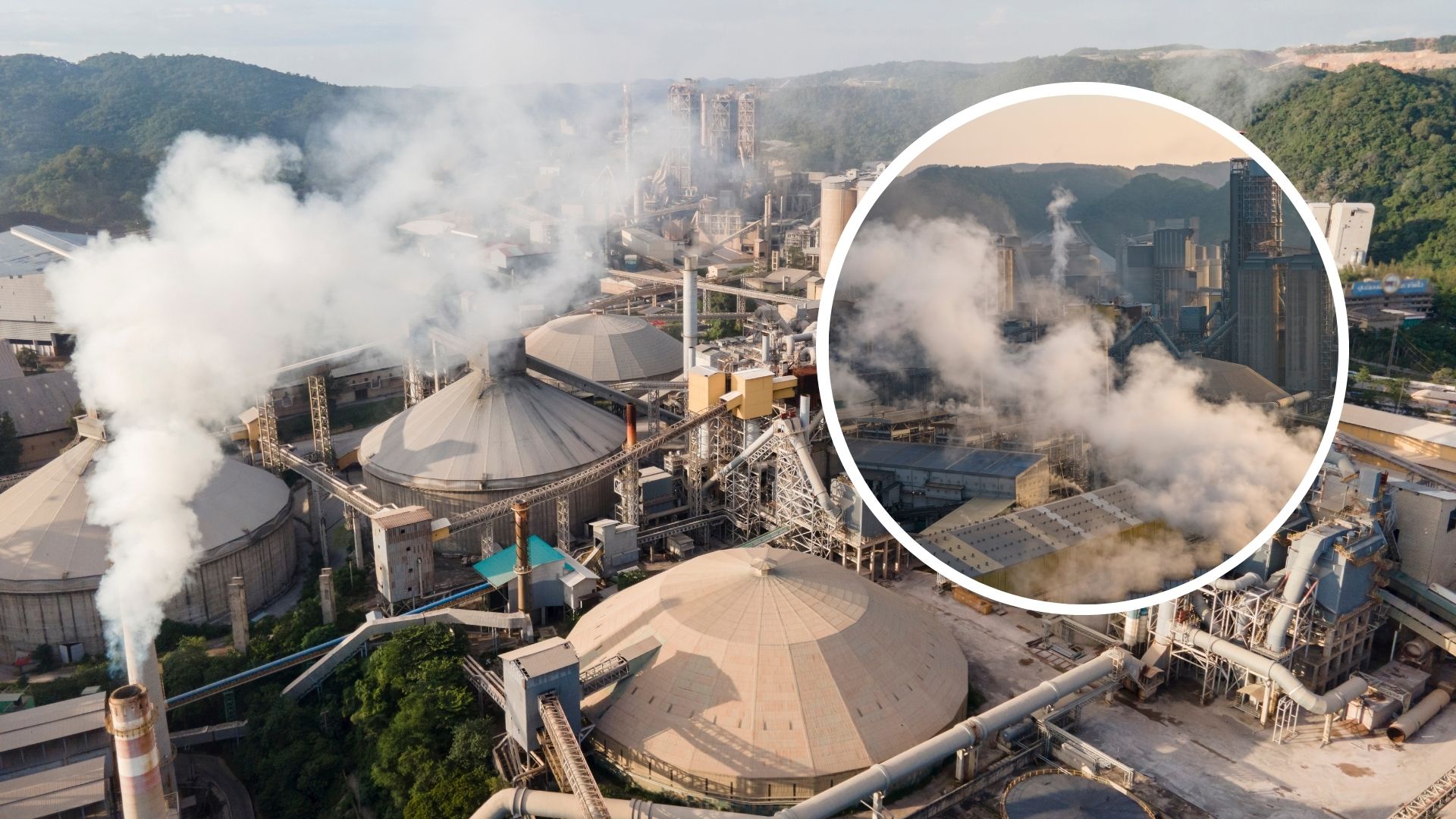
A new approach developed by researchers at ETH Zurich could transform cement plants from major sources of carbon emissions into facilities capable of removing carbon dioxide from the atmosphere.Cement is essential to modern civilisation. Roads, bridges, homes, offices and countless other structures depend on it. But there is a major environmental cost: cement manufacturing is responsible for an estimated 5–8 per cent of global carbon dioxide (CO₂) emissions. Now, researchers at ETH Zurich have identified a potentially important way to change that equation. Cement production could be integrated with Direct Air Capture technology Their study suggests that cement production could be integrated with Direct Air Capture (DAC) technology, allowing cement plants not only to reduce their own emissions but also to remove CO₂ that is already present in the atmosphere.The research, published in Chem Circularity, explores a system based on calcium looping, a process that uses the same basic material—limestone—that is already central to cement manufacturing. Cement production generates CO₂ in two major ways. First, producing cement requires enormous amounts of heat. Traditionally, cement kilns have relied heavily on fossil fuels, creating emissions from combustion.Second, and more fundamentally, limestone itself releases CO₂ when it is heated. Limestone, or calcium carbonate, is broken down during a process known as calcination, producing quicklime and CO₂.This means that simply replacing coal or gas with cleaner energy does not eliminate all emissions from cement manufacturing. This is why cement is considered one of the world’s difficult-to-decarbonise industries.“From a climate perspective, the combination of DAC and cement production is very promising,” stated Vittoria Bolongaro, a PhD student working with Bardow and lead author of the external pagepublication. The ETH Zurich research takes a different approach: instead of viewing the CO₂ released during cement production only as a waste stream, it proposes combining cement manufacturing with a technology that captures additional CO₂ directly from the atmosphere. The key technology is Direct Air Capture, or DAC. These systems use specialized materials to extract CO₂ from ordinary atmospheric air. The ETH Zurich study examines a DAC process known as calcium looping, which has a particularly interesting connection with cement production.Both technologies use calcium compounds and involve heating limestone. In the proposed system, limestone is heated to produce quicklime. Instead of allowing the captured carbon dioxide to escape, the process can separate and collect it. Water can then be added to the quicklime, producing slaked lime.The slaked lime is capable of absorbing CO₂ from the surrounding air. It is eventually converted back into limestone, which can once again enter the cement production process. In effect, the calcium material can act as a reusable carrier for atmospheric CO₂.The more times this material cycles through the air-capture stage before being used in cement production, the greater the potential amount of CO₂ removed from the atmosphere. The crucial difference: emissions reduction versus carbon removal.There is an important distinction between making cement less polluting and actually removing CO₂ from the atmosphere. If a cement plant simply replaces fossil fuels with renewable electricity, its emissions can fall substantially. If it captures CO₂ produced by the cement-making process and stores it underground, it can prevent those emissions from reaching the atmosphere.But the ETH Zurich approach goes one step further. The calcium-looping system can capture CO₂ directly from ambient air. That atmospheric CO₂ can then be compressed and transported for permanent underground storage.Consequently, the plant could potentially become net-negative—removing more CO₂ from the atmosphere than the entire system emits during its life cycle. The researchers modelled how the integrated system could perform in future scenarios. Their calculations indicate that electrifying the cement kiln and directly capturing CO₂ could reduce the climate impact of cement production by up to 78 per cent by 2050.However, the actual performance depends heavily on the source of electricity. This is because Direct Air Capture is energy-intensive. If the electricity required to operate the system comes from carbon-intensive sources, some of the benefits of capturing atmospheric CO₂ are lost.When the system is powered by low-carbon or renewable electricity, its performance improves considerably. The study estimates that by 2050, depending on the energy mix, calcium-looping DAC could achieve 85–96 per cent CO₂-removal efficiency. In practical terms, for every ton of CO₂ captured and permanently stored, approximately 40–150 kilograms of CO₂ could still be generated elsewhere in the process chain. Get the latest in engineering, tech, space & science - delivered daily to your inbox.Prabhat, an alumnus of the Indian Institute of Mass Communication, is a tech and defense journalist. While he enjoys writing on modern weapons and emerging tech, he has also reported on global politics and business. He has been previously associated with well-known media houses, including the International Business Times (Singapore Edition) and ANI.
Scientists’ new tech could help cement plants remove CO2 from atmosphere
Full Article
Original Source
Read the full article at Interestingengineering →KhanList aggregates and links to publicly available news content. We do not host full articles from third-party sources. Always verify important information with original sources.