
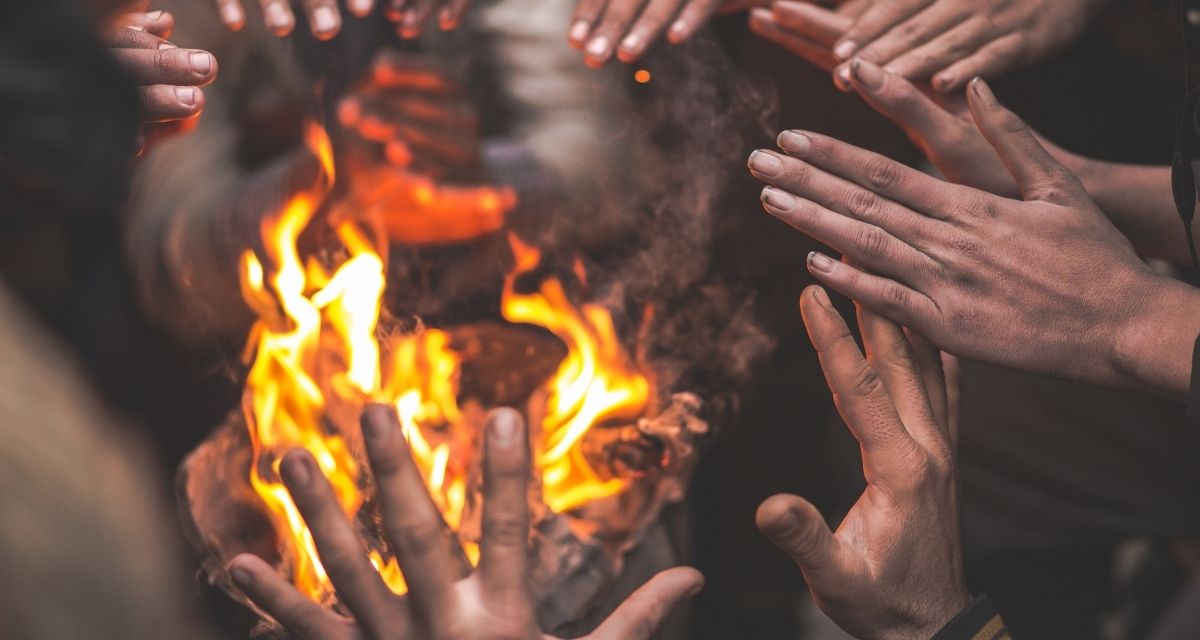
Long ago, man discovered how to make fire. Then, man developed spoken language. And with it, stories shared ’round the campfire. Works of fiction, told in darkness, that had next to nothing to do with survival and everything to do with connection. Both of these elements have remained defining characteristics of humanity ever since. And now, science has a new theory connecting these two things in a way that’s quite profound. For years, researchers have debated why humans developed spoken language when our closest ape relatives communicate primarily through gestures. The go-to explanations focus on Darwinian practicality: humans needed language to coordinate hunts, teach skills, warn one another about danger, and other more mundane matters. But researchers Catherine Hobaiter and Nathaniel Jay Dominy argue that those explanations don’t quite solve the mystery. Other animals can accomplish many of these same tasks without spoken language. Chimpanzees and gorillas have remarkably sophisticated gesture systems, with more than 140 documented gestures among eastern chimpanzees and more than 120 among mountain gorillas. Gorllia using gestures. Canva What our ape brethren haven’t been observed doing is telling stories. That requires a different kind of communication altogether. It has to follow a coherent narrative pattern that captures an audience’s attention and puts them in another time and place in their mind. It’s something humans do instinctively at this point, but it is a complex mechanism nonetheless. So where does fire come in? The researchers suggest that firelight itself may have helped push communication away from gestures and toward an increasingly sophisticated spoken language. To explore this theory, they first studied how fire behaves. The findings, published in the Proceedings of the Royal Society B, showed that a campfire can produce just enough light to make hand gestures visible. However, constantly shifting flames made those gestures hard to follow, making spoken words easier to understand. Flickering flames might have a deep connection with our mind’s capacity for taking in stories as well. Hands holding a flickering candle. Canva Fire gives off just enough blue light to lower levels of melatonin, a hormone that helps regulate sleep. That blue light gently diminishes as the flickers become embers. So, humans gained back more time for social connection (as much as four hours) without having their sleep completely disrupted. Researchers also recorded firelight flickering at roughly 1.4 to 2.7 times per second, a frequency that overlaps with some patterns of human brain activity associated with attention and memory. The authors speculate that watching the same flickering fire might have helped synchronize the attention of storytellers and listeners, potentially making stories more memorable. What the future holds for fireside storytelling These ideas remain largely untested. Instead, the paper proposes future experiments that could examine whether storytelling has a distinct rhythm, whether that rhythm relates to firelight’s flicker, and whether storytellers and listeners show stronger brain synchronization around flickering light. As Hobaiter put it in a press release, “It’s especially exciting…to be able to ask if, at the end of the day, we are the storytelling ape.” People cirlcing a campfire. Canva In a time when human connection and creativity seem at the peril of automation at every turn, the notion feels particularly moving. If the hypothesis is true, what bigger impetus do we need to reexamine whether or not efficiency is our primary collective aspiration? If we find ourselves once again gathered in the dead of night with only the flickering fire and our own imagination and each other…would that really be so terrible?
Scientists measured campfire light and discovered its incredible role in shaping human language
Full Article
Original Source
Read the full article at Upworthy →KhanList aggregates and links to publicly available news content. We do not host full articles from third-party sources. Always verify important information with original sources.