
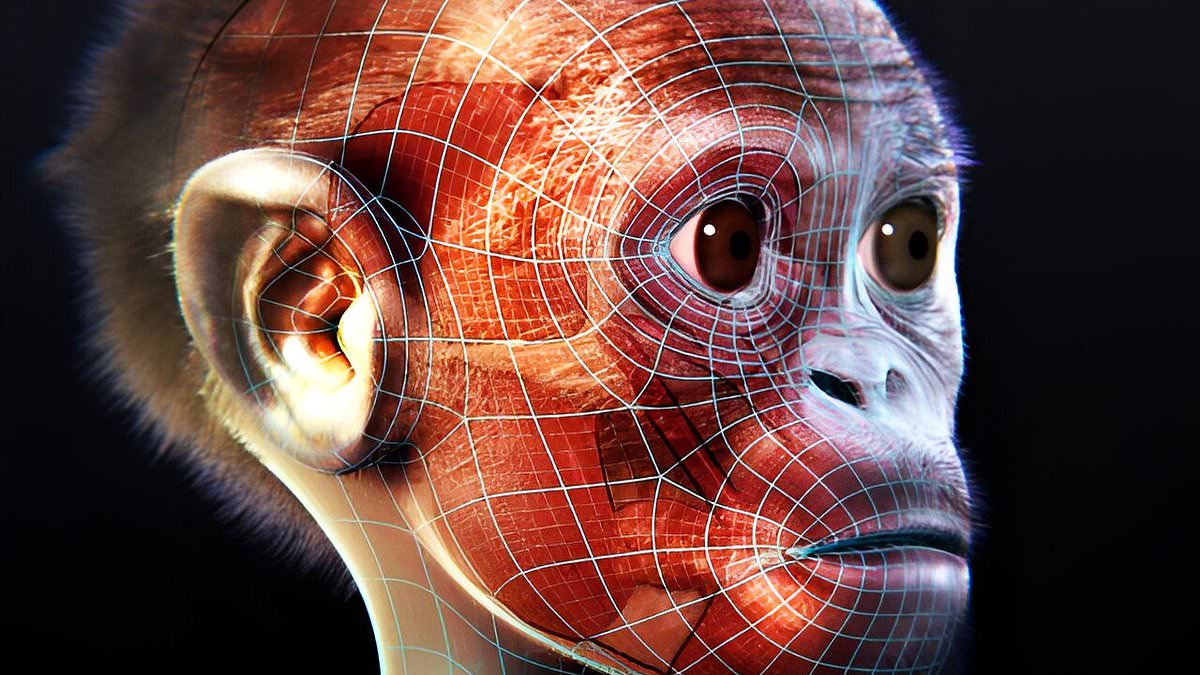
It might be time to rewrite the history textbooks, because a new analysis of a famous fossil reveals our ancient family tree is far messier than previously thought.A new study suggests that the celebrated Taung Child – one of the most important fossils ever discovered – belonged to a far more complex world of early human relatives than scientists had imagined.The child's skull was unearthed in South Africa in 1924 and became the first convincing evidence that humanity's origins lay in Africa rather than Europe or Asia.For more than a century, researchers regarded the fossil as the defining example, or 'type specimen', of the species Australopithecus africanus.Now an international team has concluded that the evolutionary picture surrounding the youngster is far more complicated.Their analysis dates the fossil to between 2.96 and 3.03 million years ago, placing the child in a turbulent period of environmental change across southern Africa.'For over 100 years, we assumed the Taung Child was just one of many similar fossils from the era,' Professor Gabriele Macho, from Vrije Universiteit Brussel, said.'Our findings turn that on its head. The human family tree wasn't a neat, straight trunk – it was a chaotic, tangled bush driven by climate shifts.' New evidence suggests Taung Child, one of the most important fossils ever discovered, belonged to a complex world of early human relatives The child's skull was unearthed in South Africa in 1924 and became the first convincing evidence that humanity's origins lay in AfricaThe researchers examined the structure of the child's teeth and compared patterns of brain and dental development with those seen in other ancient human relatives.What they found challenged long–held assumptions about fossils that have routinely been grouped together under the same species label.Rather than revealing that the famous Taung Child belonged to the wrong species, the study suggests scientists may have been wrongly grouping numerous other fossils with it for decades.Differences in brain development were particularly striking, leading the team to suspect that multiple hominin species may have lived side by side, or one after another, in the famous Sterkfontein region.If correct, the finding means southern Africa was not home to a single lineage of human ancestors but to a diverse collection of closely related groups.The study, published in the journal npj Palaeoecosystems, reads: 'The discovery of the Taung child marked a turning point in palaeoanthropology and stimulated the search for hominin fossils in Africa.'Despite numerous Plio–Pleistocene hominin discoveries, particularly in eastern and southern Africa, Taung's evolutionary position and relationship to other hominins remains unclear.' The study suggests scientists may have been wrongly grouping numerous other fossils with Taung Child for decadesAccording to the researchers, repeated swings between wetter and drier conditions transformed the landscape and repeatedly isolated populations from one another.As habitats expanded and contracted, early human relatives migrated, adapted to new predators and diseases, and occasionally mixed with neighbouring groups.The team argues that southern Africa sat at a vital crossroads between tropical and temperate environments, creating opportunities for populations to separate and reunite over thousands of generations.Evidence from fossilised pollen also paints a surprising picture of the world inhabited by the Taung Child.Rather than resembling the drier landscapes seen in parts of South Africa today, the region appears to have been considerably wetter and more heavily forested.Overall, the findings challenge one of the biggest assumptions in human evolution – that fossils from this period can be neatly sorted into a small number of ancestral species. Researchers have previously sought to create lifelike reconstructions the Taung child (pictured) by basing their constructs solely on data and minimising artistic interpretation Instead, the researchers argue that several different human relatives may have been living alongside each other in southern Africa three million years ago, making our evolutionary origins far more complex than previously thought.'Regarding the potential reasons for early hominin/morphological diversity during the Plio–Pleistocene, we argue that South Africa's geographic position and the complex population dynamics associated with it may have played an important role,' they wrote.'Admittedly, disentangling the complex drivers of (species) diversity will be challenging, but it will be essential for determining the origin(s) of our genus Homo.'The Taung child, the holotype of A. africanus, must stay at the heart of future investigations.'The most widely accepted estimate today is that the child was about 3.3 years old at death, based on detailed analyses of tooth development and enamel growth.Earlier researchers had suggested an age of around 5–7 years, but that has largely been revised downward. The complex evolution of man 55 million years ago - First primitive primates evolve15 million years ago - Hominidae (great apes) evolve from the ancestors of the gibbon8 million years ago - First gorillas evolve. Later, chimp and human lineages diverge5.5 million years ago - Ardipithecus, early 'proto-human' shares traits with chimps and gorillas4 million years ago - Ape like early humans, the Australopithecines appeared. They had brains no larger than a chimpanzee's but other more human like features3.9-2.9 million years ago - Australoipithecus afarensis lived in Africa.2.7 million years ago - Paranthropus, lived in woods and had massive jaws for chewing2.3 million years ago - Homo habalis first thought to have appeared in Africa1.85 million years ago - First 'modern' hand emerges1.8 million years ago - Homo ergaster begins to appear in fossil record1.6 million years ago - Hand axes become the first major technological innovation800,000 years ago - Early humans control fire and create hearths. Brain size increases rapidly400,000 years ago - Neanderthals first begin to appear and spread across Europe and Asia200,000 years ago - Homo sapiens - modern humans - appear in Africa40,0000 years ago - Modern humans reach Europe
Scientists may have got human evolution WRONG: 3-million-year-old fossil reveals our ancient family tree is far more complicated than we thought
Full Article
Original Source
Read the full article at Dailymail →KhanList aggregates and links to publicly available news content. We do not host full articles from third-party sources. Always verify important information with original sources.