
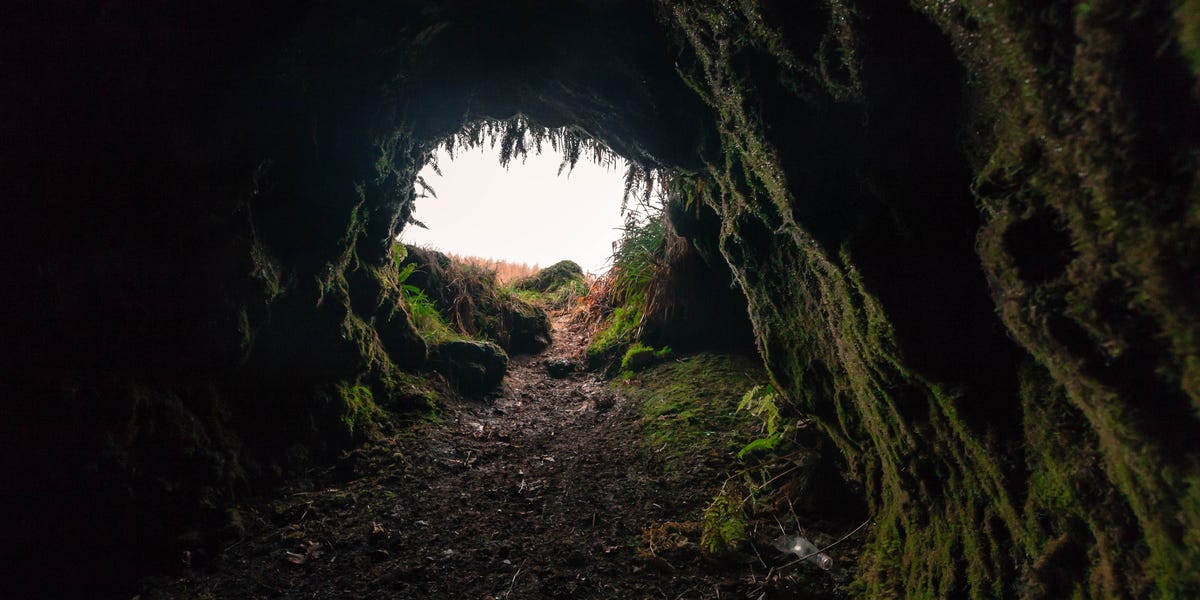
3 min readHere’s what you’ll learn when you read this story:Researchers in Europe believe cave art discovered in Ireland shows that a lost land bridge to Wales once existed.The bridge meant humans were occupying Ireland roughly 5,000 years earlier than previously believed. The caves were used as homes during the Ice Age, wherein Ireland’s earliest residents painted deer and mammoths on the walls.Humans inhabited Ireland 5,000 years earlier than we previously knew, living in caves during the bitterly cold Ice Age and creating art on the cave walls. That art, found recently in southwest Ireland and dated to 15,000 years ago, is rewriting the Emerald Isle’s human history.A team of researchers from the University of Liverpool, University College Dublin, and the University of Adelaide combined to lead the Lost Land Bridge Project, an effort to find evidence to back up their theory that humans have inhabited Ireland for longer than 10,000 years. They used artificial intelligence to aid the search.“We just weren’t looking hard enough, and not in the right places,” George Nash, a professor at the University of Liverpool, told the BBC. “The principle we worked on was ‘absence of proof isn’t proof of absence.’”The team put AI to work creating an algorithm to extract everything known about ancient cave dwellings in south Wales to help find similar locations in Ireland, streamlining the process of discovery. With 28 potential cave sites in hand, the team went to work and discovered eight locations with cave art they said show human habitation in Ireland 5,000 years earlier than previously known.The art features engravings on the limestone walls, ochre and charcoal paintings, and line sketches done with fingertips in clay. Images include deer and mammoths, according to Heritage Daily. When tied to the shift found in Wales from primitive line drawings to more representative depictions of the world, Nash said that “what we’ve found in Ireland is yet another progression from that.”During the Ice Age, the team believes, so much water sat trapped in glaciers that sea levels dropped and a “lost land bridge” emerged, connecting what is now Pembrokeshire to the southeast edge of Ireland, near the seaside town of Rosslare. Nash believes humans simply couldn’t have passed up the opportunity to explore, especially as Wales continued to grow in population density. Wild horses, mammoths, bison, and reindeer likely came across the land bridge first and, being sources of food, enticed hunters to follow them.“There were around 100 human-inhabited caves on the Gower Peninsula, for example, in a time when the technology didn’t yet exist for human groups to create their own free-standing dwellings,” Nash said. “Competition for these caves would have been intense.” It was, after all, likely between -10°C to -20°C outside. And that’s during the summer.Nash’s team theorizes that humans crossed the land bridge, which was likely a 46-mile-long plateau covered in forest and grassland, to the eastern edge of the Irish coast. While the project discovered caves in southwest Ireland, Nash said it’s logical to expect examples to also exist on the east side of the island, where humans first crossed.“As family networks grew, knowledge of how to survive by following animal migration routes improved, and they must have become bolder,” Nash said. “There must be more, and even earlier, places which are just waiting for us to find them. This project is now pushing the boundaries of what we consider to be the final vestiges of a northwest European frontier. It’s all very exciting.”For ancient humans, land bridges were one of the most reliable ways to reach new land. Nash said settlers arrived in Wales nearly 40,000 years ago thanks to land bridges across the English Channel and Bristol Channel. The need for suitable caves continually pushed human populations toward exploration, and a land bridge to Ireland offered the best way to find them.Tim Newcomb is a journalist based in the Pacific Northwest. He covers stadiums, sneakers, gear, infrastructure, and more for a variety of publications, including Popular Mechanics. His favorite interviews have included sit-downs with Roger Federer in Switzerland, Kobe Bryant in Los Angeles, and Tinker Hatfield in Portland.
Scientists Found Cave Art That Could Rewrite What We Know About Human History
Full Article
Original Source
Read the full article at Popularmechanics →KhanList aggregates and links to publicly available news content. We do not host full articles from third-party sources. Always verify important information with original sources.