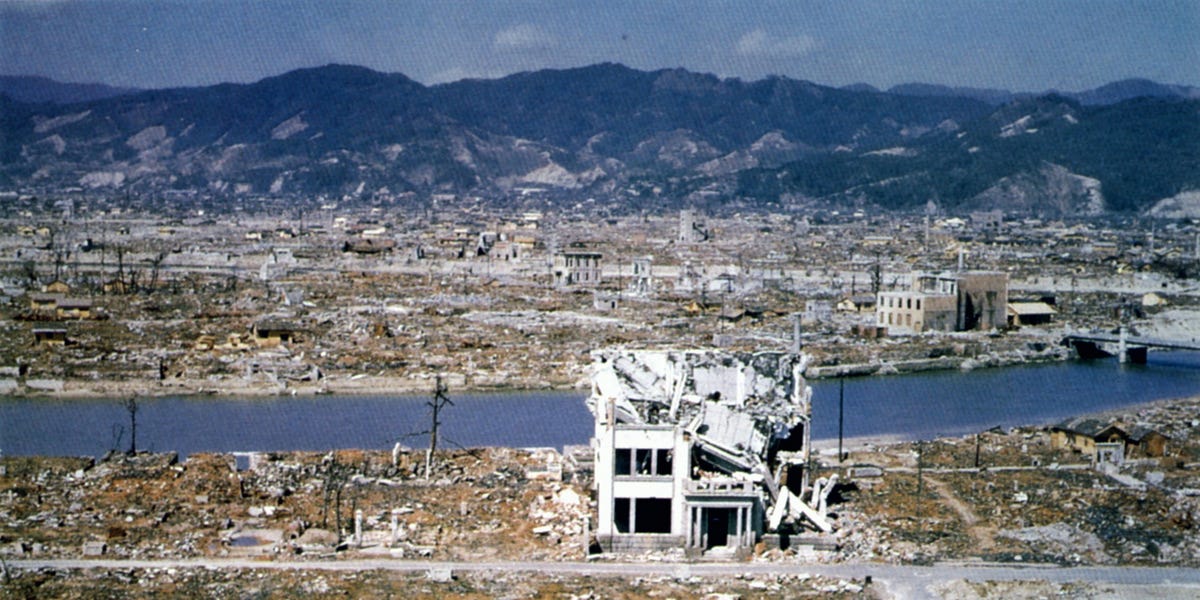
4 min readHere’s what you’ll learn when you read this story:The atomic bomb dropped on Hiroshima in 1945 melted and fused industrial materials that created an entirely new metal alloy recently discovered by researchers.Inside particles of debris known as hiroshimaites were flecks of metal that revealed a strange, almost quasicrystal structure which could have only formed under those conditions.This is similar to the quasicrystal found in trinitite, soil fused into a glassy substance by the test-detonation of the Trinity atomic bomb about a month before Hiroshima. When the B-29 bomber Enola Gay flew over Japan and dropped an atomic bomb on Hiroshima on the morning of August 6, 1945, a blast force equal to 20,000 tons of TNT obliterated half the city. Death tolls were staggering. Among the wreckage, something extraordinary created by the extreme conditions of the bombing remained hidden for decades.Hiroshima was one of two cities devastated by an atomic bomb during World War II, the first and only war in which nuclear weapons were used. The bomb detonated 1,800 feet (about 548 meters) in the air above the city. Fireball surface temperature skyrocketed to 7,700 °C (13,892 °F), while temperatures at ground zero reached between 3,000 and 4,000 °C (3,000 to 7,232 °F) and could scorch human skin from miles away. The bomb’s supersonic shock wave stirred up intense winds, more powerful than a hurricane, nearly 2 miles (3 km) above ground, and reverse winds razed homes and buildings to the ground. At least 70,000 people perished on impact, with more succumbing to cancer or other chronic illnesses caused by the bombing’s residual radiation.Years after the devastation, researchers led by mineralogist and crystallographer Luca Bindi of the University of Florence sampled fallout debris found at the bombing site. They observed unusual glassy particles that were not unlike those created by melt from meteorite impacts. Known as hiroshimaites, they formed when urban materials, such as industrial metals and glass, along with the soil and water beneath them, were vaporized.“This finding expands the known spectrum of materials generated by nuclear detonations and demonstrates that anthropogenic plasma events can produce complex metallic phases in natural settings,” he said in a study recently published in Science Advances. “Beyond its historical significance, the occurrence of a [new alloy] formed by fireball condensation provides a unique natural laboratory for studying rapid alloy nucleation under extreme nonequilibrium conditions.”Embedded in the particles were mysterious metallic flecks. Impossible to see with the naked eye, they became visible once Bindi and his team examined the larger particles with a powerful scanning electron microscope. They extracted several of them from the surrounding glass for further examination using X-ray diffraction to make out their molecular and atomic structure. While most proved to be no more than common iron-chromium alloys, one was a type of alloy high in iron and silicon with a structure that had never been seen before. It was on the verge of being (though not quite) a quasicrystal, a type of crystal whose pattern is highly organized but never repeats. Bindi now thinks the material crystallized after metallic vapors in the bomb’s fireball cooled rapidly.Nuclear blast debris has done remarkable things before. The Trinity test, in which the first atomic bomb was detonated in Alamogordo, New Mexico, hardly a month before Hiroshima, left behind a quasicrystal that was synthesized by the blast. Like the metal alloy in hiroshimaites, it was also discovered by Bindi inside particles of glass and metal known as trinitites. These quasicrystals were synthesized by the blast from quartz and feldspar in the desert sands. When fused with asphalt, iron, and copper from cables, they produced glassy particles with an embedded metal that was unlike any other alloys previously known. The rapid condensation and cooling of metal vapors kept the quasicrystal structure of the alloy intact.Though not exactly a quasicrystal, the alloy found in hiroshimaites still shows how extreme conditions can create bizarre solids that would not occur in any other way. They form and cool so incredibly fast that synthesizing them in a lab is not yet possible. Besides the fascination surrounding them, they are time capsules of mostly stable materials that arise from enormous impacts, and can also be used to study planetary impacts. The hiroshimaite and trinitite alloys have also proven that both quasicrystals and materials that are nearly quasicrystals are capable of forming during nuclear detonations. These substances are nuclear forensics evidence that can provide information about what happened inside a fireball."These [findings] motivate systematic, ethically and legally managed scientific studies of blast-derived materials,” Bindi said, “Not only to reconstruct event histories, but also to identify new structure types and compositional motifs with potential relevance to future alloy design and functional materials research.”Elizabeth Rayne is a creature who writes. Her work has appeared in Popular Mechanics, Ars Technica, SYFY WIRE, Space.com, Live Science, Den of Geek, Forbidden Futures and Collective Tales. She lurks right outside New York City with her parrot, Lestat. When not writing, she can be found drawing, playing the piano or shapeshifting.
Scientists Found a Strange New Material Born in the Fireball of the Hiroshima Atomic Bomb
Full Article
Original Source
Read the full article at Popularmechanics →KhanList aggregates and links to publicly available news content. We do not host full articles from third-party sources. Always verify important information with original sources.