
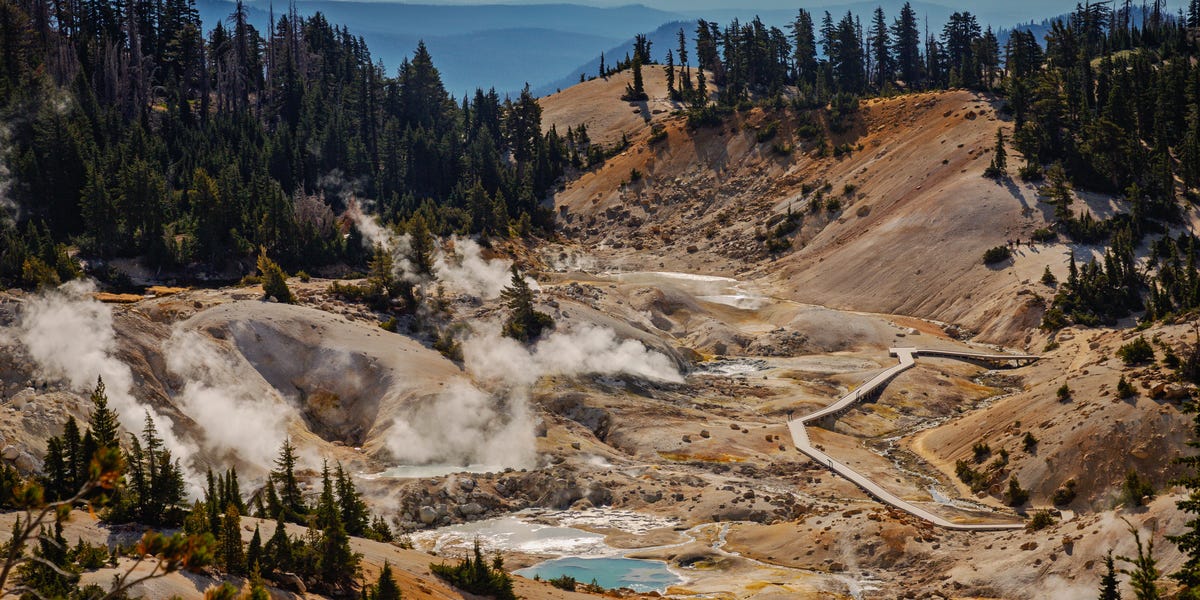
4 min readHere’s what you’ll learn when you read this story:A newly discovered eukaryotic amoeba is upending the long-held belief that only prokaryotes, which lack a nucleus, can survive extreme heat.Incendiamoeba cascadensis, also known as the “fire amoeba,” was discovered in a geothermal creek and is capable of surviving temperatures as high as 147°F (64°C).There might be other eukaryotes like this at extreme locations on land and deep underwater, and Incendiamoeba could provide a model for what to expect of extremophiles in space.Something’s lurking in the boiling, bubbling hellscape beneath the mountainous expanse of pine boughs, wildflowers, and butterflies that is Lassen Volcanic National Park. Not many visitors brave this northern California nature reserve. There is, however, one life-form that thrives in the brutal heat of geothermal pools and nearly went unnoticed in a vein of a steaming creek hidden by rushes: the fire amoeba. It’s an otherworldly creature that almost sounds like it shouldn’t exist.While microbiologist Beryl Rappaport of Syracuse University was studying bacteria and archaea that are thermophilic extremophiles—organisms that thrive in extreme heat—she wondered whether this superpower was limited to the prokaryotes she observed. Prokaryotes carry their genetic material loose in the cell, with no nucleus to worry about, which is a big advantage in punishing heat. Eukaryotes, by contrast, package their DNA inside a nucleus and rely on delicate organelles, both of which are vulnerable to high temperatures. No eukaryotes capable of surviving such heat had ever been found—but no one had looked especially hard in the right places. Lassen Volcanic National Park, perched at the southern terminus of the Cascade Range, is one of those places. Still volcanically active, the park simmers with pools of scalding water, steam vents known as fumaroles, and mud pots that belch vapor from magma below. It’s like a real-life version of the Fire Swamp from The Princess Bride.“The thermal limits of life have long been a source of scientific fascination and discovery,” Rappaport and her team, backed by NASA, said in a study recently published in Cell. “By studying the physical factors at the limits of life, we can broaden our understanding of constraints on cellular biology and of where life can emerge and persist.”Rappaport and her team crouched over Hot Springs Creek, using barbecue tongs to lower vials into water that would blister human hands. Whatever was living in there, she wanted it back in the lab. After collecting water from many of the geothermal features in the park, including treacherous Boiling Springs Lake, the researchers headed back to examine their samples. They isolated amoeba strains from a murk of water, sediment, and bacterial biofilm. In the incubator, the strains kept dividing until temperatures reached 145°F, when they finally slowed and stopped reproducing. The amoebas were still able to move and search for bacteria to devour at temperatures of up to 147°F (64°C), beating the previous eukaryote record of 140°F (60°C). Such a tolerance for heat earned the organism a fitting label from its discoverers: Incendiamoeba cascadensis, the fire amoeba.Under the microscope, Incendiamoeba shifts between two shapes: an elongated, wormlike form and the blobbier, pseudopod-extending form most people picture when they think of an amoeba. Sequencing its genome showed what happens inside the cell as the temperature climbs. The amoeba carries a suite of genes that hold its DNA, proteins, and organelles together under heat that would otherwise tear them apart. Amazingly, Incendiamoeba can dial those genes up as conditions worsen. Among the most active are genes governing protein folding the process by which a chain of amino acids collapses into the precise three-dimensional shape it needs to function. In most eukaryotes, extreme heat derails that process entirely.Another incredible feature of Incendiamoeba is that by loading its proteins with positively charged residues and keeping negatively charged ones scarce, it appears to have found a way to hold its molecules in shape rather than letting them unravel in the heat. Notably, that isn’t the strategy thermophilic prokaryotes use. Heat-loving bacteria and archaea typically stabilize their proteins with salt bridges, which are strong attractions between oppositely-charged residues that hold a protein’s folds in place. But that solution requires a strong negative charge, which the Incendiamoeba has largely dispensed with. The researchers also noticed something suggestive in the amoeba’s genome. It contained stretches of DNA closely resembling sequences recovered from thermophiles at other geothermal hotspots, including Yellowstone and New Zealand. To Rappaport, that discovery suggests that there are other evolutionary relatives still waiting to be found.“This discovery raises questions about the true maximum temperature a eukaryotic cell can endure,” she said. “Our findings demonstrate that amoebae…are capable of occupying the most extreme thermal niches available to eukaryotes, and our biogeographic analysis suggests that additional thermophilic species within this clade await discovery.”Maybe there are more species of thermophilic amoeba waiting to be found in volcanoes, geysers, or hydrothermal vents gushing heated water at the bottom of the ocean. NASA is especially excited about this new organism because it offers a new understanding of the survival limits of eukaryotes in hostile extraterrestrial environments. While Incendiamoeba was made for this planet, which provides it with the right acidity, prey, and other necessities for staying alive, it could help astrobiologists figure out what to expect if any complex life exists beyond Earth.Elizabeth Rayne is a creature who writes. Her work has appeared in Popular Mechanics, Ars Technica, SYFY WIRE, Space.com, Live Science, Den of Geek, Forbidden Futures and Collective Tales. She lurks right outside New York City with her parrot, Lestat. When not writing, she can be found drawing, playing the piano or shapeshifting.
Scientists Found a Lifeform That Endures Hell—and It May Not Be Alone
Full Article
Original Source
Read the full article at Popularmechanics →KhanList aggregates and links to publicly available news content. We do not host full articles from third-party sources. Always verify important information with original sources.