
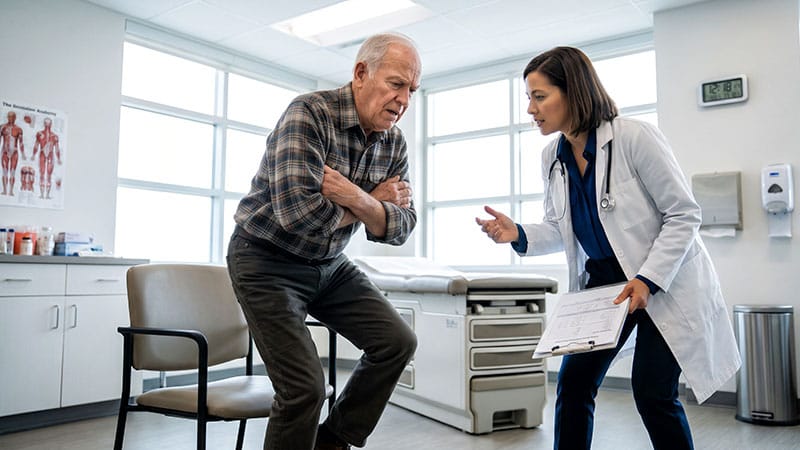
Clinicians see it every day: an older patient struggling to rise from a chair or shuffle into the exam room. For decades, treatment for sarcopenia — the age-related loss of muscle strength and mass — has relied on a simple prescription to lift weights and eat more protein.But mass doesn’t equal function.A three-part study in the Journal of Clinical Investigation (JCI) helps explain why, providing the first clear evidence in older adults that weakness stems from a breakdown in communication between nerves and muscles. Beyond uncovering this mechanism, the researchers identified a drug target that successfully restored muscle function in aged rodents.“What’s new here is a specific mechanism targeting the neuromuscular impairments behind sarcopenia,” said Thomas W. Buford, PhD, director of the Section of Translational Gerontology at the University of Alabama at Birmingham, who was not involved in the study. “To have human data, multiple rodent species, and show that this was actually reversible with a potential drug target — it’s very impressive.”More Muscle Doesn’t Mean More StrengthAge-related weakness is often treated as a problem of shrinking muscles, but size alone tells only part of the story. A 2023 systematic review found that muscle strength often declines much faster than muscle mass.In short: Growing bigger muscles doesn’t guarantee restoring function.“A number of studies have tried to boost muscle performance with therapies designed to build mass, but they aren’t always successful at increasing strength,” said Roger A. Fielding, PhD, senior scientist at the Jean Mayer USDA Human Nutrition Research Center on Aging at Tufts University in Boston. “This study gives us potentially important targets to approach the problem from a completely different direction.”The Target: The Neuromuscular JunctionMovement starts in the brain. Before it happens, the brain’s signal must travel a long electrical path to the spinal cord, across the nerve to the muscle, and finally turn that signal into action. “Anything along that whole pathway can impair force generation,” said study coauthor Brian Clark, PhD, executive director of the Ohio Musculoskeletal and Neurological Institute at Ohio University, Athens.Prior research pinpointed a critical bottleneck: the neuromuscular junction, where nerve and muscle meet. While some animal studies hinted this connection might improve with age, the JCI study proved the opposite in weak older adults, uncovering significant breakdown at this vital intersection.The culprits? Depleted levels of NaV1.4, a sodium channel essential for generating the electrical burst that triggers muscle contraction. Without enough channels concentrated at the junction, the nerve’s message gets lost.“In essence, the muscle can’t hear the signal from the nerve well enough, so it doesn’t activate, and then you have weakness,” said study coauthor W. David Arnold, MD, executive director of the NextGen Precision Health initiative at the University of Missouri, Columbia.A New Drug TargetIn the final stage of the study, researchers tested a potential fix in aged rodents. Using a drug-like compound to partially block ClC-1 — a chloride channel that regulates muscle fiber activation — they made the animals’ muscles far more responsive. Rather than replacing the missing NaV1.4 sodium channels, inhibiting ClC-1 bypassed the breakdown entirely, restoring muscle function.The compound, developed by Denmark-based NMD Pharma (which partly funded the study), already holds FDA orphan drug designation for rare neuromuscular disorders like myasthenia gravis. Because the drug has already been proven safe in humans, it could be evaluated as a sarcopenia treatment more quickly.“We’ve published a couple papers with this small molecule, and we just completed another trial for Charcot-Marie-Tooth disease,” Arnold said. Because it has already been tested in humans across multiple contexts, it could be rapidly translated to treat sarcopenia, he said.Still a Long Road to Clinical Use“Rapid” in regulatory terms still means years of clinical trials.“The question always is, does it translate up?” Clark said. “Can you improve function in humans? And if so, what’s the magnitude — is it 2% or 20%?”Translating the findings to sarcopenia brings unique hurdles. Despite decades of study, researchers still lack a universally agreed-upon definition for the condition. That ambiguity makes it difficult to select the right trial participants and pinpoint what success looks like.Ultimately, researchers have to show that it improves key measures in a specific patient population. “But is the target physical function, or is it muscle strength?” Buford said.Other hurdles include potential drug interactions, side effects on existing muscle conditions, and how the compound is processed in patients with kidney or liver impairment. Even if trials clear these obstacles, a ClC-1 inhibitor won’t be a magic bullet. Instead, it would likely serve as a valuable companion to exercise and nutrition, helping patients get more out of their physical rehabilitation.How to Help Your Patients NowWhile the study doesn’t yet change clinical guidelines, it reinforces a crucial principle: Focus on what older patients can do, not just how much muscle they have.Both Arnold and Clark advise prioritizing strength and mobility over raw muscle mass. Handgrip strength, for instance, is a stronger predictor of mortality than systolic blood pressure. Even without specialized tools like a dynamometer, quick office assessments like chair-stand tests for lower-body power and gait-speed tests for overall mobility offer vital insights — and better performance on both is linked to reduced mortality risk. When function declines, clinicians should evaluate underlying medical conditions, address nutritional gaps, and prescribe targeted exercise — resistance training, in particular, enhances both muscle and nervous system function. A future drug may one day bridge the gap between nerve and muscle, but for now, lifestyle interventions remain the cornerstone of care. By uncovering a clear signaling breakdown and a way to reverse it, this latest research opens an exciting new frontier.“This is a very strong addition to our understanding of potential sarcopenia mechanisms, and it holds a lot of promise,” Buford said. “Having a druggable target that showed real functional improvement — that’s a pretty big deal in the field.”Arnold and Clark received grant funding, consulting fees, and travel support from NMD Pharma for this study. Both also consult for other pharma companies. Fielding declared consulting for pharma companies related to sarcopenia. Buford had no relevant disclosures.
Scientists Find a New Clue to Why We Grow Weaker With Age
Full Article
Original Source
Read the full article at Medscape →KhanList aggregates and links to publicly available news content. We do not host full articles from third-party sources. Always verify important information with original sources.