
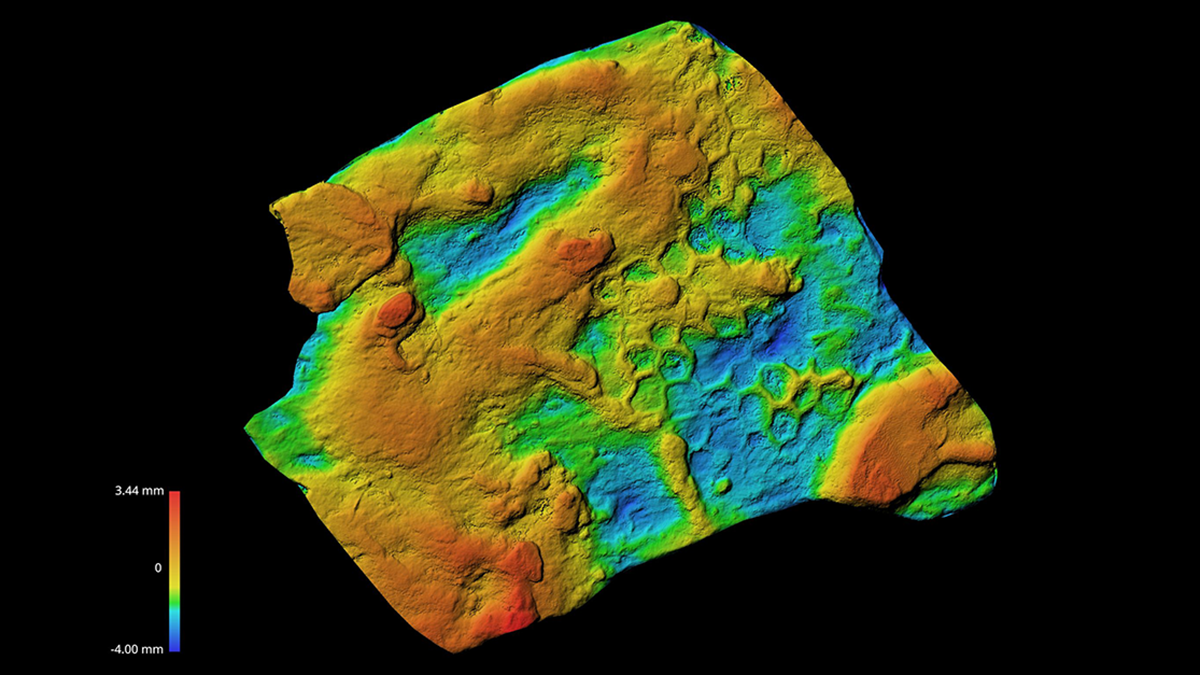
In the Apennine mountains of Italy, preserved in sedimentary rock that was once an ancient seafloor, are strange, hexagonal networks of fossilized burrows called Paleodictyon. Scientists have observed similar burrows at the bottom of modern oceans but have never seen the creatures that create them, so how these patterns formed has long been a mystery. Researchers have proposed a range of possible so-called trace makers, from worms to coral to algae. A new study published in Earth-Science Reviews provides one of the most detailed trace maker arguments yet. On the basis of new measurements of the interior angles, width, and spacing of Paleodictyon from archives and outcrops in the Apennines, the authors of the new paper think it’s most likely that an unidentified marine arthropod was—and still is—responsible for creating these enigmatic patterns. This Paleodictyon was uncovered at the Fiume Savio, a river in Italy. Credit: Hectonichus/Wikimedia Commons, CC BY-SA 4.0 Understanding such trace fossils “is really important, because it gives us a glimpse into how things evolve,” said Stephen Hasiotis, a paleontologist at the University of Kansas who was not involved in the new study. “This behavioral strategy of constructing this meshwork has survived, or been reinvented, or evolved in different lineages of animals, and continues to this day.” A Hexagonal Mesh To investigate, Andrea Baucon and a research team took more than 1,000 measurements of the interior angles of Paleodictyon’s hexagons, the distances between its vertices, and the widths of its burrows. They measured Paleodictyon specimens housed at the University of Genoa and the Natural History Museum of Piacenza, as well as new specimens found by the research team in the Apennine mountains. To find the new samples, they spent days on their hands and knees hunting for centimeter-wide hexagonal cells, said Baucon, a coauthor and paleontologist at the Universitá degli Studi di Cagliari in Cagliari, Italy. The team’s measurements showed that the fossils present a high level of precision and uniformity: Interior angles of the hexagonal structures are, on average, just 8.5° off a perfect 120° angle, and lengths of sides vary within a structure only by an average of 0.5 millimeter. Researchers (from left to right) Girolamo Lo Russo, Filippo Guerrini, and Andrea Baucon examine a rocky outcrop in the Apennines, where they did much of their fieldwork for the new study. Credit: Girolamo Lo Russo Because of the fossils’ straight lines and precise angles, the study’s authors think it’s most likely these burrowing networks were made by hard-bodied arthropods rather than worms, corals, or foraminifera. Arthropods include crustaceans (a likely Paleodictyon trace maker), as well as insects, arachnids, and centipedes. Worms and other soft-bodied creatures tend to follow a wandering path of least resistance in their locomotion, Baucon said. The tunnels of Paleodictyon, in contrast, are straight and meet at sharp angles. These characteristics are common among arthropod tracks and are made possible through the animals’ tough exoskeletons and jointed appendages. “An arthropod can cut the substrate like a knife through butter,” Baucon said. Andrew Gooday, a marine biologist and emeritus fellow of the National Oceanography Centre in Southampton, England, said the case made in the study was highly detailed and that he found the arthropod hypothesis very plausible. “The arguments in the paper are very convincing.” Gooday was not involved in the research. Though other scientists previously proposed that arthropods created Paleodictyon, the rigor of the new study’s statistical analysis and the number of samples they measured make it a particularly interesting contribution to the field of ichnology (the study of trace fossils), Hasiotis said. Arguing for Arthropods Besides the geometry of the fossils, other lines of evidence support the arthropod hypothesis. First, Paleodictyon began to appear in the fossil record in the early Cambrian period, right when arthropods themselves were becoming more abundant. Today, Arthropoda is the largest phylum in the animal kingdom, with more than a million distinct species. “This level of architectural complexity is within the behavioral repertoire of arthropods.” Clues about the trace maker’s cognition also hint at an arthropod origin: Researchers observed that the small deviations in the length of the hexagons’ sides and the degree of their angles did not propagate through the network, possible evidence that the creator of the fossils was able to make a mistake, realize that mistake, and correct it, according to Baucon. Such behavior would require the trace maker to keep track of direction and distance traveled. Additionally, “the animal was able to reach such accuracy at 3,000 meters of depth in total darkness and at around two degrees [Celsius] of temperature,” Baucon explained. These conditions would have required a relatively high level of cognition. Creating the hexagonal burrows would have been “quite a complicated process,” Gooday agreed. The patterns resemble those created by a familiar arthropod sometimes considered among the most intelligent insects on Earth: bees. Paleodictyon resemble honeycombs and have been compared to bee-made structures since at least the 1880s. Bees and beehives, Baucon said, show that “this level of architectural complexity is within the behavioural repertoire of arthropods,” Baucon wrote in an email. Finally, past research has shown that whatever creature is creating these traces in modern oceans can do so in just a few weeks. That speed means it must be a relatively fast burrower—which arthropods are, Baucon said. Even with such strong supporting evidence, however, identifying the trace maker as an arthropod is not certain. Though the shape of the burrow networks has remained remarkably stable overall, it’s likely that the creature that created Paleodictyon evolved over the 500 million years, Baucon said. Multiple creatures, instead of a single species, could also be responsible for creating the fossils, Hasiotis suggested. Paleodictyon Persistence Studying trace fossils like Paleodictyon can give paleontologists insight into ancient animal behavior, whereas studying body fossils mostly reveals what an animal looked like. With trace fossils, “we can have a glimpse of how animals lived millions of years ago,” Baucon said. “Maybe the hexagonal mesh of Paleodictyon holds a lesson about resilience to environmental change.” For Paleodictyon, this insight into animal behavior is especially intriguing, he added, because whatever animal created the patterns was able to survive all five of Earth’s mass extinction events. “It colonized our oceans for 500 million years,” Baucon said. “Maybe the hexagonal mesh of Paleodictyon holds a lesson about resilience to environmental change.” Baucon said he hopes the study will drive more deep-sea exploration, which could even lead to observations of Paleodictyon being created in real time. The use of deep-sea cameras, underwater castings of modern-day Paleodictyon, and even DNA analysis of organic materials left in modern-day burrows could lead scientists closer to an answer, according to Hasiotis. “All these things are worth exploring, because it might help solve the enigma of who produced this,” he said. Creatures continue to make Paleodictyon today, such as these spotted in the Gulf of Mexico in 2014. Credit: NOAA Okeanos Explorer Program, Gulf of Mexico 2014 Expedition, CC BY 2.0 Gooday pointed out that because such a high percentage of deep-sea creatures are still undescribed by science, it’s likely that the trace maker hasn’t been described by science, either. “I’m very proud of our results, but this is still an educated hypothesis,” Baucon wrote in an email. “Until we actually observe the producer in the deep sea, the enigma will remain.” —Grace van Deelen (@gvd.bsky.social), Staff Writer Citation: van Deelen, G. (2026), Scientists finally think they know what made these geometric fossils, Eos, 107, https://doi.org/10.1029/2026EO260318. Published on 6 October 2026. Text © 2026. AGU. CC BY-NC-ND 3.0Except where otherwise noted, images are subject to copyright. Any reuse without express permission from the copyright owner is prohibited.
Scientists Finally Think They Know What Made These Geometric Fossils
Full Article
Original Source
Read the full article at Eos →KhanList aggregates and links to publicly available news content. We do not host full articles from third-party sources. Always verify important information with original sources.