
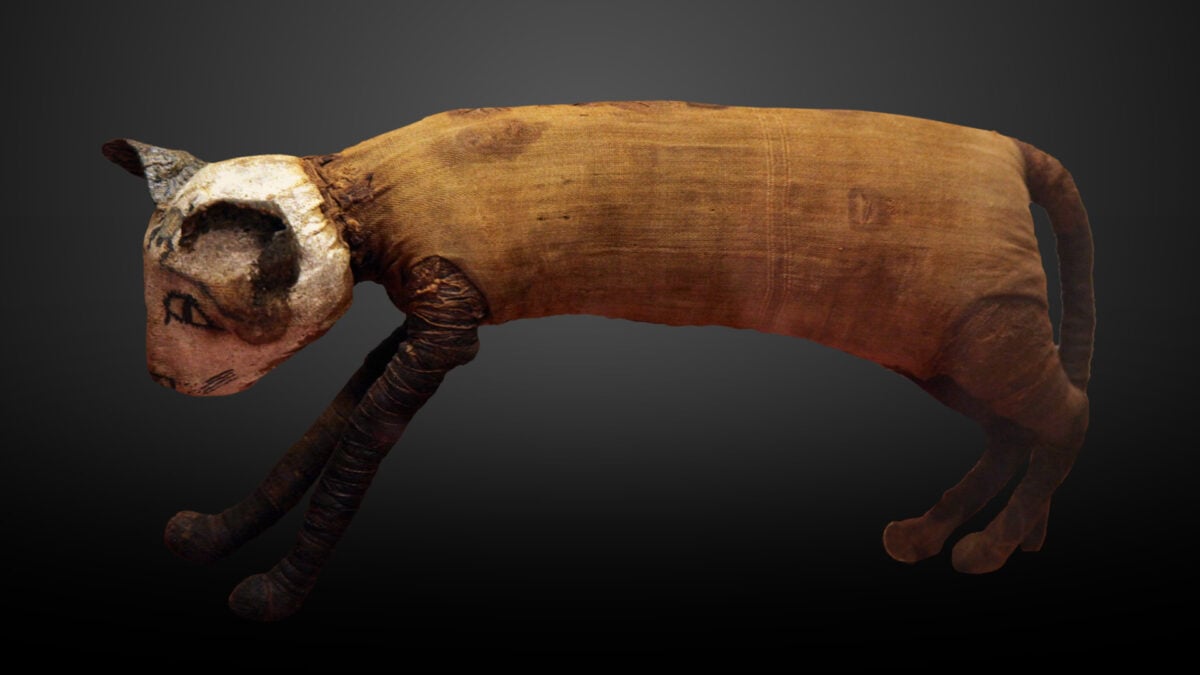
Ancient Egyptians famously loved cats—they appear in hieroglyphics, obelisks, and other art forms, and experts believe cats eventually became symbols of divinity and protection in Egypt. But whether that meant the cats were pampered might be less clear, according to new research. A close analysis of 131 well-preserved felid skulls from Beni Hassan, a funerary site from ancient Egypt, revealed “pathologies” that suggest cats at the time lived under subpar conditions. For instance, more than half showed signs of gum disease and “healed fractures, puncture marks, and deformations” linked to infections or other illnesses, according to a paper describing the findings, published recently in the Journal of Archaeological Science. There’s also evidence that the cats were packed into crowded spaces—which, if you’re a cat owner or ally, isn’t great news. “What struck us most was the high proportion of injuries and evidence of disease, suggesting that these cats lived in poor conditions,” Bea De Cupere, a study co-author and a zooarchaeologist at the Royal Belgian Institute of Natural Sciences, told Phys.org. “This is not what one would expect for animals destined to become votive mummies.” A true story A drawing on limestone of a scene from a fable about a cat. Dated to circa 1120 BCE, during the 19th dynasty of Ancient Egypt. © Egyptian Museum via Wikimedia Commons (Public Domain) According to Julia Troche, an Egyptologist at Missouri State University, it’s “hard to say the Egyptians thought one thing or another, since so much change happened across their 3,000+ years of history.” But the archaeological record strongly suggests cats were important to them, she added. Mummified cats have turned up in human tombs whose walls depict cats lying below chairs, chasing birds, or playing. That emphasis, unfortunately, seems to have been lost on folks from the 19th and early 20th centuries. According to the paper, people at the time unearthed deposits of pits containing “densely packed layers of mummified cats, ten to twenty animals deep.” Here’s the wild part: At the time, animal mummies weren’t thought to be that important and were “repurposed as ship ballast, fertilizer, fuel, or even powdered medicine,” the team explained in the paper. It was only thanks to scholars like British biologist William A. Herdman—who secured a small portion of roughly 200,000 animal mummies set out for a fertilizer auction—that the valuable remains survived to this day. But Herdman mostly salvaged the skulls, and the rest of the body was probably discarded, according to the paper. Piecing the cats Needless to say, science has changed since. In addition to basic osteological analysis, the researchers opted for noninvasive methods where they could, such as using X-ray analyses when constructing an age profile of the cats at the time of death. Interestingly, 86% of the specimens in this study were adults, whereas the proportion of adults in previous studies on cat mummy deposits was typically much lower, around 20%. As for the types of cats, there were jungle cats, domestic cats, African wild cats, and possible hybrids of these felines. Radiocarbon dating was performed on nine of the skulls, and eight of them dated to between 380 and 40 BCE, spanning the Late Period and the Ptolemaic period. The one outlier was from much earlier, during the Third Intermediate Period (around the 10th century BCE). Examples of puncture marks observed on the cat skulls. © Van Neer et al., 2026 Compared to modern cats, the Beni Hassan cats actually had dental problems “broadly comparable to or lower than those reported” in modern feral populations, according to the study. However, the skulls did display a variety of punctures and fractures, possibly from both cats and humans. Some lesions suggested that a cat was struck with a sharp metal object and possibly a thick wooden stick. These didn’t heal, which likely means that’s how the cat died. A conflicted relationship “The intention behind these acts of violence is not always clear,” the team wrote in the paper. The fatal injuries could have given the cats a quick death before their mummification. The healed wounds may be evidence that the cats survived the injury. Alternatively, a human resorting to “disciplinary measures” could have left them, according to the paper. Sadly, the “numerous indications” of infections and metabolic diseases indicate the cats lived in poor conditions and faced nutritional stress. “The high density of animals would inevitably have led to stress and aggression among them, resulting in injuries, while diseases could spread easily,” Wim Van Neer, the study’s first author and a researcher at the Royal Belgian Institute of Natural Sciences, told Phys.org. An image of a cat inscribed onto the sarcophagus of a cat belonging to Egypt’s Crown Prince Thutmose. © Larazoni via Wikimedia Commons (CC BY 2.0) This doesn’t definitively mean the Egyptians were bad cat owners. As the team noted in the paper, the investigation faced inherent limitations, primarily due to the fact that only the skulls were available. For instance, a health-related diagnosis would have been much more “straightforward” with a near-complete skeleton, the researchers explained. We’re also talking about thousands of years ago, so it’s entirely possible that the Egyptians were just trying their best with what they had.
Scientists Expected Egypt’s Sacred Cats to Have Lived Pampered Lives. Their Skulls Say Otherwise
Full Article
Original Source
Read the full article at Gizmodo →KhanList aggregates and links to publicly available news content. We do not host full articles from third-party sources. Always verify important information with original sources.