
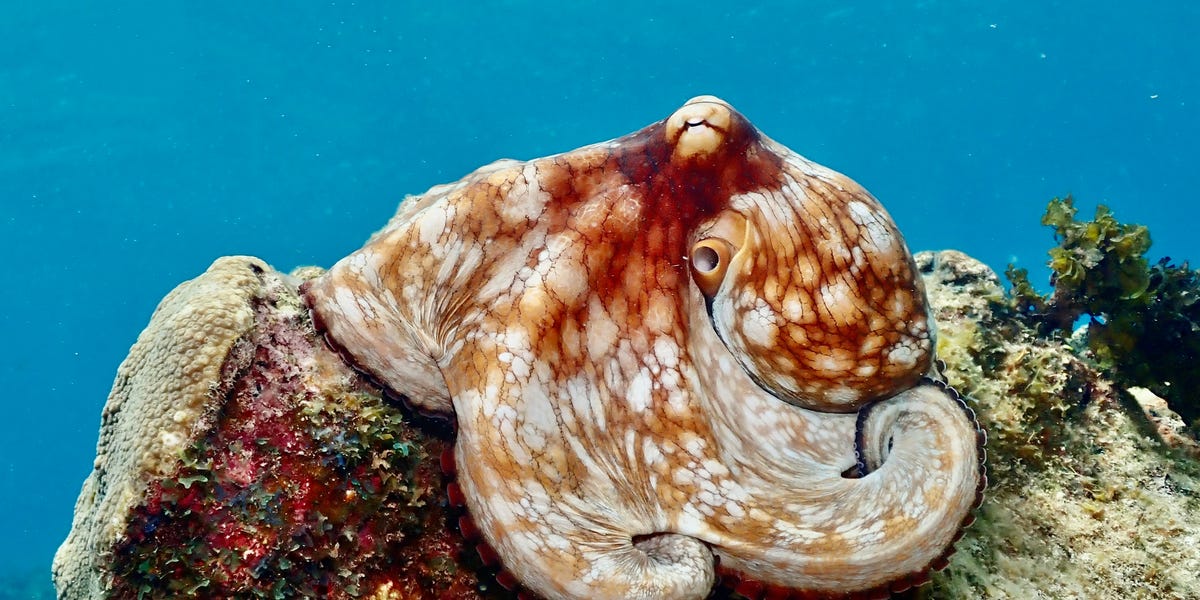
From the octopus who went viral playing piano underwater to cuttlefish that solve puzzles, many cephalopods have an uncanny intelligence. These tentacled life-forms inherited almost supernatural abilities, like taking mere fractions of a second to morph into forms that blend in with their surroundings, over hundreds of millions of years, deceiving predators in prehistoric seas, but at least some of that intelligence evolved in ways that were unexpected.Octopus, squid and cuttlefish, also known as coleoid cephalopods, developed the largest brains of any invertebrates after they appeared around 270 million years ago. Evolution also gave them specialized organs and behaviors for survival, a sizable advantage in a sea of hungry jaws that would otherwise snap up their boneless bodies. Way back then, the common ancestor of coleoids is thought to have undergone a massive rearrangement of its genome.As the species separated themselves a bit over the course of the last few hundred million years, octapodiformes (octopus and vampire squid) and decapodiformes (other squid and cuttlefish) experienced further expansion and reorganization of their genome. Molecular biologist Thea Rogers of the University of Vienna dug a little deeper to, well, deepen our understanding of their genomic origins.“The mechanisms by which changes in genome architecture give rise to organismal novelties via gene regulation remain poorly understood,” she said in a study recently published in Nature Communications. “Coleoid cephalopods therefore offer a compelling model to investigate how ancient macroevolutionary processes influence the structure, maintenance, and evolvability of regulatory landscapes.”Rogers and her team analyzed the octopus, squid, and cuttlefish genome structures to better understand where their shapeshifting powers come from. Findings suggested that it could have something to do with the way their DNA is packaged. When the double helix of DNA folds itself inside a cell, sections of the sequence that would otherwise be far apart end up being pushed physically close into a chromatin loop. This can determine activation, usage, and function of genes on those segments, depending on how they interact. These interactions continued to grow more sophisticated through evolution over time, leading to regulatory entanglement, wherein the genes become so involved that they are nearly inseparable. It is possibly the reason genes continue to carry out essential functions while new patterns of gene expression emerge.Another aspect of the coleoid cephalopod genome that caught the researchers’ attention was that its larger structural units had remained stable through millennia of evolution. These units are known as chromatin domains, which are mostly the same throughout different cell types and manage to keep their stability through repeated cell divisions. They also remain largely unchanged across coleoid species. Because the chromatic domains are largely unchanged, they’re seen as the basic units of chromosome folding that brings distant genes into close contact. Chromatin loops that result from folding are more specific links that are subject to change, but in the cephalopods studied, they were found near genes, many of which had connections to the nervous system, that give cephalopods many of bizarre but brilliant traits.While chromatin domains are constant, smaller structures like chromatin loops are more dynamic and adaptable to different situations, creating new patterns of gene activity for an organism to survive. This reaches beyond changing in response to evolution. The structure of coleoid cephalopod genomes is showing that organization and reorganization of DNA, with some regions activated the most at certain developmental stages, can actually influence how evolution plays out. Shifts in these cephalopods created networks of gene regulation. Though it is unknown whether this contributes directly to their intelligence, since other factors exist, it definitely has a part in building the complex nervous systems that allow them to play musical instruments or pull off stunts like disguising themselves as rocks in the face of a predator.“Taken together, our findings establish coleoid cephalopods as a model system for understanding how 3D genome architecture, differential evolutionary constraints, and large-scale chromosomal changes interact to drive regulatory innovation,” said Rogers, “illustrating how spatial genome organization both shapes and is shaped by evolution over deep timescales.”Elizabeth Rayne is a creature who writes. Her work has appeared in Popular Mechanics, Ars Technica, SYFY WIRE, Space.com, Live Science, Den of Geek, Forbidden Futures and Collective Tales. She lurks right outside New York City with her parrot, Lestat. When not writing, she can be found drawing, playing the piano or shapeshifting.
Scientists Discovered Shape-Shifting DNA That Birthed Some of the Smartest Creatures in the World
Full Article
Original Source
Read the full article at Popularmechanics →KhanList aggregates and links to publicly available news content. We do not host full articles from third-party sources. Always verify important information with original sources.