
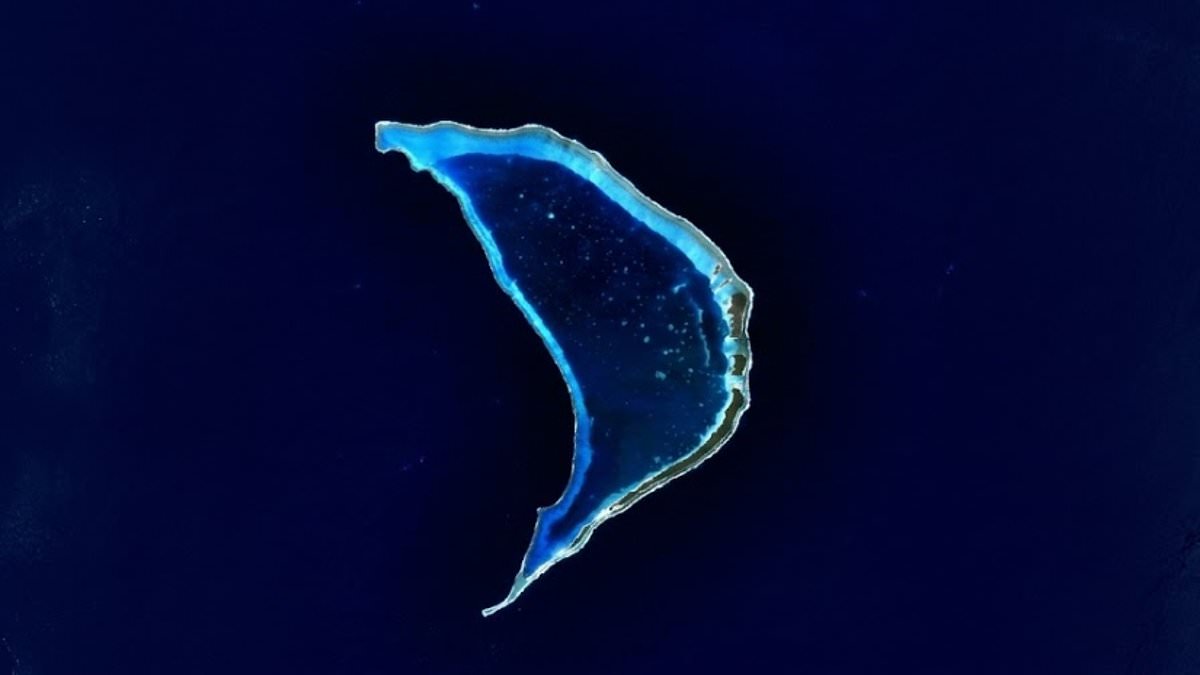
Humans have left their mark on almost every place on the planet, from the bottom of the Mariana Trench to the peaks of Mount Everest.But scientists have discovered two remote atolls in the Pacific Ocean which appear to be the exception. These coral atolls, Bikar and Bokak, appear to be truly 'wild and untouched', researchers said.Located near the Marshall Islands, they could be some of the most intact ecosystems remaining in the region – and perhaps the world.'This study provides the first comprehensive ecological baseline of the newly created National Marine Sanctuaries of Bikar and Bokak atolls from the sky and land to the deep sea, and highlights some of the most intact ecosystems remaining in the region,' first author Dr Alan Friedlander, a marine ecologist at the University of Hawai'i, said.'Bikar and Bokak are not just treasures for the Marshall Islands but for the entire planet, a gift from the community of Utirik Atoll, which has traditionally and vigilantly safeguarded these fragile ecosystems for decades.' These coral atolls, Bikar and Bokak (pictured), appear to be truly 'wild and untouched', researchers said Bikar and Bokak are the northernmost atolls in the Marshall Islands, lying approximately 72 miles (116km) and 239 miles (385km) from the nearest inhabited atoll. Pictured: The reef habitat at Bikar Bikar and Bokak are the northernmost atolls in the Marshall Islands, lying approximately 72 miles (116km) and 239 miles (385km) from the nearest inhabited atoll.In 2023, the team carried out an extensive survey of the local land, sea and sky, assessing seabird and shorebird populations, mapping vegetation, and studying turtle nesting sites, coral reefs and fish communities.Using scuba surveys, underwater video, deep-sea cameras and even a submarine, they built a detailed picture of the region's biodiversity.Two years later, the findings helped pave the way for the designation of a 48,000-square-kilometre marine sanctuary around the atolls, the country's first national marine protected area.'These atolls have extensive seabird colonies, mature native vegetation and active turtle nesting,' Dr Friedlander said.'They also have high reef-fish biomass and large predators, coral-dominated reefs at Bokak, structurally complex mesophotic habitats, and surprisingly diverse and poorly known deep-sea communities.'Across both atolls, the researchers found 15 seabird colonies that were confirmed or likely to be breeding.They also found at least 266 groups of reef fish, 138 groups of fish living at greater depths, and 79 groups of deep-sea fishes. Sea turtle nesting was almost exclusively concentrated at Bikar, with 132 green sea turtle nest pits recorded The researchers found at least 266 groups of reef fish, 138 groups of fish living at greater depths, and 79 groups of deep-sea fishes. Pictured: A bumphead parrotfish at Bokak atoll Across both atolls, the researchers found 15 seabird colonies that were confirmed or likely to be breeding. Pictured: Brown boobies at Bikar atollA total of 15 groups of open-water predators including sharks, jacks and wahoo, were recorded.Of the species identified, two may be new to science.Despite sharing many characteristics and housing many of the same species, the atolls also differ from each other.Sea turtle nesting, for example, was almost exclusively concentrated at Bikar, with 132 green sea turtle nest pits recorded.The total biomass of reef fish was higher at Bokak which is characterised by coral-dominated reef communities.Bikar, on the other hand, supported a greater diversity of algae.The extensive surveying of these ecosystems offers an unparalleled glimpse into how they function with only minimal human influence.'They are among the best ecological reference systems we have to better understand what we have lost elsewhere and to provide fundamental insights needed for effective conservation and restoration efforts,' Dr Friedlander said. The Bikar atoll (pictured from the International Space Station) supported a greater diversity of algae The total biomass of reef fish was higher at Bokak which is characterized by coral-dominated reef communities. Pictured: An orange-fin anemonefish The team used scuba surveys, underwater video, deep-sea cameras and even a submarine to build a detailed picture of the region's biodiversity. Pictured: Giant clams at Bokak atoll'The Marshall Islands government should be applauded for their foresight in protecting these global biodiversity hotspots, where human activity is distant and habitats teem with life. 'As human activities increasingly threaten biodiversity, areas devoid of intense human impacts serve as vital refuges.'Large marine protected areas serve as globally important ecological reference systems for understanding the structure and future trajectories of tropical oceanic ecosystems.'The study, published in the journal Frontiers in Marine Science, warns that although these ecosystems lie far from human populations, they are not immune to the growing effects of global environmental change.Rising ocean temperatures, coral bleaching, sea-level rise and shifts in marine productivity are increasingly affecting even the world's most isolated tropical reefs.The conditions documented by the researchers provide a crucial benchmark against which future ecological changes can be measured.The team explained that as untouched marine environments become ever rarer, Bikar and Bokak offer a valuable window into how healthy tropical ocean ecosystems function.
Scientists discover two 'wild and untouched' worlds hidden in the Pacific
Full Article
Original Source
Read the full article at Dailymail →KhanList aggregates and links to publicly available news content. We do not host full articles from third-party sources. Always verify important information with original sources.