
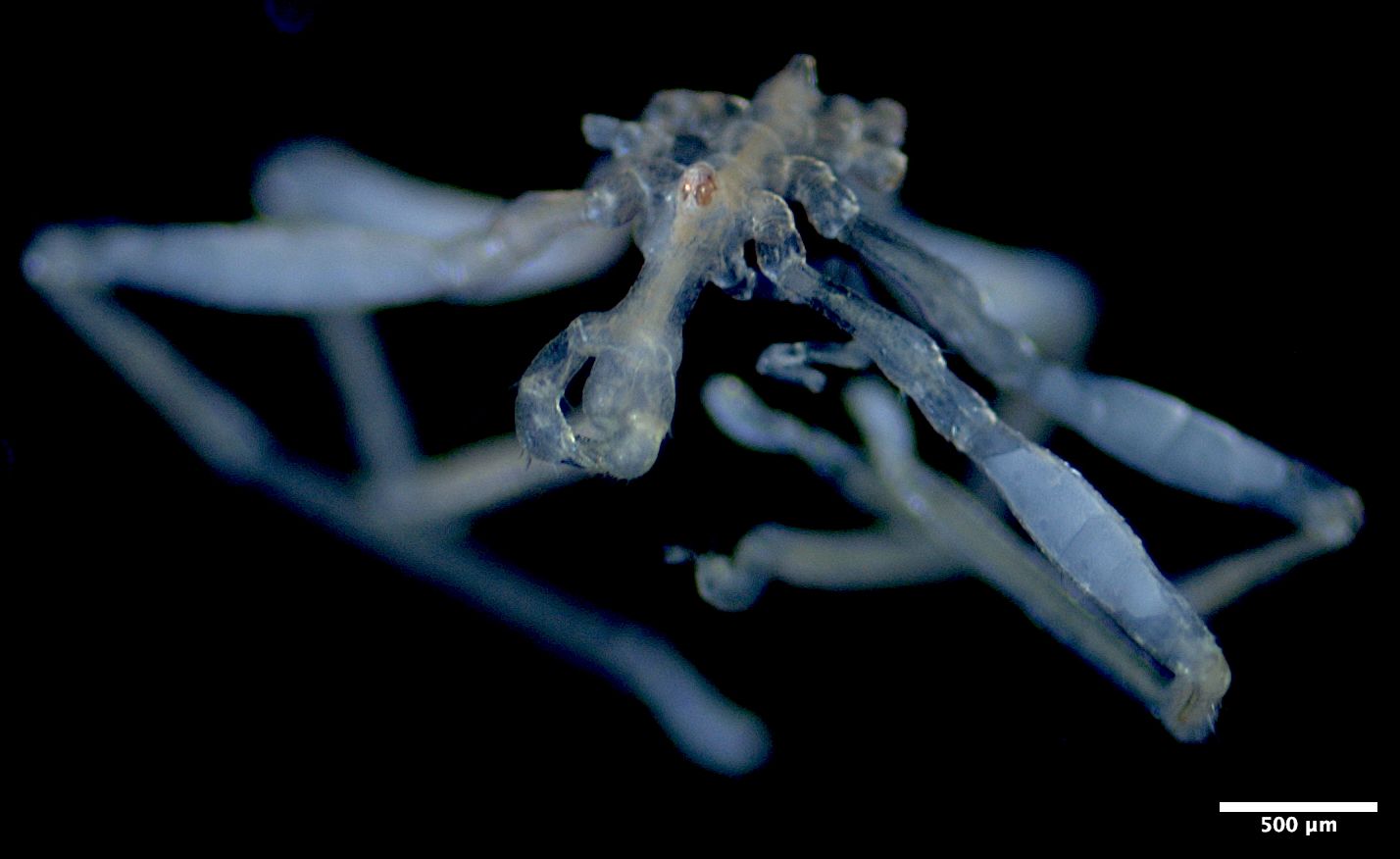
You don’t need to worry about the critters coming after you, since they’re only a fraction of an inch across. They join the roughly 1,400 known species of ocean-dwelling spiders October 2, 2026 10:00 a.m. Researchers discovered Callipallene pilosuspedes, a new species of sea spider, in the Salish Sea. Cormac Toler-Scott Glowing red eyes. Hairy legs. Claws for grasping food. No, it’s not a human-made monstrosity or alien attacker from this season’s latest horror movie—it’s real, and it’s lurking along the Pacific Coast. It’s one of two new species of sea spider discovered in the Salish Sea, which stretches along the coastal Pacific Northwest between Washington state and British Columbia in Canada. But there’s no need to fear the newfound creatures; the red-eyed one is only around one-third of an inch across, and the other is even smaller. Researchers described the itsy-bitsy sea spiders in a study published August 26 in the journal Organisms Diversity & Evolution. “It’s everyone’s dream to find new species, but it’s pretty uncommon,” says study co-author Cormac Toler-Scott, an evolutionary biologist at the University of British Columbia, to NPR’s Chandelis Duster. He and his colleagues found the strange multi-legged critters during dives at sites including Quadra Island, Vancouver, Bamfield and Victoria between September 2023 and August 2024. They collected more than 150 individual sea spiders from depths of up to 60 feet. After examining the animals’ physical characteristics and analyzing their DNA, the researchers determined the creatures represented five species of shallow-water sea spiders—two of which had never been described. Callipallene pilosuspedes has a three-lipped, tendril-filled mouth. Cormac Toler-Scott While scientists know of roughly 50,000 species of land-lubbing spiders, only about 1,400 species of their ocean-dwelling relatives have been documented, Kaija Jussinoja reports for CTV News. New sea spiders can be tough to identify because they’re often small and look like one another, Toler-Scott tells Gizmodo’s Ed Cara. Still, these two new species have plenty of characteristics that set them apart. One of them boasts ruby eyes; a claw-adorned feeding tube called a proboscis; a three-lipped, triangle-shaped mouth covered in sensory tendrils; and, of course, fine spines on its legs, according to a statement. The researchers found just one individual and named its species Callipallene pilosuspedes—a play on the Latin words for “hairy feet.” The other recently described sea spider resembles something like a swamp monster. Because of its underdeveloped egg-carrying limbs, or ovigers, the critter cannot clean itself. The research team found 82 individuals, and they were often covered in dirt, debris and tiny parasites, creating an “ecosystem within an ecosystem within an ecosystem,” Toler-Scott says in the statement. The species was dubbed Tanystylum kiixin (pronounced “kee-hin”) to reference the ancient Indigenous village site where the first specimens were collected. Tanystylum kiixin, the other new species, hosts parasites. Cormac Toler-Scott Sea spiders have retained “some weird traits,” Toler-Scott says in the statement. “A lot of the shallow-water species are quite small, and so they’ll live as parasites on larger organisms, and they use this weird apparatus called a proboscis to suck the juices out of their host.” Both new species were found near an underwater organism called a hydroid, which resembles a jellyfish attached to the seafloor, reports CBC News’ Ruby Cornish. The multi-legged creatures probably stay near hydroids and feast on the stationary animals. Sea spiders evolved roughly 500 million years ago. They’re related to land spiders, scorpions and horseshoe crabs. The marine arthropods can have up to 12 legs and range in size from a fraction of an inch to more than two feet across. Over time, these spiders evolved to lack abdomens; instead, they breathe, reproduce and digest food with organs in their legs. “They’re all legs,” Felipe Barreto, an evolutionary biologist at Oregon State University who wasn’t involved in the new study, told National Geographic’s Alice Sun in 2024. “They’re kind of their own thing.” Quick fact: First known sea spiders to “eat” methane According to a study published in June 2025, some sea spider species collect bacteria that can convert methane gas from the deep sea into fats and sugars that the spiders can eat. New research continues to reveal the diversity that has evolved among these strange sea critters. For instance, a study that will be published in October in the journal Deep Sea Research Part I: Oceanographic Research Papers details some massive sea spiders that glow in the dark via bioluminescence. Scientists found them in samples collected at depths of up to 16,300 feet in the Australian abyss. Claudia Arango, a sea spider expert at Queensland Museum in Australia who wasn’t involved in the new research, told National Geographic that these revelations are par for the course in the field. “Every expedition to a remote island or remote seamount, scientists come back with new species, with something new that we didn’t know.” And the new species found in the Salish Sea show that even well-studied places might be hiding creatures waiting to be discovered—that could soon disappear. “If a master’s student can find two new species of sea spiders in one field season of scuba diving along the coast of [British Columbia], imagine how many undescribed species of marine invertebrates need to be documented before anthropogenic disturbance and climate change completely alter these marine communities forever,” Toler-Scott tells Gizmodo. You Might Also Like Get the latest stories in your inbox every weekday. More about: Animals Canada Creepy Crawlers New Research Oceans Pacific Ocean spiders Weird Animals
Scientists Discover Two New Species of Sea Spider in the Pacific Northwest—and They Look Like They Came Straight Out of a Horror Movie
Full Article
Original Source
Read the full article at Smithsonianmag →KhanList aggregates and links to publicly available news content. We do not host full articles from third-party sources. Always verify important information with original sources.