
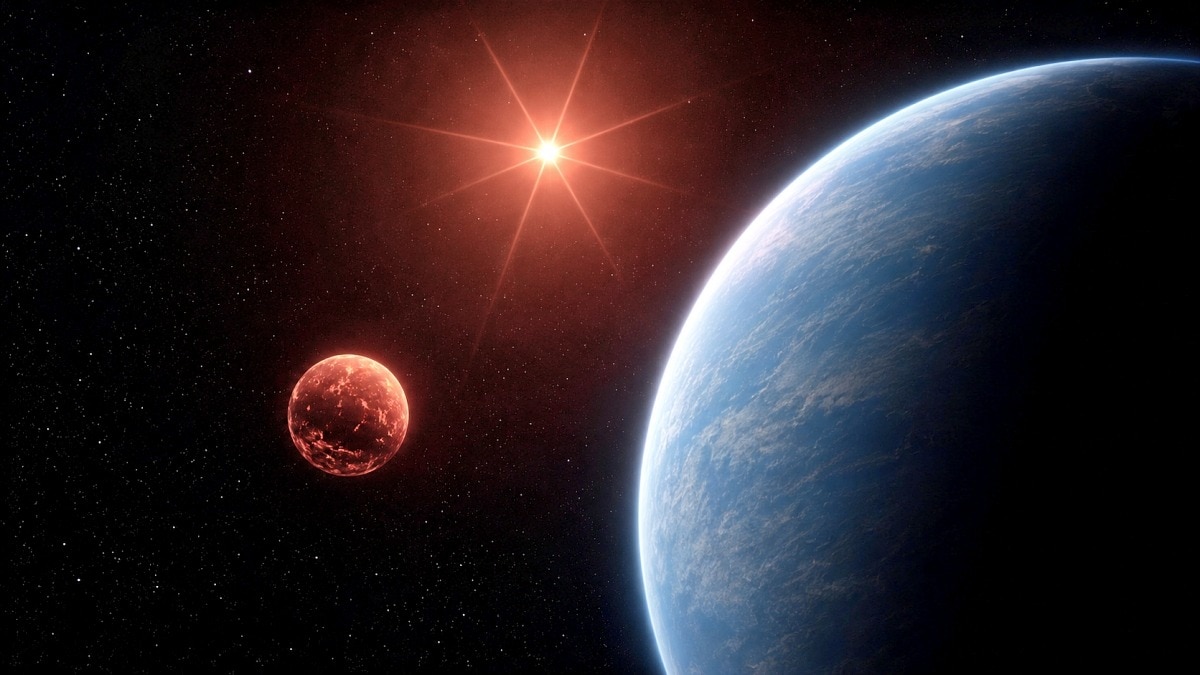
Spanish researchers have identified two exoplanets orbiting the red dwarf TOI-1752. One of them has emerged as a key target because it may support liquid water if its atmosphere is suitable.TOI-1752 b is a scorching lava world larger than Earth, with an estimated mass of around 4.35 times that of our planet. Spanish scientists have announced the discovery of two new exoplanets orbiting a nearby red dwarf star, including a potentially habitable super-Earth that may have conditions suitable for liquid water.The discovery of the two worlds, named TOI-1752 b and TOI-1752 c, was announced on August 31 by an international team led by Spanish researchers.TOI-1752 b is a scorching lava world larger than Earth, with an estimated mass of around 4.35 times that of our planet. Its companion, TOI-1752 c, is particularly intriguing because scientists believe it could be a potentially habitable super-Earth.The planet is believed to be a rocky world with an estimated mass of 5.20 Earth masses. Scientists say it could potentially host liquid water, although this would depend on several factors, particularly whether the planet possesses a suitable atmosphere. The research was led by Alberto Pelaez Torres from the Institute of Astrophysics of Andalusia and Spain's National Research Council in Granada. The study also involved the Institute of Astrophysics of the Canary Islands, which carried out observations using the MuSCAT2 instrument at Teide. Researchers from the University of Tokyo's exoplanet group also participated, using the MuSCAT3 instrument in Hawaii.Both planets orbit TOI-1752, a red dwarf star located around 337 light-years from Earth in the direction of the constellation Draco. The star has slightly more than half the mass of the Sun and is cooler than our own star.Red dwarfs have become important targets in the search for small exoplanets. Their relatively small size makes it easier for astronomers to detect tiny changes in starlight when an orbiting planet passes in front of them.The discovery was made using the transit method, which detects planets by measuring small, periodic dips in the brightness of their host star.The next major challenge for scientists will be studying the atmospheres of the two newly discovered worlds.Future ground-based and space telescopes could potentially analyse starlight passing through a planet's atmosphere during a transit. Such observations may reveal information about atmospheric composition and whether conditions suitable for liquid water exist.However, the technique depends on the planet having an atmosphere that is not completely obscured by thick clouds.For now, the two discoveries add another pair of fascinating worlds to the rapidly growing catalogue of planets beyond our Solar System, with TOI-1752 c emerging as a particularly interesting target for future studies.- EndsPublished By: Sibu Kumar TripathiPublished On: Sep 1, 2026 15:23 IST
Scientists discover a planet made of lava, another looking like Earth
Full Article
Original Source
Read the full article at Indiatoday →KhanList aggregates and links to publicly available news content. We do not host full articles from third-party sources. Always verify important information with original sources.