
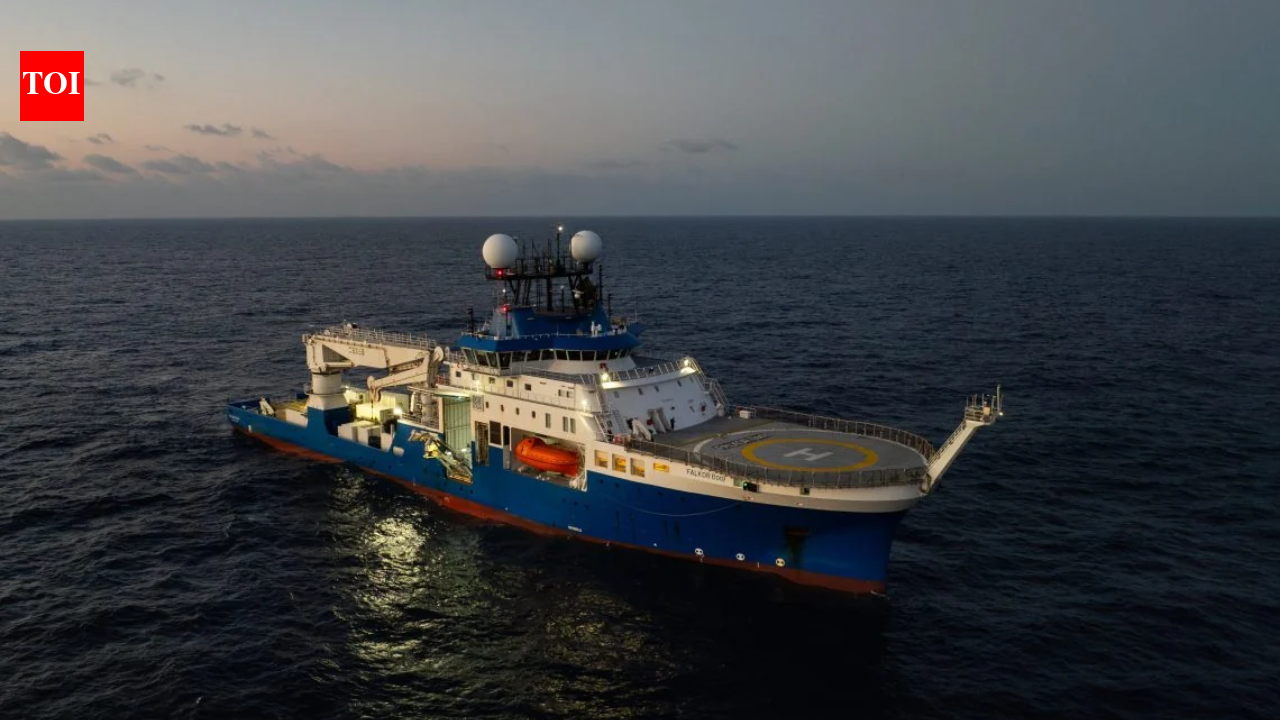
Scientists find 5-million-year-old Atlantic coral atoll, confirming a 30-year-old theory (Image Credit: Schmidt Ocean Institute)An ancient coral island that disappeared beneath the Atlantic Ocean millions of years ago has been found supporting thriving marine life deep beneath the surface. Elsewhere in the region, scientists also discovered sponge and coral gardens thousands of metres underwater. The discovery offers a rare glimpse into the ocean's geological past while revealing ecosystems that scientists had long suspected existed in this part of the Atlantic.According to a November 23, 2026, announcement by the Schmidt Ocean Institute, an international team led by Brazilian scientists discovered the five-million-year-old submerged coral atoll in the Romanche Fracture Zone during a 35-day expedition. Its summit lies about 900 metres below the ocean surface. The finding confirms a hypothesis proposed around 30 years ago that coral atolls once existed in the middle of the Atlantic, where such formations are no longer found today.Five-million-year-old coral structure discovered beneath the AtlanticThe ancient atoll was identified during an expedition aboard the Schmidt Ocean Institute's research vessel Falkor (too). Scientists first used the vessel's mapping systems and an autonomous underwater vehicle called The Childlike Empress to locate the geological formation. They then deployed the remotely operated vehicle SuBastian, equipped with high-definition cameras, to examine the seafloor.The investigation revealed a structure approximately 300 metres tall, made of fossilised coral and resting on a volcanic ridge that rises 4,100 metres above the seabed. Its height is comparable to that of the Eiffel Tower.The fossilised coral provides evidence that the area once supported shallow-water reefs. Over millions of years, geological changes caused the ancient formation to become submerged, leaving its summit hundreds of metres below the surface. Today, the structure supports a thriving garden of deep-sea corals, creating an unusual connection between an ancient geological formation and a living marine ecosystem.Scientists discover ancient sponge gardens and 1,000-year-old coralsThe expedition uncovered much more than the prehistoric atoll. Across four regions of the 950-kilometre Romanche Fracture Zone, researchers documented dozens of vulnerable marine ecosystems at depths ranging from 600 to 4,000 metres. Among the discoveries were ancient sponge gardens, cold-water corals estimated to be up to 1,000 years old, rare zoanthid meadows, squids and octopuses. Corals and sponges are slow-growing, largely immobile organisms that can survive for centuries.One particularly surprising discovery was a thriving sponge and coral garden at a depth of 4,300 metres. Scientists had not expected to find such large communities at this depth because deep-sea environments generally have less available food and fewer essential minerals. At another site, approximately 1,200 metres underwater, researchers found thousands of tiny, light-pink zoanthids carpeting the seabed across an area roughly the size of a football field. Zoanthids are marine animals related to sea anemones and corals.Romanche Fracture Zone could be important for marine protectionThe Romanche Fracture Zone is the longest geological fault in the Atlantic Ocean. Located near the equator, it is characterised by deep underwater valleys and steep slopes. It also acts as a corridor where North Atlantic Deep Water and Antarctic Bottom Water mix. The region's surface conditions support frequent phytoplankton blooms. When these microscopic organisms die, they sink and provide food for marine life in deeper waters, helping sustain ecosystems far below the surface.Scientists had previously suspected that the region was a biodiversity hotspot, but earlier expeditions had not used remotely operated vehicles to document its seafloor habitats and marine species visually.The latest findings provide the first visual evidence of the area's ecological importance. Expedition chief scientist Dr Jose Angel Perez of Brazil's Universidade do Vale do Itajaí said the discoveries strengthen the case for considering the Romanche Fracture Zone for protection under the recently ratified High Seas Treaty. Researchers also suspect that some of the collected samples could contain previously unidentified species. The extensive data gathered during the expedition could support decades of further scientific research.The discovery highlights how little is still known about deep-sea environments and why documenting these ecosystems is important for understanding ocean biodiversity and protecting vulnerable marine habitats.
Scientists discover 5-million-year-old coral atoll hidden 900 metres underwater
Full Article
Original Source
Read the full article at Timesofindia →KhanList aggregates and links to publicly available news content. We do not host full articles from third-party sources. Always verify important information with original sources.