
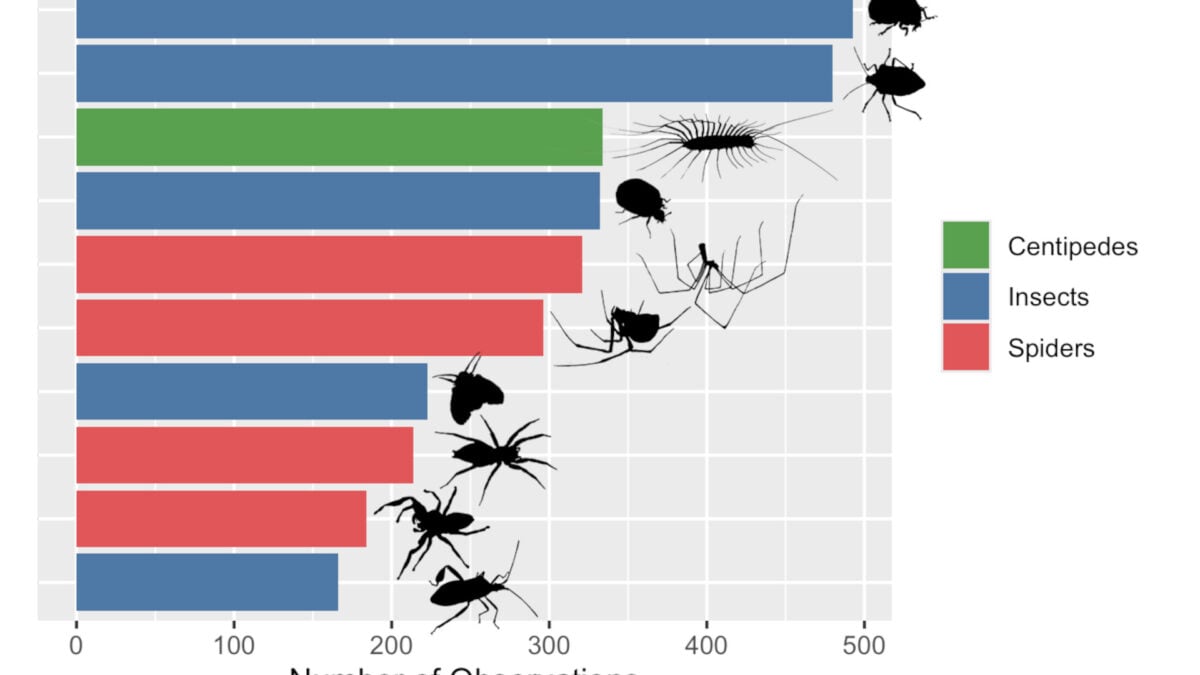
Everyone knows that roommates can be hit-or-miss. They can become our best friends or a nightmare nuisance, while others might be so quiet we forget they’re there half the time. But it’s not just other people that share our living spaces. New research provides a closer look at the many different types of non-human creatures nestled inside our homes. Scientists at North Carolina State University and others have embarked on a mission to catalog the wildlife that inhabit our indoor environments. For the new study, they’ve been sorting through the many reports sent in by people across the world. So far, they’ve identified at least 2,000 distinct species of insects, arachnids, and other living things that count us as roommates. So many bugs in our homes. © Allf, et al/Ecology, CC BY 4.0 “When we think we’re alone, we’re still surrounded by far more species than we imagined. And there are tens of thousands of people who are not only interested in paying attention to those species, but are taking photos of them, taking notes, and describing their relationship to these species,” senior study author Rob Dunn, a professor of entomology and plant pathology at NC State, told Gizmodo. “Some people are afraid of the life around them in their homes, but there’s another way.” The Never Home Alone project Try as we might, we haven’t come close to finding every possible permutation of life out there. Scientists have identified roughly a million known species of insect, for instance, yet the actual count might be as high as 20 million. Many unknown or less characterized species reside in regions remote to humans. Yet the researchers say we’ve also neglected the study of the living things closest to us, perhaps because they’re so easy to overlook. So they began the Never Home Alone project, an attempt to identify and better understand these creatures. The project is an example of citizen science, meaning it’s reliant on the observations made by amateur naturalists and other curious volunteers. People have been encouraged to submit photos and videos of wild things inside their homes, offices, or other indoor places through the website iNaturalist. Though this project is still ongoing, the current study analyzed a subset of submissions from people in the U.S. and Canada that were sent through early 2024. After removing entries that clearly didn’t fit the project’s criteria, the research team, which included dozens of experts in taxonomy, looked through roughly 24,000 observations from 3,000 people that were made between May 1996 and April 2024. The reports came from all 50 states and every Canadian province. From these, the researchers identified nearly 2,100 species. But even this is likely an undercount, since the researchers couldn’t narrow down a specific species in 44% of reports. About 95% of these species were arthropods, a broad branch of invertebrate life that covers insects, arachnids, and other groups that the average person would consider a creepy-crawly creature. Reptiles and mammals largely represented the rest, with one documented report of a wayward alligator in a person’s garage. Fungi, plants, and other invertebrates like annelids (earthworms, for instance) also made the list. The most common species observed was the Asian lady beetle (Harmonia axyridis), followed by the brown marmorated stink bug (Halyomorpha halys) and house centipede (Scutigera coleoptrata). They also identified hundreds of different spider species. And more than 50% of species were only observed indoors once. The team’s findings were published last week in the journal Ecology. “It’s a reminder of how we are connected to the natural world. It’s a reminder that we can still connect with the species around us,” Dunn said. “People are spending hours on Grand Theft Auto, which took 13 years to develop. The jumping spider in your kitchen took millions of years to evolve.” Lessons left to be learned The Never Home Alone project is still growing, with nearly 80,000 observations of approximately 9,300 indoor species. And these reports are only the start of answering many unresolved questions about the wild life inside our homes. A close-up of a house centipede (Scutigera coleoptrata). © Colombe Photographie via Shutterstock Given how some people freak out at the sight of a cockroach, the researchers know that plenty might be unnerved by having to share spaces with these many-legged roommates. But in truth, many of these species pose no threat to us, and some actually hunt the few that are genuine pests. If nothing else, the researchers are optimistic their work can help people better appreciate the complexity and diversity of the life that surrounds us. “I hope the study makes people curious enough to go on a little expedition into their own living room and see what they find. We know so little about the indoor environment, you might just learn something no one else knows, or be shocked by how beautiful some of these species are,” lead study author Bradley Allf, a postdoctoral fellow studying urban biodiversity at Colorado State University, told Gizmodo. “Ever seen a carpet beetle up close? The colors and patterns are unbelievable.”
Scientists Cataloged 2,000 Species Living in Our Homes—Including an Alligator
Full Article
Original Source
Read the full article at Gizmodo →KhanList aggregates and links to publicly available news content. We do not host full articles from third-party sources. Always verify important information with original sources.