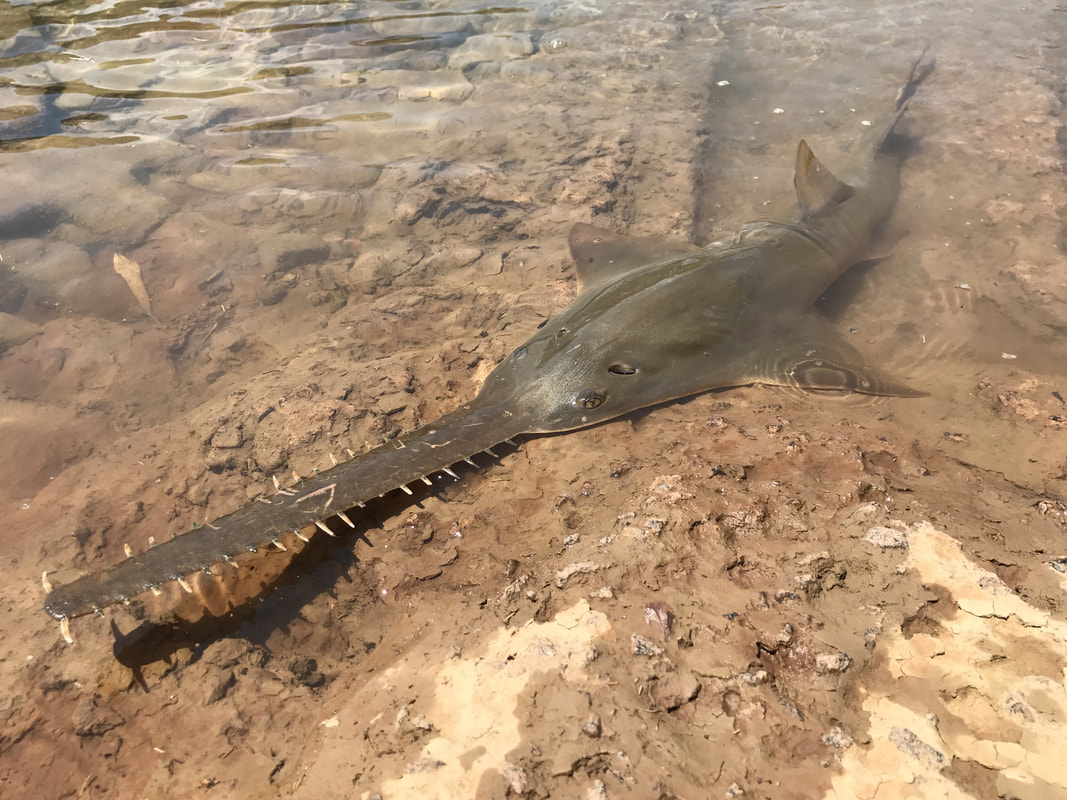
Teeth of critically endangered sawfish species continue to be used as cockfighting spurs in Latin America despite bans from cockfighting organizations, a new study found.Researchers interviewed cockfighting practitioners in Peru, where the sport is widely prevalent, and leaders from cockfighting associations in Peru, Mexico, Ecuador and Puerto Rico to understand the dynamics of this illegal trade.The study found sawfish teeth are sold for anywhere between $25 and $400 per pair, making them some of the most valuable wildlife products. Peru, Ecuador, Costa Rica, Brazil and Colombia supply most of the teeth, while Peru tops the list of consumers.All commercial international trade in sawfish is prohibited under CITES, and the fish is a protected species across Latin America. Scientists call on countries to enforce their laws and on CITES to act against hidden illicit trade. Sawfish, a group of large marine rays, derive their name from a striking appendage: Their long, saw-like snout lined with teeth-like scales. Nature intended these fish to use their snout, also called a rostrum, to send out electric signals that shock unsuspecting prey, slice it like a sword to impale it, and devour the catch. Humans, on the other hand, use these sharp teeth as cockfighting spurs — a spiky object strapped to a game cock’s legs so it can deliver lethal blows to its opponent and win the fight. For centuries, practitioners of the sport in Latin America have carved sawfish (fam.Pristidae) teeth into spurs. But in the 2000s, as sawfish became overfished for their fins, many cockfighting associations in the region officially banned using their teeth as spurs. In 2007, all sawfish species were added to CITES, the global wildlife trade agreement, and their commercial international trade was banned. A sawfish’s rostrum is lined with sharp teeth-like scales, which are carved into cockfighting spursCredits: Vassil – CC0. A recent study, published in the journal Conservation Letters, found that international commerce in sawfish rostra and teeth continues in Latin America despite bans. Talking to cockfighting practitioners and association representatives, the researchers found most rostral teeth entering the trade came from Peru, Brazil, Ecuador, Central America and Colombia. Peru topped the list as a destination. They call for stricter law enforcement and coordination in these countries, and urge CITES to take action to curb the “hidden” trade. Although the peak of the trade in Peru was between 1980 and 2000, the market has remained active to this day,” said study lead author Mariano Cabanillas-Torpoco at the Instituto Chico Mendes de Conservação da Biodiversidade (ICMBio), Brazil. The illicit commerce, he said, “remains hidden from the national governments” as the countries “lack specific strategies to curb this trade due to a lack of awareness.” Mario Espinoza, who studies sawfish species in Central America at the University of Costa Rica, called it “not surprising” that the trade continues. “Unfortunately, sawfish trade is still happening, yet the magnitude of the scale remains unknown to me,” he said, recalling his experience from 2016. His research group, which studies largetooth sawfish (Pristis pristis), ran an awareness campaign about the species and displayed sawfish rostra. Instead of questions about the fish, the team received inquiries from interested buyers. “Several individuals contacted us on Facebook and WhatsApp interested in purchasing some of the rostrums we used for education/outreach,” Espinoza said. A ‘forgotten trade’ spurred by cockfighting Latin America has a long tradition of cockfighting, which is played out in arenas before an audience, like other sports. But in recent years, recognized cockfighting associations have banned the use of spurs made from natural materials, such as sawfish teeth or sea turtle shells, because of the harm caused to the species. Instead, these associations encourage practitioners to switch to cheaper plastic spurs. But in informal arenas, sawfish teeth continue to be used, researchers said. Cockfighting spurs, made of plastic, metal or animal parts, are attached to a gamecock’s leg to inflict lethal blows to the opponent. Credits: © Superbass / CC-BY-SA-3.0. Between 2016 and 2022, Cabanillas-Torpoco and his colleagues interviewed 47 Peruvian cockfighting practitioners and five representatives from national cockfighting associations in Peru, Mexico, Ecuador and Puerto Rico to understand the prevalence of trading and using sawfish teeth for spurs. They collected information about when the interviewees last saw sawfish spurs in use, where they source them, and their cost. The researchers found that trade in sawfish teeth has continued, in physical markets and online, for more than a decade since international and national bans were put in place. Nearly all Peruvian cockfighting practitioners said they saw sawfish spurs used or offered for sale in the country. More than half of them were locally sourced, they said, and the rest came from Brazil and Ecuador. Peru was the top destination for teeth, because cockfighting is legal and permitted in the country; it is banned or restricted in Brazil and Ecuador. The study found that the trade is lucrative, with a single rostrum selling for up to $5,600, making it one of the most valuable wildlife products in the global trade. On average, a rostrum with typically 40 teeth is offered on eBay for about $1,242, according to the study. A sawfish rostrum, such as this one, can sell for about $1,200 online, and can be highly profitable, further threatening the species, researchers say. Credits: (c) Sacha R, (CC BY-NC) Each tooth yields an average of 4 spurs, resulting in a minimum of 160 spurs (or 80 pairs). Each pair of spurs can cost $100 – $130,” Cabanillas-Torpoco said. “The net profit is $8,000.” He also added that the trade network involves the fisherman, the buyer of the whole rostrum or just the teeth, who either makes spurs himself or resells them to manufacturers. The most coveted of the spurs, the caramel-hued “caramelo” spurs, come from teeth in the center of the rostrum. These are the hardest spurs, with the “greatest potential to inflict injuries to opponents” and are believed to come from female sawfish, according to the study. Most sawfish teeth traded come from accidental bycatch, the researchers found. In recent years, people have shifted from selling whole rostra with teeth to selling just loose teeth, because they fetch higher prices and are easier to smuggle across borders without being detected by authorities, the study found. Conservationists call for action to curb illegal trade Sawfish swim in the coastal and estuarial waters in the tropics and subtropics. As large predators, they play a vital role in maintaining an ecosystem balance by feeding on smaller fish. “These larger predators are also very mobile and can transfer nutrients between habitats or entire ecosystems,” Espinoza said, adding that there’s now scientific evidence to show their presence is linked to healthier ecosystems. “So, having sawfish in the environment is crucial to the health of our oceans.” But in recent years, marine predators, including sharks and rays, are at risk of extinction. All five species of sawfish are critically endangered due to overfishing for their meat and fins. Their coastal habitats are being destroyed by human development and pollution. Warming temperatures and intense storms, supercharged by climate change, are decimating their prey numbers. Their long snout makes these fish especially vulnerable to getting caught in fishing gear. As long-living, slow-reproducing species, sawfish don’t easily bounce back from steep declines, and they have become locally extinct in parts of South America. Conservationists worry that the prevalent “hidden” trade in their teeth will further drive their declines. The sawfish uses its long rostrum to send out electric signals that shock the prey, slice it like a sword to impale it, and devour the catch. Credits: (c) birdman_australia, (CC BY-NC). “The trade of teeth for spurs in Latin America is extremely worrying, given that sawfish are not very common in Costa Rica or Central America nowadays,” Espinoza said. “I believe this trade could impact the remaining sawfish, which are [now] only found in specific locations.” The study’s authors are calling on countries in Latin America to address this trade by enforcing their laws and training authorities to use forensic tools and visual guides to identify smuggled and illegally traded teeth. They also urge countries party to the CITES agreement to act on this illegal trade with improved coordination and tighter regulations, given that they already receive the highest protections from trade. “Collaboration with local authorities, the police, shipping agencies and INTERPOL is necessary at a national and regional level,” Espinoza said. “The authorities need better tools and regulations to deal with those involved in the trade.” Spoorthy Raman is a staff writer at Mongabay, covering all things wild with a special focus on lesser-known wildlife, the wildlife trade, and environmental crime. Banner image: A largetooth sawfish (Pristis pristis). All species of sawfish are critically endangered, and the international commercial trade in their parts is prohibited. Image by Peter Kyne. Citations: Wueringer, B. E., Squire, L., Kajiura, S. M., Hart, N. S., & Collin, S. P. (2012). The function of the sawfish’s saw. Current Biology, 22(5), R150–R151. doi:10.1016/j.cub.2012.01.055 Cabanillas‐Torpoco, M., Forsberg, K., Dulvy, N. K., Thykjaer, V. S., & Charvet, P. (2026). The forgotten international trade of sawfish rostral teeth in Latin America. Conservation Letters, 19(2). doi:10.1111/con4.70053 FEEDBACK: Use this form to send a message to the author of this post. If you want to post a public comment, you can do that at the bottom of the page. Related articles: https://news.mongabay.com/video/2026/02/why-is-cockfighting-a-risk-to-perus-rarest-fish/ Credits Topics
Scientists call on countries to act on ‘forgotten’ sawfish teeth trade
Full Article
Original Source
Read the full article at News →KhanList aggregates and links to publicly available news content. We do not host full articles from third-party sources. Always verify important information with original sources.