
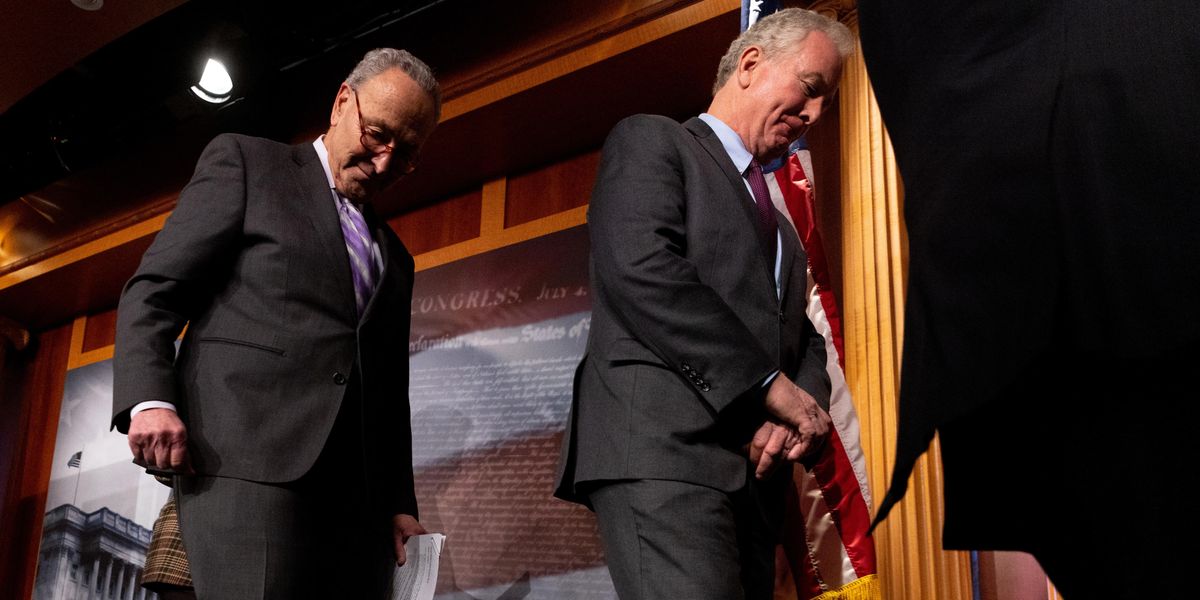
In some of his first remarks on the Senate floor since his leadership of the Democratic caucus was formally challenged, Sen. Chuck Schumer of New York blasted President Donald Trump for pursuing an insufficiently hawkish foreign policy.“Trump calls the trilateral meeting with Xi and Putin ‘historic’. Yes, it’s a historic embarrassment that people will remember long into the future,” Schumer said on Thursday. “It’s a betrayal of the United States.”Schumer went on to criticize the President for not securing any concessions from his counterparts, including on curbing Chinese espionage or preventing Beijing and Moscow from helping Iran target American troops. The emphasis of Schumer’s remarks was striking given that dissatisfaction with Trump’s foreign policy and its economic ramifications helped propel Democrats back into the Senate majority earlier this month.As Democrats debate whether their electoral victory presents an opportunity to rethink the party's foreign policy, Schumer's remarks suggest that some of its longtime leaders remain wedded to an older approach.That tension is also emerging as a central dividing line in the contest to lead the new Democratic majority. Sen. Chris Van Hollen (D-Md.), who announced last week that he would challenge Schumer, has made their disagreements over foreign policy, and in particular over how to approach the issues in the Middle East, as central to his pitch. The two senators represent competing visions of the Democratic Party’s future. Faiz Shakir, a senior advisor to Sen. Bernie Sanders (I-Vt.), who has supported Van Hollen’s challenge, described him as a“pragmatic progressive” who is “going to know what the people of this country are asking us to do at this moment” and “can bring a lot of factions of the party together.” Much of the debate is over how Democrats should approach using their power of the purse to cut off funding for the war in Iran before the new Congress is seated in January. Van Hollen and a number of his Democratic colleagues have called on the party to insist on a government funding bill that excludes money for the Iran war, which they say will force Trump and the Republicans to decide whether to risk a shutdown to continue the war. Other Democrats argue that a shutdown would be politically risky for the party, and that Democrats should wait until they are in the majority to force the issue. Schumer, for his part, has not clarified his stance, as he continues to say that the war must end and a shutdown must be avoided. Schumer's reluctance to say that he will prioritize ending the war has renewed scrutiny on his longstanding hawkishness toward Iran. Many foreign policy analysts and congressional critics have highlighted his place as one of a few Democratic opponents to the Obama-era Joint Comprehensive Plan of Action (JCPOA), commonly known as the Iran nuclear deal, as one clear example. Van Hollen has made this contrast central to his leadership campaign. “I don't see how after an election like this where ending the war and bringing down prices was a priority, we can cast a vote to fund the war,” he said recently. “And of course, Senator Schumer was one of the folks who originally opposed President Obama and the JCPOA, but I think the caucus wants to bring this war to an end,” Progressives have also condemned Schumer’s approach in the lead-up to the war, during which he attacked Trump’s diplomacy with Tehran and, critics say, did not act quickly enough to slow the president’s march to war in February. On Thursday, during his floor speech, Schumer questioned what “commitments” Trump made and what he “gave away” over dinner with Chinese President Xi Jinping, echoing his controversial June 2025 accusations that Trump was negotiating “side deals” and “folding on Iran.”The disagreements extend beyond Iran. Van Hollen has taken a leading role in the effort to remove provisions of the National Defense Authorization Act (NDAA) that would deepen military and intelligence cooperation between the United States and Israel.“The agreements and projects these provisions envision threaten U.S. national security interests by handing Israel leverage over American weapons systems and military technology,” Van Hollen and 11 Senate colleagues wrote in a recent letter to congressional leadership. “If enacted, these agreements would create long-term dependencies by embedding Israeli technology into the U.S. defense industrial base that could make future policy changes costly or difficult to implement.” The letter further argues that the provisions would shift U.S. military assistance to Israel to more “opaque, less discernible avenues,” which the Senators call particularly troubling given Israel's conduct in Gaza, the West Bank, and elsewhere in the region. Schumer has not publicly commented on these provisions, but is seen as one of Israel’s strongest supporters in Congress. In 2025, he told the New York Times that his “job...is to keep the left pro-Israel.” He has repeatedly called himself a “guardian of Israel” throughout his congressional career, which spans 45 years.Their perspectives on the U.S-Israel relationship appears to be a key dividing line between the two senators. Van Hollen was first elected as an establishment-supported, Israel-friendly candidate, but his views have shifted. “Times have changed in a lot of ways, where the Democratic base has changed in a lot of ways, and he has changed along with it,” Yousef Munayyer of the Arab Center recently told The Intercept. “I don’t know that the same can be said for a lot of other folks, like Chuck Schumer.”Independent trackers show that the sitting minority leader currently has more support, though the tallies remain close. The vote for majority leader is expected to take place in a secret ballot on Dec. 1.
Schumer doubles down on hawkery despite Van Hollen's anti-war test
Full Article
Original Source
Read the full article at Responsiblestatecraft →KhanList aggregates and links to publicly available news content. We do not host full articles from third-party sources. Always verify important information with original sources.