
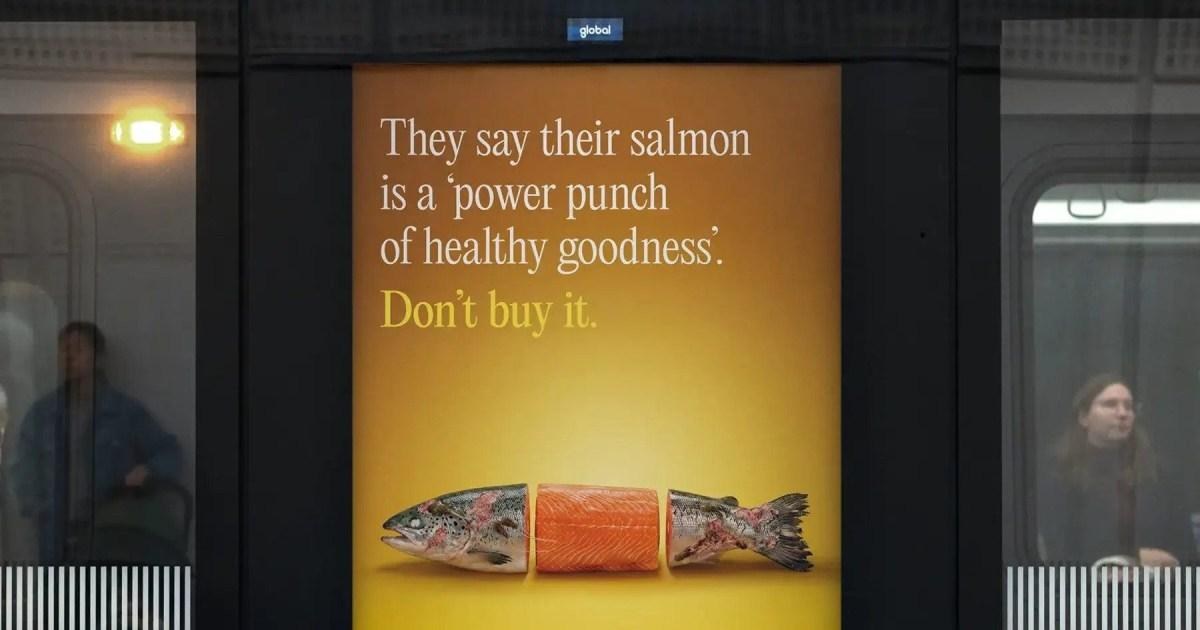
Commuters have been shocked by the images (Picture: Project Slingshot) If you’ve been out and about recently, you might have been greeted by a series of ‘scandalous’ adverts on the Tube. Images showing ‘nasty’-looking fish that’s been eaten by sea lice, and salmon that’s more grey than pink. The ads have been popping up all over the London Underground over the last few weeks, shared by animal activist group Project Slingshot. The organisation claims to be revealing ‘the hidden truth’ behind farmed salmon and putting pressure on the supermarkets selling it. The ads have prompted mixed reactions, with some grossed out by the content, and others concerned and confused about whether they should keep on buying salmon. The grim adverts have been popping up all over the London Underground (Picture: Project Slingshot) What’s going on with salmon? It’s the top-selling fish in the UK, with sales reaching nearly £1.6 billion, but activists and top chefs want people to stop buying it. Why? Salmon can be wild-caught in oceans, lakes, or rivers, but the vast majority of salmon on the shelves in UK supermarkets is Atlantic salmon, farmed predominantly in Scotland. The UK currently has more than 200 salmon farming sites, mostly located along the west coast of Scotland, Shetland, and Orkney. There are different types of salmon farming, including open-net sea cages and land-based recirculating aquaculture, where fish are kept in tanks in large facilities. And there’s currently a lot of controversy surrounding open-net farms. The campaign claims there are issues with Scottish salmon farming (Picture: Arterra/UIG via Getty Images) According to Project Slingshot (a vegan-led group, largely funded by American philanthropists), the Scottish salmon farms are ‘overcrowded’ and ‘filthy’ places where ‘flesh-eating sea lice are endemic’. Ask Metro Use AI to go deeper into the stories you care about – powered by Metro and trusted publications. Grim campaign posters show fish with missing eyes and chunks of flesh eaten away by these parasites. The campaign also highlights issues with farmed fish being treated with ‘toxic chemicals’ such as emamectin benzoate, an antiparasitic medicine, as well as insecticides, like azamethiphos, used to control sea lice. In open-net farming, residues from these chemicals can enter the surrounding environment, potentially polluting the water and harming other marine life, such as shrimp and lobsters. Project Slingshot also highlights that farmed salmon is not actually the characteristic pink colour you’re used to seeing – it’s much paler and can be off-white or grey. Wild salmon is in 'crisis' Wild Atlantic salmon are endangered in the UK (Picture: Getty Images/iStockphoto) Wild Atlantic salmon are endangered in Great Britain, with their numbers falling by more than 70 per cent in the last few decades. According to the Atlantic Salmon Trust, the fish are facing a ‘crisis’, caused by several factors, including climate change, biodiversity loss, habitat degradation, water pollution, disease, barriers to migration, water abstraction, and open-net pen salmon farms. Thousands of fish have been known to escape from farms when nets get torn. The Trust explains this can be an issue as ‘farmed fish interbreeding with wild populations reduces their genetic integrity’, as the farmed fish don’t usually have the traits needed to survive in the wild. Scientific research shared by the Scottish Government has also indicated there is a risk that sea lice from fish farms ‘negatively affect populations of salmon on the west coast of Scotland’. What’s the reality? SEPA (the Scottish Environment Protection Agency) acknowledges that open-net salmon farms, where thousands of fish are kept in the same location, can impact the surrounding marine environment. Their website states: ‘Waste products like fish excreta, uneaten food, used fish medicines and other chemicals are discharged through the nets intothe marine environment.’ SEPA is in charge of regulating these discharges and has set environmental standards for the use of chemical substances such as emamectin benzoate. Farmed salmon can contain trace residues of veterinary medicines and pesticides. However, the levels are said to fall well below the maximum permitted safety limits set by the UK Food Standards Agency. Food Standards Scotland says sea lice on salmon do not pose a public health risk (Picture: Getty Images/iStockphoto) When it comes to sea lice, these parasites are a persistent problem in UK aquaculture, feeding on fish skin and blood to survive. They thrive in fish farms as they can exploit the high density of fish. SEPA notes that fish farms can contribute to the concentration of sea lice in the local area, as ‘sea lice larvae hatching from adult female sea lice on the farmed fish can also pass through the nets into the surrounding coastal waters.’ While sea lice might be common on salmon, Food Standards Scotland says it does not pose a public health risk. They explain: ‘Salmon lice, L. salmonis, is a strict ectoparasite, where all life stages live either as a free-swimming pelagic nauplii or copepodid stage or as an adult parasitic stage living on the outside of the salmonid fish. ‘This parasite is at no point to be found inside the product, as this is not a part of the parasite’s life cycle.’ In more basic terms, Food Standards Scotland claims sea lice are only on the outside of the fish. Wild salmon naturally has a much higher colour intensity than farmed salmon (Picture: Getty Images/iStockphoto) As for the colour of the fish, it’s true that farmed salmon flesh is not naturally as pink as wild salmon. This is all because of a difference in diet. The wild fish’s flesh is a more vivid pink due to astaxanthin, a naturally occurring red-orange carotenoid pigment. Salmon get it from eating organisms that have consumed pigmented algae like shrimp, krill, and zooplankton. Farmed Atlantic salmon receive this pigment through their formulated feed, as the controlled environment and diet don’t provide the same sources of carotenoids available to wild fish. Although synthetic astaxanthin is widely used in salmon farming, it’s not the only option. The carotenoid can also be sourced naturally from microalgae, yeast, and certain bacteria. Synthetic and natural astaxanthin both share the same basic chemical formula and structure. How often do you buy salmon from the supermarket? Multiple times a weekCheck Sign up to Metro's The Slice newsletter for your guide to what's on in London, with trusted reviews, offers and giveaways. British organic salmon is losing its Soil Association certification Several other welfare issues in the salmon farming industry have been highlighted as part of an extensive review by The Soil Association. This includes high mortality rates, concerns around ‘preventing suffering’, feed sustainability, and disease. The findings have prompted the charity to announce it is withdrawing from setting standards for organic salmon, as environmental and welfare outcomes are not meeting its ‘high bar’. Helen Browning, chief executive of the Soil Association, said: ‘When we started working on salmon 20 years ago, we had an aspiration for an aquaculture system that could deliver the principles of organic production in the sea. ‘We envisioned a multi-trophic, enriched environment which could provide the resources for a good life for salmon, with minimal negative impact on other species. However, progress along these lines has been negligible. ‘While our standards ensure lower stocking rates and prohibit the most damaging chemical treatments, the evidence suggests that welfare and environmental outcomes are not sufficient for us to continue.’ Top chefs and restaurants have thoughts A campaign by WildFish called Off The Table has brought together chefs and restaurants that have pledged to remove farmed salmon from menus. This includes Michelin-starred chef Angela Hartnett OBE and her Cafe Murano sites in London, as well as chef Luke Holder, food critic Tom Parker Bowles, Gordon’s Wine Bar, and Polpo. Angela and Luke have encouraged ‘all chefs to take farmed salmon off their menus’ and signed an open letter in support of Off The Table. What does the farming industry say? Salmon Scotland is the official trade body representing Scotland’s salmon farming industry. Speaking to Metro, a spokesperson said: ‘Scottish salmon farmers provide the highest welfare standards for the animals in their care, and our sector is highly regulated with full transparency so that consumers know they are eating one of the healthiest foods they can put on their plate.’ Regarding sea lice, they added: ‘Scottish salmon farmers monitor their salmon every day and invest heavily in preventative measures to protect fish health, with lice data reported transparently and overseen by regulators’. As for Project Slingshot, Salmon Scotland claims the campaign presents a ‘distorted picture’ of the sector. ‘These activists do not speak for the thousands of people whose livelihoods depend on Scottish salmon, or the millions of consumers who choose the UK’s most popular fish. ‘If campaigners drove Scottish salmon off supermarket shelves, demand would not disappear – it would simply be met by more imports, often from countries with lower standards and a bigger carbon footprint.’ What does this mean for shoppers? Should you still buy salmon? (Picture: Getty Images) As for whether to keep buying salmon from the supermarket, that decision is completely up to you. In 2024, the British government said that the Food Standards Agency was ‘not aware of any evidence to indicate that fish farmed in the UK are unsafe to eat’. And the British Retail Consortium adds that UK retail sourcing requirements are ‘robust’. Jim Bligh, Director of Food Policy at the BRC, comments: ‘Retailers are committed to sourcing seafood responsibly and have their own robust sourcing requirements covering animal welfare and the environmental impact, and these will not change as a result of this decision. Deals of the Day Shoppers ditch expensive dental work for these £19.99 MySweetSmile whitening strips The best Black Friday sleep deals to upgrade your bedroom with Simba’s 33% off sale The Orlando holiday deal Disney fans shouldn't miss We're adding this discounted NEOM gift set straight to basket Want an LED face mask for less? This Black Friday deal could save you hundreds ‘Salmon is the nation’s most popular fish, and retailers will continue to work closely with their suppliers to use the highest standards to bring organic salmon to customers, protecting animal welfare and the environment.’ What's the NHS advice about eating salmon? The NHS recommends eating at least two portions of fish a week as part of a ‘healthy, balanced diet’, including one oily fish, such as salmon. They explain that salmon is high in long-chain omega-3 fatty acids, which can help keep the heart healthy. The experts add: ‘Oily fish usually have higher levels of pollutants than other seafood. For this reason, there are maximum recommendations for the number of portions some groups should be eating each week.’ The following people should eat no more than two portions of oily fish a week: Girls Women who are planning a pregnancy, or may have a child one day Pregnant and breastfeeding women ‘This is because pollutants found in oily fish may build up in the body and affect the future development of a baby in the womb.’ Do you have a story you’d like to share? Get in touch by emailing MetroLifestyleTeam@metro.co.uk Arrow MORE: Girl, 3, ‘stuffs stolen goods down pyjama bottoms’ after being ‘trained by mum’ Arrow MORE: France claims it knows who is behind mass cyber attacks on fridges Arrow MORE: Popular fast food chain unveils ‘tremendous’ Christmas menu with boozy Baileys milkshake The Slice Your free newsletter guide to the best London has on offer, from drinks deals to restaurant reviews.
‘Scandalous’ Tube adverts are making Londoners reconsider their food shop
Full Article
Original Source
Read the full article at Metro →KhanList aggregates and links to publicly available news content. We do not host full articles from third-party sources. Always verify important information with original sources.