
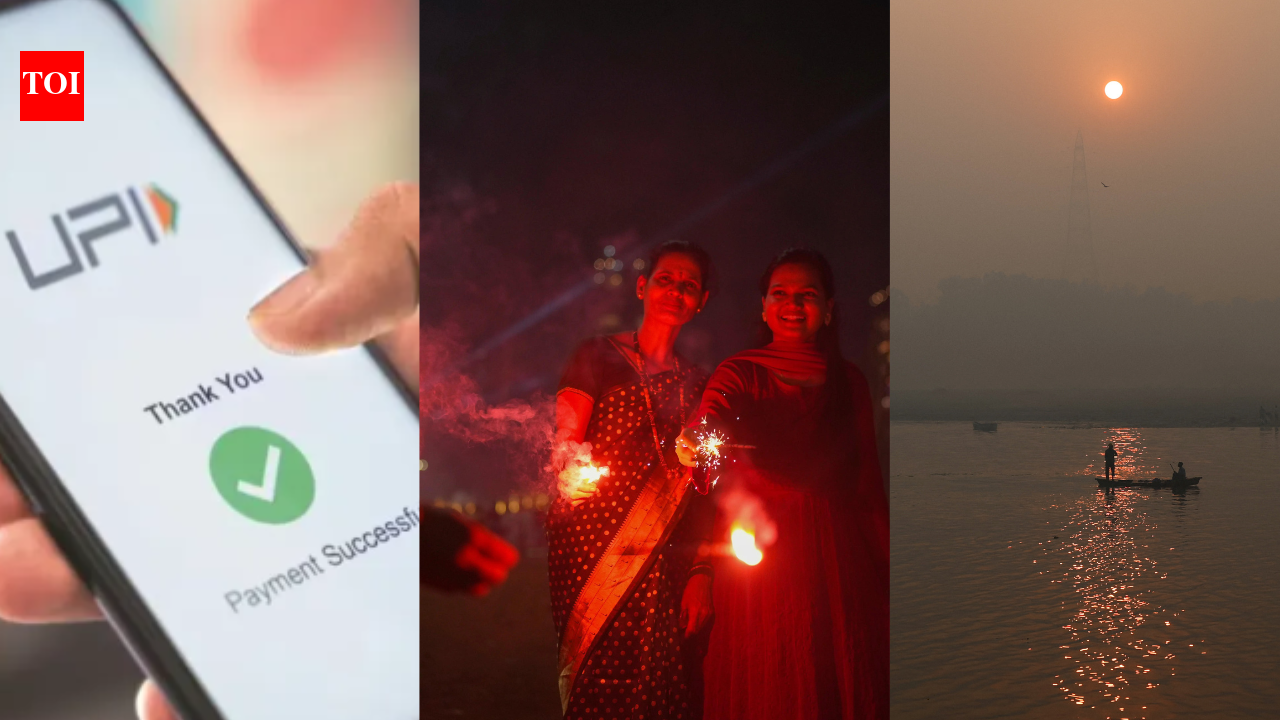
How Delhi-NCR's Diwali changed in a decadeNEW DELHI: The shopkeeper is still wrapping your diya, and your phone has already buzzed with the payment confirmation.A decade ago, the same festive shopping run in Delhi-NCR meant cash in hand, a round of bargaining and a string of small payments at the neighbourhood shop. The rituals are still here. Almost everything around them has changed: how people pay, what they are allowed to burst, how cities prepare and how the air is measured.In its November 2, 2026 order, the Supreme Court has allowed certified green crackers in Delhi-NCR on November 7 and 8, but only between 6am and 7am and between 8pm and 10pm. The complete ban returns from November 9.Since Diwali 2016, UPI has grown from a newly launched payment system into a daily habit. Courts have rewritten the rules of celebration, and air quality has become a standing item on the festive calendar. Official records from 2016 and 2025, along with this year's orders, show how much has changed, and where the record goes silent.From haggling to QR codes How UPI took over the festive shopping bagThe clearest shift is in how people pay.UPI was launched on August 25, 2016, with 21 banks. By FY2025-26, 703 banks were live on the network, according to the PIB's release marking UPI's tenth year.The growth is steeper still. The PIB release says annual UPI transactions rose from 1.78 crore in FY2016-17 to 24,161.69 crore in FY2025-26. Transaction value went from Rs 0.07 lakh crore to about Rs 314 lakh crore.In calendar year 2025 alone, UPI processed about 22,000 crore transactions, roughly 60 crore a day, according to the government release. Person-to-merchant transactions made up 63% of UPI volume in the first half of 2025, and 86% of these were below Rs 500.That points to everyday, small-value retail payments, the kind a festival is full of.Diwali 2016 fell within UPI's first year. The figures above are national numbers, not Diwali sales data, so they cannot tell us how much festive spending has moved from cash to digital. They do show the scale of the payment system that now sits behind much of the festival's commerce.How crackers became a Supreme Court matterOne court order, ten years, a full rulebookThe rules around firecrackers have changed just as dramatically.In November 2016, in the Arjun Gopal case, the Supreme Court suspended licences for the sale of firecrackers in Delhi-NCR. It was the start of sustained judicial intervention in the festival. The court returned to the issue, and in its October 23, 2018 judgment in the same case it permitted the manufacture and sale of improved and green crackers, subject to conditions.The framework tightened again. In its April 3, 2025 order in the Arjun Gopal matter, the court recorded a complete ban in Delhi-NCR on the manufacture, storage, sale and use of firecrackers, citing the region's pollution situation. It added that any relaxation would depend on scientific evidence that green crackers caused the "bare minimum" pollution.In October 2025, the court eased this for Diwali. Its October 15, 2025 order allowed the sale of green crackers listed on the CSIR-NEERI website from October 18 to 20, only through licensed traders at designated locations. Crackers brought in from outside NCR were restricted.Barium-based and unapproved products were prohibited, laris and serial crackers were barred, and so was online sale and purchase.This year follows the same broad template. The November 2, 2026 directions allow certified green crackers on November 7 and 8, between 6am and 7am and between 8pm and 10pm. Bursting is prohibited within 300 metres of hospitals, nursing homes, health centres, old-age homes and notified silence zones. The complete ban is restored from November 9.A practice once governed mainly by custom now runs on court orders, designated markets, product restrictions and compliance deadlines.Why Delhi's AQI is not Noida'sDelhi-NCR celebrates on the same dates, but it is not governed as one city.Delhi, Noida, Ghaziabad, Gurugram and Faridabad come under different municipal bodies, state governments and pollution-control authorities. Enforcement, market regulation, sanitation and environmental monitoring therefore involve different administrations and agencies.That matters for any comparison. A reading from Delhi cannot automatically stand in for Noida, Gurugram, Ghaziabad or Faridabad. The Central Pollution Control Board's AQI bulletin for October 30, 2016, for instance, recorded Delhi at 431, Faridabad at 410 and Gurugram at 317 at 4pm. Those were three separate readings, not one regional average.The same applies to 2025 and 2026. Each city needs its own official reading, and the restrictions for each jurisdiction have to be checked separately.What Diwali's air tells us, and what it doesn't431 then, 345 nowAir quality is one part of the changing Diwali record, but it is not the whole story.On October 30, 2016, the CPCB's 4pm bulletin put Delhi's AQI at 431, in the "severe" category. On Diwali 2025, October 20, the AQI stood at 345 at 4pm, in the "very poor" category, according to CPCB data.That is 86 points lower. But Diwali fell 10 days earlier on the calendar in 2025, and an earlier festival meets different temperatures, winds, humidity and stubble-burning conditions. The gap is an indicator. It is not proof that restrictions alone produced cleaner air.The CPCB's report on air quality during Deepawali 2016 recorded very high particulate matter at individual stations. At Pitampura, PM10 stood at 1,297 micrograms per cubic metre and PM2.5 at 1,238. At ITO, the readings were 878 and 797. These are station-level readings, not citywide averages, and they cannot be compared directly with an AQI.The same report noted a mean wind speed of 1.3 metres per second on Diwali 2016, against 3.4 metres per second in 2015. The Diwali-night mixing height was 152 metres, compared with 324 metres the year before.These numbers show why air monitoring has become part of the festival's official record. They do not, on their own, establish how much of the pollution came from firecrackers, or how conditions varied across the NCR.What the record can't tell usThe official record captures some of the biggest shifts around Diwali: the rise of digital payments, the evolving regulatory framework and the growing role of environmental monitoring.It does not tell us whether households celebrate differently, whether neighbourhood markets have lost ground to online platforms, or why the air in 2025 was better than in 2016. Answering those would need comparable commercial, mobility and enforcement data that no single bulletin provides.What the record does show is that the machinery around the festival looks very different from 2016. This Diwali, the lamps may be much the same. But the QR code, the court order and the 4pm bulletin are now part of the celebration too.
Scan to pay, burst by clock, breathe by bulletin: Delhi-NCR's Diwali, 10 years on
Full Article
Original Source
Read the full article at Timesofindia →KhanList aggregates and links to publicly available news content. We do not host full articles from third-party sources. Always verify important information with original sources.