
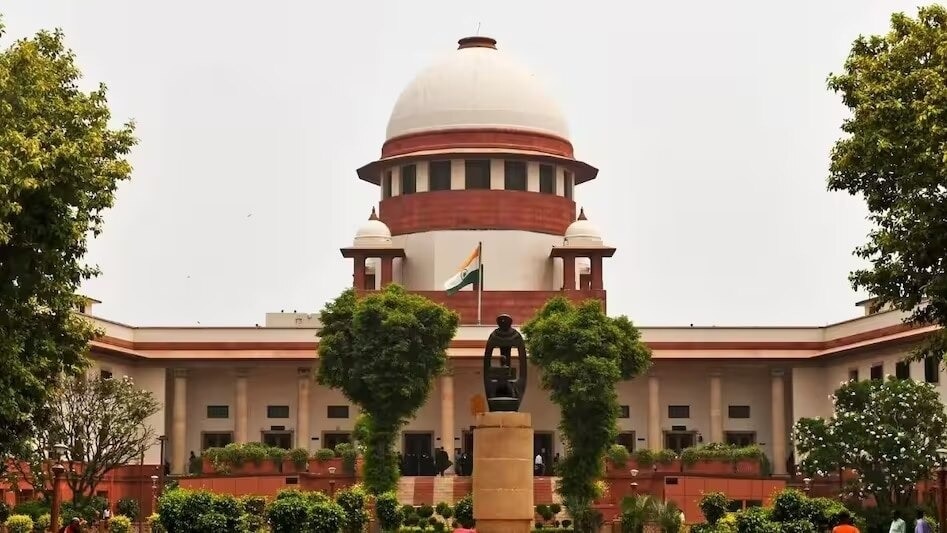
Justice Dipankar Datta questioned whether the panel under the 2023 law provides an independent check on executive power, while the matter will now go before the Chief Justice for deciding on a larger bench.The Supreme Court of India. (File photo)A two-judge bench of the Supreme Court on Wednesday delivered a split verdict on whether petitions challenging the law governing the appointment of the Chief Election Commissioner (CEC) and Election Commissioners (ECs) should be referred to a larger, five-judge bench. The matter will now be placed before the Chief Justice, who will decide whether a larger bench should hear the petitions.The case was heard by a bench of Justices Dipankar Datta and Satish Chandra Sharma. The petitions challenge the 2023 law that replaced the Chief Justice of India (CJI) on the selection panel with a Union Cabinet minister nominated by the Prime Minister.In his judgment, Justice Datta raised broader concerns over the independence and neutrality of the Election Commission and questioned whether the appointment mechanism under the 2023 law meets the constitutional standards required for free and fair elections."Inclusion of cabinet ministers fails to provide an independent counterweight that a neutral selector would. It becomes largely ornamental," Justice Datta said. He also stressed that the Election Commission must not only be independent but must also be perceived as independent."Free and fair elections depend on a truly independent ECI. It is not enough for the ECI to be independent; it must appear to be independent," he observed. Justice Datta questioned whether a selection panel comprising the Prime Minister, the Leader of Opposition and a Union minister nominated by the Prime Minister could provide an effective check on executive power.He observed that a minister nominated by the Prime Minister could not reasonably be expected to oppose the Prime Minister and side with the Leader of Opposition. The principle of collective responsibility, he said, would also make it difficult for the minister to oppose the Prime Minister.According to Justice Datta, this could effectively result in a 2:1 decision on the panel, giving the executive an effective veto.He referred to the Attorney General's response when the court asked whether the Prime Minister's nominee would take a position against the Prime Minister: "Probably no."Justice Datta said that even if the persons ultimately appointed were meritorious, the perception of executive dominance could remain."The umpire has effectively been chosen by the winning captain," he said while questioning the credibility of the mechanism.He said the issue before the court was not whether the individuals appointed were constitutionally credible, but whether the mechanism itself inspired confidence."Is the mechanism constitutionally credible?" he asked, adding that the process must generate public confidence.Justice Datta said the inclusion of a Union minister nominated by the Prime Minister did not provide an independent and neutral member on the selection panel and could make the minister's role largely ornamental.- EndsPublished On: Sep 23, 2026 14:28 IST
SC bench split on whether pleas against ECs selection law go to 5-judge bench
Full Article
Original Source
Read the full article at Indiatoday →KhanList aggregates and links to publicly available news content. We do not host full articles from third-party sources. Always verify important information with original sources.